

Ch4 Corporate Information Systems Strategy (13.3) PowerPoint PPT Presentation
1 / 23
Title: Ch4 Corporate Information Systems Strategy (13.3)
1
Ch4 Corporate Information Systems Strategy (13.3)
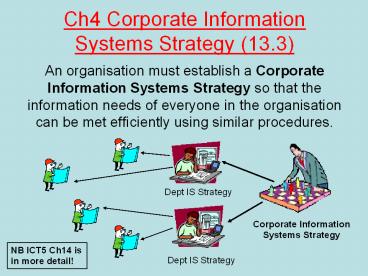
- An organisation must establish a Corporate
Information Systems Strategy so that the
information needs of everyone in the organisation
can be met efficiently using similar procedures.
Dept IS Strategy
Corporate Information Systems Strategy
NB ICT5 Ch14 is in more detail!
Dept IS Strategy
2
Who should draw up the Strategy?
- The Director of the Information Technology
section - As he/she knows more about the factors to
consider than other directors. - He/she would consider opinions from strategic and
tactical management as these managers would have
to carry out the policy.
3
Why have an IS Strategy?
- Must have guidelines for managers making IT
decisions so decisions are consistent within the
organisation - To ensure the consistency of hardware and
software (factor 6) - so maintenance and support is at a realistic
cost technicians can have in depth knowledge of
some systems as apposed to brief knowledge of
many. - Staff can move across departments with the
minimum of re-training. - To ensure different IT systems compliment each
other so common data can be used without retyping
(factor 6) - To have known timescales to replace/update old
hardware and software so managers can plan
budgets and not get left behind in the race for
useful new technology. (factor 6) - There are other reasons see Ch 14
4
What factors influence the policy?
- The syllabus says (13.3) describe the factors
influencing a corporate information system policy
within an organisation - Organisation and functions of management within a
general organisational structure, - Methods for planning and decision-making,
- Legal and audit requirement,
- Responsibility for the information system within
an organisation, - Information Flow,
- Hardware and Software,
- Standards and Behavioural factors, e.g.
personalities, motivation, ability to adapt to
change.
OFMfP LAR IF HS SB
The next 7 slides are about each factor ? ? ? ?
5
1. Organisation and Functions of management
(General Organisational Structure)
- General organisation structure must be considered
with a description of the current departments and
how information is used within the department.
The I.S. must provide info to the right person at
the right level at the right detail. - Eg An organisation managed geographically will
have regional managers who require reports
summarising performance within that region. - Eg A formal hierarchical structure require a
method to pass the info up and down the structure
in an appropriate timely manner Email,
Intranet..
6
2. Methods for planning and decision-making
- The nature of the I.S. depends on who makes the
decisions in the company. - Eg Chief Executive (CEO), Managing director,
Board of Directors - Eg Extensive use of committees
- Eg Delegation to less senior staff (Flat
structures) - (This is part of the Information Flow in the
company)
7
3. Legal and Audit Requirement
- This will vary from business to business
- Eg Data Protection Act must comply with the 8
principles - Eg Financial data must be archived for 7 years
so audits can take place
8
4. Responsibility for the particular information
system within an organisation
- This will vary from business to business
- Eg In a large company it lies within the company
computer department technical knowledge is
better than knowledge of a particular company
department. It is usual to have the Head of
Technical Services within the senior management
team of the company. - Eg In a small company it may lie within the
department that uses it technical knowledge is
not as good as knowledge of department
procedures. However it is usual to have a
maintenance contract with the supplier of the IS
to provide a help desk and software upgrades. - The nature of the I.S. will depend on who makes
the decisions for the I.S., who has
responsibility for carrying them out and who has
the responsibility for maintaining it. They may
be 3 different sets of people. Also different
personnel will be responsible for writing the ICT
strategy and purchasing the ICT hardware. - (This is part of the organisation and personnel
in the company)
9
5. Information Flow
- The I.S. should enable good communication and
should take account of the information flow
around the organisation - Eg The use of a company email system can be used
to get info to different groups of managers
quickly and efficiently eg distribution lists
attaching management reports - Eg The use of a company Intranet can be used to
get info to different groups of employees
ensuring the up-to-date copy always accessible in
one place
10
6. Hardware and Software
- Continuity is very important and any new I.S.
should consider - being able to read existing data files
- Being able to run old software and peripherals
from new computers and operating systems - If existing data files, hardware and software are
not considered then the new I.S. will be much
harder to implement as it may cause existing
systems to fail excessive time and money spent
on training and file conversions. - However aging hardware and software may be the
reason why a new I.S. is needed. New facilities.
11
7. Standards and Behavioural factors
- Standards laid down in the ICT strategy of a
company may influence a I.S. and the way it is
implemented. - Behavioural traits in key personnel may have some
influence personalities, motivation, ability to
adapt to change.Eg the head of department may
resist an I.S. because they are close to
retirement and lack the motivation to introduce
something they personally will not use.
12
Question Jan 07
- When writing a Corporate Information Systems
Strategy for an organisation, various factors
have to be taken into account, including the
structure of the organisation. Give five other
factors that might be considered when writing a
Corporate Information Systems Strategy and, for
each one, give a reason why it might be
considered. (10 m) - 1 for factor (f), 1 for reason for consideration
(r) to max 5 x (2,1,0) - Business strategy/Business objectives (f) (r)
- Legal and Audit requirements (f) (r)
- Information flow within the organisation (f)
(r) - Staff knowledge and experience with ICT (f),
(r) - Management style and methods/culture (f), (r)
- Responsibilities for ICT (f), (r)
- Personalities within org (f), (r)
- Ability to adapt to change (f), (r)
- Motivation of staff (f), (r)
- Training facilities for staff (f), (r)
- Hardware/technology available/considerations
(f) (r) - Software/applications/systems
available/considerations (f) (r) - Standards in use within organisation/within the
industry (f) (r) - The need for security (f) (r)
- e.g. Legal Audit requirements (f) because it is
important to work within the laws of the country
in which the organisation operates (r). - Motivation of staff (f) because the staff should
be regarded a big contributor to the
organisations success/unhappy staff may affect
profit margins (r).
13
Information Flow P33-36
- The syllabus said (13.3)
- Describe the methods and mechanisms of
information flow within an organisation, both
formal and informal, and the constraints imposed
upon that flow by organisational structures.
14
Managers Need Information
- To be relevant, timely and accurate to the task
in hand. This helps them plan, to control and to
make the right decisions. - The better the information, the greater their
knowledge, the better the decision!
15
External and Internal Flow
- External between the company and the outside
world eg Email from a customer and automatic
response if employee is out of the office - Internal between the company and the company eg
How are management reports sent to managers from
the I.S. egIn a hierarchical structure usually
info flows just between one level and the next.
16
Formal Flow
- Flow of information created by the procedures of
an organisation. EGs - Formal minutes of meetings
- Internal memos to individual or groups of staff
- Intranet used for storing the most up to date
policy documents so all staff can access them.
17
Informal Flow
- Flow of information not created by the procedures
of an organisation. This may be less accurate or
reliable EGs - Phone calls
- The office grape vine
- Stories in the press or rumours
- Personal conversation or observation
18
Information Flow and Structure P35/36
- Size, type and structure of an organisation EGs
- The amount of information EGS
- The nature of the information EGS
19
Jun 2006 Question
- (a) What is meant by formal information flow?
Give an example of a formal information flow
mechanism. (3 m) - (b) What is meant by informal information flow?
Give an example of an informal information flow
mechanism. (2 m) - (a)
- A system with fully documented and agreed
procedures (1) - Stating stages of information flow including
the medium, channel of communication, and
distribution list of personnel. (1) - Such as Business letter, memorandum, formal
meeting, meeting agenda and minutes, email (1) - NOT plain (unqualified) /letter or meeting
- (b)
- Information that naturally arises/not
structured/ad-hoc (1) - Such as a phone call, personal conversation,
during a meeting or by observation, e-mail,
bulletin board, special interest group, texting
(1) - NOT memo NB. Do not give positive/negative as
2 marks
20
Personnel P36-37
- The syllabus said (13.3)
- Understand the levels of task/personnel within an
organisation strategic implementation
(tactical) operational. - Relate the needs of these three levels to the
information system.
21
Personnel issues that influence IS Strategy
- Attitudes/personalities (Some staff maybe
terrified technophobes or advocates of any new
technology regardless of use, or preferred
pragmatists who introduce new technology only if
useful) - Motivation/leaders (encourage whole company
policy within a department without any complaint
to subordinates about negative effects at a
departmental level, manage change successfully,
streamline IS procedures) - Working in teams (flexibility of team are
teams used to being broken apart and reformed
into other teams according to the task) - Ability to adapt to change (too much change
can de-motivate staff, need periods of
consolidation of procedures, staff recruited with
this personal quality.) - Skills of staff (Training needs in correct
medium at correct time. Eg?) - Levels of personnel (Strategic, tactical,
operational info appropriate to the level of
need. Eg?)
22
13.3 The 20 marker Jan 2006
- A long-standing national chain of shoe shops has
built up its information systems one at a time,
and without an overall plan. It is now having
difficulty in getting these systems to work
together effectively and has therefore decided to
create a Corporate Information Systems Strategy.
Discuss the influence of the following factors
when planning a Corporate Information Systems
Strategy - the structure of the organisation
- information flow around the organisation
- personnel in the organisation.
- The Quality of Written Communication will be
assessed in your answer. (20 marks) - Continuous prose is expected for this answer.
Discuss is the question, so each point made must
be full, not just a single word/phrase. Mark as
O, F or P for three bullets. A full
explanation/description gets an extension mark
(Oe, Fe or Pe) . - No more than 6 marks awarded in each section - to
a maximum of 16 content marks.
23
Answer 13.3
- O . organisation structure
- Organisational shape (hierarchical, flat etc)
- Functions in the organisation
- Organisational size (single site/national/inter
national) - Centralised/Distributed management
- Levels of personnel or task (or in P)
- Different levels need different tasks (or in
P) - Business objectives
- F . information flow .
- Formal methods
- Informal methods
- Planning and decision making methods
- Examples of information flow
- Effects of legislation on flow
- P . people
- Behavioural factors
- Attitudes/personalities
Recommended

