

ESCI 108 Crises of the Earth http:www.owlnet.rice.eduesci108 PowerPoint PPT Presentation
1 / 26
Title: ESCI 108 Crises of the Earth http:www.owlnet.rice.eduesci108
1
ESCI 108 Crises of the Earthhttp//www.owlnet.r
ice.edu/esci108
- Leeman - Lecture 2 Energy and processes behind
natural disasters/geologic events
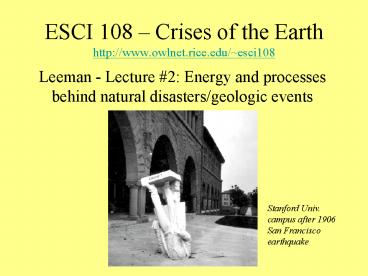
Stanford Univ. campus after 1906 San Francisco
earthquake
2
Previous assignment - Chapter 1Answer review
questions and questions for further thought at
end of the chapter, and be prepared to discuss
the following
- What parts of the world are most affected by
natural disasters - what types and approximate
magnitude? - How do you explain the relation between magnitude
and frequency of natural disasters? - How do the unique properties of water influence
our lives both positively and negatively? How
would our world differ if we had little water on
the surface? - How important to our lives is the internal energy
of the planet? How would the surface differ if
internal heat flow ceased for 100 million years?
3
Distribution of earthquakes in the western
USand where are the most populated areas?
4
Smoothed population density map of North America
5
A night-view of the U.S. from the Space Shuttle
presents a graphic image of population density
distribution based on light emissions.
6
Magnitude vs. frequency relations - an example
from studies of impacts by extraterrestrial
objects
7
Graph showing equivalent energy from impacts
(proportional to size of impactor) vs. recurrence
interval
8
(No Transcript)
9
North America relief map (NOAA)
10
Energy sources for geologic processeslets
review some of the evidence
- Planetary - impacts with asteroids, comets tidal
forces gravity - Internal energy in the Earth - gravitation
radioactive elements - External energy sources - solar radiation
hydrologic cycle heat capacity and energy
transfer (importance of water) - Forces of construction (tectonics, internal
convection, magmatism) vs. destruction
(weathering, erosion, sedimentation)
11
Some key distinctive features of our planet
- Solar system age 4.57 billion years (Ga or 109
yrs) (based on radiometric ages of meteorites) - Unlike the Moon and inner planets, Earth is
affected by active tectonics (internally driven) - Earth has a well developed hydrosphere and
atmosphere that promote weather and have
continually reshaped the surface
12
Objects in the solar system - inherent diversity
13
A big difference between the planets in
availability of water...
- Mosaic of Viking 2 Orbiter images of the south
pole of Mars. The cap is about 400 km across in
this image, taken during southern winter. (Viking
2 Orbiter MG90S000-407B)
- Apollo 16 view of the Earth on 16 April, 1972.
Most of the United States is visible at right
center. Mexico and part of Central America are
also visible. The Earth is 12,740 km in diameter.
14
The surface of our Moon is pockmarked with a
multitude of impact craters.
This Lunar Orbiter 3 oblique image shows Kepler
impact crater (32 km in diameter), located near
the outer rim of the Imbrium Basin (8 N, 38 W).
15
The Earths physiographic features
16
Digital tectonic map of the world
17
Volcanoes of Hawaii are among the largest on
Earth. The summit of Mauna Loa rises nearly 10
km above the adjacent seafloor
18
Color mosaic of Olympus Mons volcano on Mars.
Olympus Mons is about 600 km in diameter and the
summit caldera is 24 km above the surrounding
plains. (Viking 1 Orbiter)
19
Jupiter's moon Io (3640 km diameter) is the most
volcanically active body in the solar system.
This Galileo image shows the volcanic centers
Pele and Loki Patera. Pele (at the center of the
large red circle in the lower part of the image)
produced the largest observed volcanic plume on
Io, which deposited the material forming the red
ring. Loki Patera is the black horseshoe-shaped
feature towards the upper left. The varied
colors on the surface are due to sulfur rich
compounds.
20
Distributions of earthquakes and volcanoes imply
that the outer portion of the solid Earth is
tectonically active and is subdivided into a
number of relatively rigid plates that slide
around the globe - three distinct types of plate
boundaries are observed
21
Three general types of plate boundaries
convergent (destructive), divergent
(constructive), and transform (horizontal slip)
22
New oceanic crust is being formed at divergent
margins and older crust being consumed or under
thrust at convergent margins.
23
The structure of the Earth comprises a brittle
outer layer (lithosphere - on the order of 100 km
thick), a thick relatively ductile mantle, and a
dense core - the outer part of which is molten.
By comparison, the other rocky planets in the
solar system have been tectonically inactive for
most of their history.
24
From space we see a Blue Planet - unique in the
abundance of water at its' surface, with a
dynamic atmosphere.
25
Unique role of water on Earth
- Oceans and ice on the surface act as a capacitor
for regulating the storage of solar radiation
(heat capacity) - Oceans and atmosphere are instrumental in
distributing the stored heat and regulating the
global temperature (latent heats of
vaporization/condensation and fusion, high heat
conductivity) - currents and climate even out
the thermal energy - Chemical properties make water a universal
solvent - Solid phase is less dense than the liquid this
is rare, but causes ice to float - albedo or
reflectance helps regulate surface temperatures - The above features create weather as well as
effective erosional forces - The abundance of water supports a rich array of
life forms
26
Assignment for next class - read Ch. 2and answer
review and thought questions at the end
- What is the geologic evidence supporting the
plate tectonic paradigm? - How fast do tectonic plates move, and how is this
determined? - In what ways are tectonic processes dangerous?
- In what tectonic settings/regions do the
strongest earthquakes occur and why? Ditto for
volcanoes
To assess self-understanding and practice for
test questions, take the on-line quizzes for our
textbook http//highered.mcgraw-hill.com/sites/0
072528095/student_view0/
Recommended

