

Chapters 22 and 23 Cont Wet Corrosion Key Concepts PowerPoint PPT Presentation
1 / 22
Title: Chapters 22 and 23 Cont Wet Corrosion Key Concepts
1
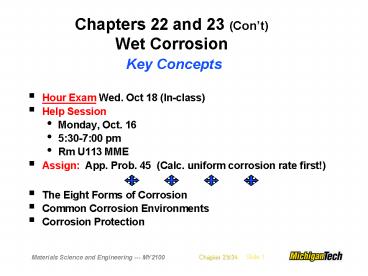
Chapters 22 and 23 (Cont)Wet Corrosion Key
Concepts
- Hour Exam Wed. Oct 18 (In-class)
- Help Session
- Monday, Oct. 16
- 530-700 pm
- Rm U113 MME
- Assign App. Prob. 45 (Calc. uniform corrosion
rate first!) - The Eight Forms of Corrosion
- Common Corrosion Environments
- Corrosion Protection
2
Voltage Differences Drive Corrosion
3
The Eight Forms of Corrosion
- Uniform Attack
- Galvanic Corrosion
- Crevice Corrosion
- Pitting
- Selective Leaching
- Intergranular Corrosion
- Erosion-Corrosion
- Stress Corrosion
- Corrosion Fatigue
4
Intergranular Corrosion
Source W. Callister, Materials Science and
EngineeringAn Introduction, New York, John Wiley
Sons, 1997.
5
Weld Decay(Stainless Steel)
6
Weld DecayAn Example(Stainless Steel)
7
Erosion-Corrosion
Source W. Callister, Materials Science and
EngineeringAn Introduction, New York, John Wiley
Sons, 1997.
8
Stress Corrosion(The Process)
9
Stress Corrosion(The Result)
- (A few)
- Dangerous Combinations
- Chloride ions with
- stainless steel
- Ammonia with
- brass
- Caustic soda with
- mild steel
Source W. Callister, Materials Science and
EngineeringAn Introduction, New York, John Wiley
Sons, 1997.
10
Corrosion Fatigue
11
Common Corrosion Environments
- The Atmosphere
- Primarily moisture with dissolved oxygen
- Acid rain, sodium chloride (marine atms) and
industrial pollutants may aggravate corrosion - Commonly-used metals include aluminum, copper and
galvanized steel - Water
- Fresh waterCast iron, steel, aluminum, copper,
brass and some stainless steels generally
suitable - Sea water (3.5 NaCl)Titanium, brass, some
bronzes, Cu-Ni alloys, and Ni-Cr-Mo alloys often
acceptable
12
Common Corrosion EnvironmentsII
- Soils
- Wide range in compositions and susceptibilities
for corrosion - Cast iron and plain carbon steelswith and
without coatingsgenerally most cost-effective
13
Corrosion Protection
- Materials Selection
- Modify the Environment
- Design Practices
- Galvanic, Crevice, Erosion corrosion
- Drainage
- Physical barriers
- Inhibitors
- Cathodic Protection
14
Cathodic Protection
Sacrificial Anode
Applied Voltage
Source W. Callister, Materials Science and
EngineeringAn Introduction, New York, John Wiley
Sons, 1997.
15
Galvanized Steel
16
Anodized Aluminum
- Aluminum Metal
- Oxide Layer
- Colored Die
17
Area Effects
Large cathodes with very small anodes lead to
VERY rapid corrosion of the anode.
Avoid It ! !
18
ReviewFast Fracture
- Fast Fracture
- What is it?
- Relative toughness of different classes of
materials (metals, ceramics, polymers,
composites common metals) - Fracture mechanisms (ductile tearing, cleavage,
crack blunting)
19
Fatigue and Crack Growth
- Fatigue
- What is fatigue? (Ds, sm, sa)
- Mechanisms of fatigue crack initiation and growth
- Basquins Law
- Coffin-Manson Law
- Goodmans Rule
20
Diffusion, Creep and Creep Fracture
- Primary, secondary and tertiary creep
- Creep damage time to fracture
- Mechanism of diffusion (incl. fast diffusion
paths) - Power law creep
- Diffusion creep
- Material design to resist creep
- Materials for common temperature ranges
21
Oxidation
- What is it?
- Linear, parabolic and linear loss behavior
- Micromechanisms of oxidation
- Stainless steels and superalloys
- Coatings and protective scales
22
Corrosion
- Anodic and cathodic reactions
- Ranking of common materials in galvanic series
- Mg
- Zn
- Aluminum
- Iron and steel
- Copper
- Titanium
- Types of corrosion
- Ways to control corrosion (incl. cathodic
protection) - Thin wall pressure vessels
Recommended

