

IMPROVING LEARNING AND REDUCING COSTS: The Program in Course Redesign PowerPoint PPT Presentation
1 / 42
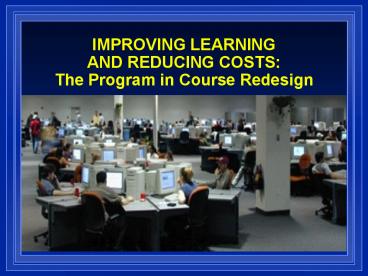
Title: IMPROVING LEARNING AND REDUCING COSTS: The Program in Course Redesign
1
IMPROVING LEARNING AND REDUCING COSTSThe
Program in Course Redesign
2
HIGHER EDUCATIONS CHALLENGES
- Access
- Quality
- Cost
How can we move the ATMs outside the bank?
3
- PROGRAM IN
- COURSE REDESIGN
- To encourage colleges and universities to
redesign their approaches to instruction using
technology to achieve cost savings as well as
quality enhancements.
6 million 30 projects
4
ASSUMPTIONS THAT GET IN THE WAY
- Improving quality means increasing cost
- Adding IT increases cost
- Using IT may even threaten quality
5
TRADITIONAL INSTRUCTION
Seminars
Lectures
6
BOLT-ON INSTRUCTION
7
THE ONE PERCENT SOLUTION
- Maricopa Community College District
- 200,000 students year-round
- 2,000 course titles
- 25 courses
- 44 enrollment
- All CCs 51
- All four-year 35
8
THE ONE PERCENT SOLUTION
- Accounting (1)
- EMT (1)
- Spanish (1)
- Chemistry (1)
- English (7)
- Psychology (1)
- Mathematics (5)
- Fitness (1)
- Sociology (1)
- Computing (1)
- Philosophy (1)
- Economics (2)
- Biology (2)
9
ROUND I INSTITUTIONS20,585 Students Annually
- IUPUI (Sociology)
- Penn State (Statistics)
- Rio Salado College (College Algebra)
- SUNY at Buffalo (Computer Literacy)
- U of Central Florida (American Government)
- U of Colorado-Boulder (Astronomy)
- U of Illinois-Urbana Champaign (Statistics)
- U of Southern Maine (Psychology)
- U of Wisconsin-Madison (Chemistry)
- Virginia Tech (Linear Algebra)
10
ROUND II INSTITUTIONS14,119 Students Annually
- Cal Poly Pomona (Psychology)
- Carnegie Mellon University (Statistics)
- Fairfield University (Biology)
- Riverside Community College (Math)
- The University of Alabama (Math)
- University of Dayton (Psychology)
- University of Idaho (Math)
- The University of Iowa (Chemistry)
- University of Massachusetts (Biology)
- University of Tennessee (Spanish)
11
ROUND III INSTITUTIONS18,734 Students Annually
- Brigham Young U (English Composition)
- Drexel U (Computer Programming)
- Florida Gulf Coast U (Fine Arts)
- Iowa State U (Discrete Math)
- Northern Arizona U (College Algebra)
- Ohio State U (Statistics)
- Portland State U (Introductory Spanish)
- Tallahassee CC (English Comp)
- U of New Mexico (Intro Psychology)
- U of Southern Mississippi (World Lit)
12
QUANTITATIVE (13)
- Mathematics
- Iowa State University
- Northern Arizona University
- Rio Salado College
- Riverside CC
- University of Alabama
- University of Idaho
- Virginia Tech
- Statistics
- Carnegie Mellon University
- Ohio State University
- Penn State
- U of Illinois-Urbana Champaign
- Computer Programming
- Drexel University
- University at Buffalo
13
SCIENCE (5) SOCIAL SCIENCE (6)
- Biology
- Fairfield University
- University of Massachusetts
- Chemistry
- University of Iowa
- U of Wisconsin-Madison
- Astronomy
- U of Colorado-Boulder
- Psychology
- Cal Poly Pomona
- University of Dayton
- University of New Mexico
- U of Southern Maine
- Sociology
- IUPUI
- American Government
- U of Central Florida
14
HUMANITIES (6)
- English Composition
- Brigham Young University
- Tallahassee CC
- Spanish
- Portland State University
- University of Tennessee
- Fine Arts
- Florida Gulf Coast University
- World Literature
- University of Southern Mississippi
15
REDESIGN CHARACTERISTICS
- Redesign the whole course, not just a single
class - Emphasize active learning greater student
engagement with the material and with one another - Rely heavily on interactive software used
independently and in teams - Provide on-demand, individualized assistance
- Provide 24 x 7 access to online learning
resources
Improving the Quality of Student Learning
16
REDESIGN CHARACTERISTICS
- Emphasize practice, feedback, reinforcement
- Respond to differences in learning style
- Use course management software to monitor student
performance - Automate grading of homework, quizzes, exams
- Replace single mode instruction with
differentiated personnel strategies
Technology enables good pedagogy with large s of
students.
17
IMPROVED LEARNING OUTCOMES
- Penn State - 68 on a content-knowledge test vs.
60 - UB - 56 earned A- or higher vs. 37
- CMU - scores on skill/concept tests increased by
22.8 - Fairfield 88 on concept retention vs. 79
- U of Idaho 30 earned As vs. 20
- UMass 73 on tougher exams vs. 61
- FGCU - 85 on exams vs. 70 75 As and Bs vs.
31 - USM - scored a full point higher on writing
assessments - IUPUI, RCC, UCF, U of S Maine, U of Tenn and U of
Ala - significant improvements in understanding
content
5 of 10 (Round I), 9 of 10 (Round II), 8 of 10
(Round III) have shown improvement.
18
REDUCTION IN DFW RATES
- FGCU - 45 to 11
- UNM - 42 to 18.
- Drexel - 49 to 38
- Iowa State - 32.5 to 23.8
- IUPUI - 39 to 25
- U of S Maine - 28 to 19
- Ohio State - 33 to 24
- Penn State - 12 to 9.8
22 of the 24 that measured have shown improvement.
19
VARIETY OF WAYS TO REDUCE COSTS (Variety of
Instructional Models)
- Maintain constant enrollment while reducing
resources - Increase enrollments while maintaining resources
- Reduce course repetitions
- Do two or more simultaneously
20
Instructional Task Analysis Financial Planning
- Determine all personnel costs expressed as an
hourly rate. - Determine the specific tasks associated with
offering a course. - Determine how much time each person spends on
each of the tasks. - Calculate the total instructional costs.
- Redesign the course by task and
re-calculate the costs.
21
Instructional Costs per Hour
22
Traditional Course Preparation
23
Traditional Course Delivery
24
Redesigned Course Preparation
25
Redesigned Course Delivery
26
COST SAVINGS RESULTS
- Redesigned courses reduce costs by 40 on
average, with a range of 20 to 77. - Collectively, the 30 courses project a savings of
about 3.6 million annually. - Final Round I II results show savings of
2,066,258 compared with projected 2,204,527.
27
WHAT HAPPENS TO THE SAVINGS?3.6 Million Annually
- Stay in department for continuous course
improvement and/or redesign of others - Provide a greater range of offerings at upper
division or graduate level - Accommodate greater numbers of students with same
resources - Stay in department to reduce teaching load and
provide more time for research - Redesign similar courses
- Miscellaneous
- Offer distance sections
- Reduce rental expenditures
- Improve training of part-time faculty
28
FIVE REDESIGN MODELS
- Supplemental Add to the current structure
and/or change the content - Replacement Blend face-to-face with online
activities - Emporium Move all classes to a lab setting
- Fully online Conduct all (most) learning
activities online - Buffet Mix and match according to student
preferences
29
GENERAL BIOLOGY (Lecture-Lab)
- Inconsistent student academic preparation
- Inadequate student interaction with learning
materials and complex topics - Inadequate use of modern technology
- Inability of students to retain what they have
learned (amnesia) - Inability of students to apply chemical
principles to other disciplines (inertia)
- Memorization vs. Application of Scientific
Concepts
30
ACADEMIC GOALS
- Enhance quality by individualizing instruction
- Focus on higher-level cognitive skills
- Create both team-based and independent
investigations - Use interactive learning environments in lectures
and labs - to illustrate difficult concepts
- to allow students to practice certain skills or
test certain hypotheses - to work with other students to enhance the
learning and discussion of complex topics
31
- Traditional
- 7 sections (35)
- 7 faculty
- 100 wet labs
- 131,610
- 506 cost-per-student
- Redesign
- 2 sections (140)
- 4 faculty
- 50 wet, 50 virtual
- 98,033
- 350 cost-per-student
- Content mastery significantly better performance
- Content retention significantly better (88 vs.
79) - Course drops declined from 8 to 3
- Next course enrollment increased from 75 to 85
- Declared majors increased by 4
32
FIRST-YEAR SPANISH (Replacement Model)
- Increase active speaking via in-class interaction
- Use technology to support skill practice
- Provide immediate feedback online
- Increase student and instructor computer literacy
- Encourage collaborative learning, both online and
in class
33
- Traditional
- 57 sections (27)
- Adjuncts 6 TAs
- 100 in class
- 167,074 (2931/section)
- 1529 students _at_ 109
- Redesign
- 38 sections (54)
- Instructor-TA pairs
- 50 in class, 50 online
- 56,838 (1496/section)
- 2052 students _at_ 28
- Oral skills significantly better performance
- Language proficiency language achievement
- no significant difference
- A second Spanish project final exam scores in
- speaking, reading and listening were higher
34
THE EMPORIUM MODEL71 Cost Reduction (V1)30
Cost Reduction (V2)
35
VIRGINIA TECHLinear Algebra
- Redesign
- Single section (1520)
- 1 tenured faculty, graduate under-graduate
assistants - 24 x 7 in open computer lab
- 26 cost-per-student
- Traditional
- 38 sections (40)
- 10 tenured faculty, 13 instructors, 15
GTAs - 2 hours per week
- 86 cost-per-student
36
FULLY ONLINE MODEL
- Traditional
- Redesign one class
- Emphasize instructor-to-student interaction
- Instructor does all grading and provides all
student feedback - Use a single personnel strategy
- Redesign
- Redesign whole course
- Emphasize student-to-student interaction and
teaming - Automate grading and student feedback
- Use a differentiated personnel strategy
37
RIO SALADO COLLEGEPre-Calculus Mathematics
- Redesign
- 4 courses taught by 1 instructor
- Student interaction interactive software, 1
course assistant, and 1 instructor - 31 cost-per-student
- Retention 65
- Traditional
- 4 courses taught by 4 instructors
- Student interaction each instructor
- 49 cost-per-student
- Retention 59
38
U. OF S. MISSISSIPPIWorld Literature
- Redesign
- Single online section
- Team-taught by 4 faculty and 4 TAs
- 50 automated grading via WebCT 50 TAs
- 31 cost-per-student
- Traditional
- 16 20 sections (65)
- Taught by 8 faculty and 8 adjuncts
- Faculty do all grading
- 70 cost-per-student
- Redesign triples course capacity.
39
THE BUFFET MODEL
- Assess each students knowledge/skill level and
preferred learning style - Provide an array of high-quality, interactive
learning materials and activities - Develop individualized study plans
- Build in continuous assessment to provide
practice and feedback - Offer appropriate, varied human interaction
when needed
40
FLORIDA GULF COAST UPerforming Visual Arts
- Traditional
- 25 sections (30)
- 6 sections (15) 800
- Taught mainly by adjuncts
- Course drift
- 132 cost-per-student
- Redesign
- Single section (950)
- Taught by 1 faculty, 1 course coordinator, 16
preceptors - Consistent coherent
- 81 cost-per-student
- Average exam scores increased from 70 to 85
- Number of As/Bs increased from 31 to 75
- DFW rate decreased from 45 to 11
41
WHAT DO THE FACULTY SAY?
- Its the best experience Ive ever had in a
classroom. - The quality of my worklife has changed
immeasurably for the better. - Its a lot of work during the transition--but
its worth it.
42
FOR MORE INFORMATIONWWW.CENTER.RPI.EDU
- Full project plans
- Monograph
- Progress reports
- Completed course planning tools
- Project contacts
Dr. Carol A. Twigg, Executive Director
Recommended

