

2 x 2 Case: Real Eigenvalues, Saddle Points and Nodes PowerPoint PPT Presentation
1 / 7
Title: 2 x 2 Case: Real Eigenvalues, Saddle Points and Nodes
1
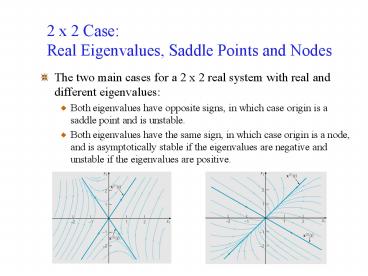
2 x 2 Case Real Eigenvalues, Saddle Points and
Nodes
- The two main cases for a 2 x 2 real system with
real and different eigenvalues - Both eigenvalues have opposite signs, in which
case origin is a saddle point and is unstable. - Both eigenvalues have the same sign, in which
case origin is a node, and is asymptotically
stable if the eigenvalues are negative and
unstable if the eigenvalues are positive.
2
3/ General system (n x n matrix)
- In general, for an n x n real linear system x'
Ax - All eigenvalues are real and different from each
other. - Some eigenvalues occur in complex conjugate
pairs. - Some eigenvalues are repeated.
- If eigenvalues r1,, rn are real different,
then there are n corresponding linearly
independent eigenvectors ?(1),, ?(n). The
associated solutions of x' Ax are - Using Wronskian, it can be shown that these
solutions are linearly independent, and hence
form a fundamental set of solutions. Thus
general solution is
a/ Real Eigenvalues
3
Special case matrix A real and symmetric
(special case of Hermitian matrices)
- Then all eigenvalues r1,, rn are real, although
some may repeat. - Even if some of the eigenvalues are repeated,
there are n corresponding linearly independent
eigenvectors ?(1),, ?(n). The associated
solutions of x' Ax are - and form a fundamental set of solutions.
4
Example Hermitian Matrix (1 of 2)
- Consider the homogeneous equation x' Ax below.
- The eigenvalues were found previously in Ex 5 Ch
7.3, and were r1 2, r2 -1 and r3 -1. - Corresponding eigenvectors
5
Example 3 General Solution (2 of 2)
- The fundamental solutions are
- with general solution
- This example illustrates the fact that even
though an eigenvalue (r -1) has algebraic
multiplicity 2, it may still be possible to find
2 linearly independent eigenvectors and, as a
consequence, to construct the general solution.
6
b/ Complex Eigenvalues (examined Ch7.6)
- If some of the eigenvalues r1,, rn occur in
complex conjugate pairs, but otherwise are
different, then there are still n corresponding
linearly independent solutions - which form a fundamental set of solutions.
7
c/ Repeated Eigenvalues (examined Ch7.8)
- If some of the eigenvalues r1,, rn are repeated,
then there may not be n corresponding linearly
independent solutions of the form - In order to obtain a fundamental set of
solutions, it may be necessary to seek additional
solutions of another form. - This situation is analogous to that for an nth
order linear equation with constant coefficients,
in which case a repeated root gave rise solutions
of the form
Recommended

