

How To Use The Igneous Rock ID Chart page 6 PowerPoint PPT Presentation
1 / 20
Title: How To Use The Igneous Rock ID Chart page 6
1
How To Use The Igneous Rock ID Chart (page 6)
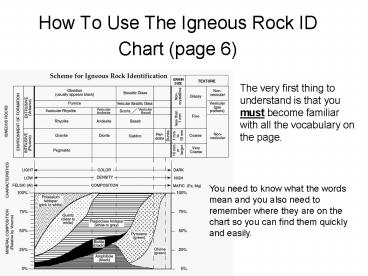
- The very first thing to understand is that you
must become familiar with all the vocabulary on
the page.
You need to know what the words mean and you also
need to remember where they are on the chart so
you can find them quickly and easily.
2
The first thing to understand is that all of the
names in the upper (shaded) part of the chart are
the igneous ROCKS. If you are asked for the name
of an igneous rock, it must be one of these.
3
The next thing to understand is that all the
names on the lower (shaded) part of the chart are
the MINERALS that are commonly found in igneous
rocks. You should keep in mind that since these
are minerals, there is a lot of information about
each of them on page 16 of your reference tables.
4
Igneous rocks are classified according to two
basic characteristics 1) TEXTURE which is also
known as GRAIN SIZE.
And....................... 2) Mineral
composition. We need to be able to use these
two characteristics in order to identify one
particular igneous rock. Heres
how................
5
Lets deal with the top part (IGNEOUS ROCKS)
first.
All the igneous rocks are classified according to
TEXTURE, also called GRAIN SIZE.
6
Intrusive (Plutonic) rocks formed deep within the
crust. Because they were so deep they cooled very
slowly giving the mineral crystals in the rocks a
very long time to grow. Thats why intrusive
igneous rocks usually have a coarse to very
coarse texture.
7
As you can see from the chart, coarse texture
grain sizes of 1 to 10 mm and very coarse texture
grain sizes of 10mm and larger. Granite,
Diorite, Gabbro, Peridotite and Dunite are the
names of the coarse grained igneous rocks. These
rocks are INTRUSIVE (Plutonic) rocks.
8
Pegmatite is another INTRUSIVE (Plutonic) igneous
rock. It has very coarse texture with a grain
size of 10mm or larger.
REMEMBER INTRUSIVE SLOW COOLING
COARSE TEXTURE
9
Igneous rocks with fine texture have grain sizes
less than 1mm. These rocks formed at or near the
surface and are called EXTRUSIVE (Volcanic)
rocks. Because they formed at or near the
surface they cooled rapidly. Their crystals
(grains) had very little time to grow so they
remain small. Rhyolite, Andesite, and Basalt are
the fine grained igneous rocks EXTRUSIVE RAPID
COOLING FINE TEXTURE
10
Some EXTRUSIVE (Volcanic) igneous rocks cool so
fast that crystals cannot form. Such rocks have
no crystal structure (grain) and are classified
as GLASSY. They are really volcanic
glass. Obsidian, Pumice, and Basaltic Glass are
EXTRUSIVE (volcanic), glassy igneous rocks. They
are non-crystalline.
11
Some EXTRUSIVE igneous rocks are described as
VESICULAR. That means that they have many small
holes formed as gas escaped while they were
cooling. Its as if you suddenly solidified the
foam that escaped from a can of soda that you
shook before you popped the top. Vesicular rocks
are like solidified foam. As you can see, some
are fine grained, some are glassy, and all
are extrusive.
12
Now lets look at the MINERALS that are found in
igneous rocks.
13
Any or all of the minerals in the shaded area
(below) can be found in any of the rocks in the
shaded area (above). But granite, for
example, would never contain olivine or pyroxene.
14
The same rule applies to the minerals in the next
zone (shaded). Any or all of these may be found
in the rocks in the shaded area above. For
example, Diorite might contain Biotite
or Amphibole but it is very unlikely that it
would con- tain Potassium feldspar or even much
quartz.
15
OK, by now it should be clear. The yellow
shaded rocks could contain any or all of the
yellow shaded minerals. Peridotite could only
contain Pyroxene and/or Olivine and Dunite
is 100 Olivine.
So lets put this all together and use the
information to identify a specific rock.
16
Name a coarse grain igneous rock that
contains Amphibole, Biotite. Plagioclase Feldspar
and Potassium Feldspar.
OK, if it has coarse grain it must be one of
these shaded rocks.
Amphibole, Plagioclase and Biotite are no help
because they are found in more than one zone but
Potassium Feldspar is the important clue.
The 2 clues together point to only one possible
igneous rock........
GRANITE!
Lets try another..................
17
Name a fine grain, vesicular igneous rock which
contains Plagioclase feldspar, Biotite, and
Olivine.
The only rocks that have fine grain AND are
vesicular are Vesicular Rhyolite,
Vesicular Andesite, and Scoria/Vesicular Basalt.
Now we have to look to the mineral content to
narrow the possibilities.
The key is the Olivine which is found in only one
fine grain vesicular rock Scoria/Vesicular
Basalt.
One last item to understand Characteristics
(those items between the rocks and the minerals).
18
This part is easy. Rocks on the left side are
light (in color), low (density) and FELSIC. The
term FELSIC means that these rocks contain a lot
of the mineral feldspar. If you look up both
kinds of feldspar on page 16 of the reference
table you will see that both contain the element
aluminum (Al). Thats why (Al) appears after the
word FELSIC. FELSIC rocks contain a lot of
aluminum.
Rocks on the right are MAFIC. These rocks are
usually dark in color, have a high density and
contain a lot of iron (Fe) and magnesium (Mg).
The word MAFIC was made up by combining MA from
magnesium and F from the word ferric
which describes minerals rich in iron. If you
look up Biotite, Pyroxene, and Olivine on page 16
of the reference tables youll see they all
contain iron and magnesium.
Lets try one last igneous rock
identification...........................
19
Identify a non-vesicular, non-crystalline
igneous rock which has low density and contains a
lot of aluminum.
Non-crystalline could be any of the glassy rocks
but only Obsidian and Basaltic Glass are both
non-crystalline and non-vesicular. But which is
it?
The low density, FELSIC rocks (contain
Aluminum) are on the left side so the rock were
looking for must be Obsidian.
Wait a minute! Arent the low density, FELSIC
rocks supposed to be light colored. But Obsidian
is usually black!
True. But remember that this chart just provides
general guidelines. There are an almost infinite
variety of igneous rocks and many dont fit these
rules. Thats just the way it is.
20
What to take away
1) Make sure you are familiar with the
vocabulary. When you read the word MAFIC or
VESICULAR or PLUTONIC in a regents question you
should know what the word means and also that
you should probably be opening your reference
table to page 6.
2) Use information about texture, grain size,
intrusive or extrusive, vesicular or
non-vesicular to narrow your choices to certain
igneous rocks that fit the information in the
question.
3) Use information about the characteristics
and/or the mineral composition to refine
your choices to one igneous rock.
4) Remember that the ONLY way to get good at this
is to practice and practice some more. So
find as many old regents questions as you can and
see how you do. Its no different than any
sport. The more you practice the better you
get!
Recommended

