

Using Torrefied Wood as a Coal Replacement and for Pellet PowerPoint PPT Presentation
1 / 11
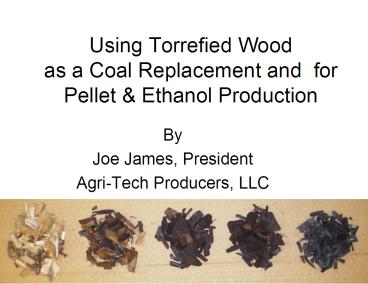
Title: Using Torrefied Wood as a Coal Replacement and for Pellet
1
Using Torrefied Wood as a Coal Replacement and
for Pellet Ethanol Production
- By
- Joe James, President
- Agri-Tech Producers, LLC
2
Torrefaction A Technology to Densify Enhance
Biomass
- Untreated biomass may be 50 water, its bulky
and its not the most efficient or useable fuel
or bio-feedstock. Torrefaction - Drives off most of the water
- Reduces the bulk
- Makes a better co-fire feedstock to burn with
coal - Makes superior briquettes and pellets
- Mobile torrefaction, applied at the point of
harvest - Reduces transportation costs of biomass, per BTU
- Produces a more valuable biomass shipment
3
Torrefaction Adding Value and Reducing
Transportation Cost/BTU
- Untreated Biomass
- Bulky
- Moist
- Fibrous
- Perishable
- Waste
- Expensive to transport
- Torrefied Biomass
- Dense, If Pelletized, Etc.
- Dry Water Resistant
- Easily Crushed
- Does Not Rot
- Valuable Fuel
- Energy Dense
4
The Process of Torrefaction
- Heating (300-400º C) wood, in a low-oxygen
environment, liberates water, volatile organic
compounds (VOCs), and hemicellulose (HC) from
the cellulose and lignin. - The VOCs and HC are combusted to generate 80 of
the torrefaction process heat. - The remaining and warm lignin acts as a binder
when the torrefied wood is pelletized. - Torrefied wood can easily replace coal in
combustion or be a feedstock for further
pyrolysis or gasification for combined heat and
power or Fischer-Tropsch liquids.
5
Conceptual Schematic of Torrefaction Machine
6
Making Electricity With Torrefied Wood
- Torrefied wood is a much better fuel for
co-firing with coal than untreated wood. - Torrefied wood can be ground to a particle size,
similar to that of pulverized coal, with the same
or less energy use. - Untreated wood requires many times the energy
use, in grinding (by a factor of 7.5 to 15), to
achieve a similar particle size.
7
Pelletizing Briquetting Torrefied Wood
- At torrefaction temperatures, the lignin in wood
becomes plastic and can actually become a binder
of individual wood particles. - Pellets made from torrefied wood may withstand
1.5 to 2 times the crushing force of normal wood
pellets. - Torrefied pellets show little water uptake on
immersion (7-20 of mass), unlike normal
pellets. - University research in the 1930s and 1940s
details benefits of torrefied wood pellets.
8
Torrefied Woods Advantages As A Co-Fire Fuel
With Coal
- Assumptions used in the following chart
- Coal is valued at 60-80 per ton delivered price
- Torrefied wood (11,000 BTU/lb.) has a heating
value nearly that of coal (12,000 BTU/lb.) - Torrefied wood generates electricity with a
similar efficiency to coal (35 fuel to
electricity) - Untreated wood has a lower efficiency of
conversion (23 fuel to electricity) - Wood can be processed into chips at a cost of
about 15/green ton - Transportation costs for chips and/or torrefied
wood are about 0.23 per ton, per mile
9
(No Transcript)
10
(No Transcript)
11
Using Torrefied Wood for Electricity, Briquette
Pellet Production
Joe James, President Agri-Tech Producers, LLC
803 462-0153
JosephJJames_at_bellsouth.net
Recommended

