

visiBabble: a System for Reinforcement of Early Vocalization PowerPoint PPT Presentation
1 / 1
Title: visiBabble: a System for Reinforcement of Early Vocalization
1
visiBabble a System for Reinforcement of Early
Vocalization
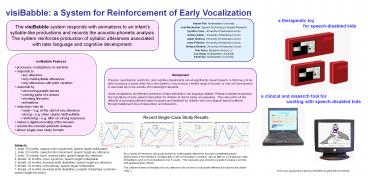
a therapeutic toy for speech-disabled kids
The visiBabble system responds with animations
to an infants syllable-like productions and
records the acoustic-phonetic analysis. The
system reinforces production of syllabic
utterances associated with later language and
cognitive development.
Background Physical, neurological, oral/motor,
and cognitive impairments can all significantly
impact speech. A child may not be able to produce
a sound when he or she wants to, may produce a
limited range of sounds, or may not have learned
to associate his or her sounds with meaningful
referents. Infant vocalizations are effective
predictors of later articulation and language
abilities. Research studies emphasize the
importance of early speech intervention for
children at risk for being non-speaking. They
also point out the difficulty of providing
sufficient speech practice and feedback for
children with such atypical speech patterns
through traditional forms of intervention and
interaction.
a clinical and research tool for working with
speech-disabled kids
Recent Single-Case Study Results
Subjects 1 male, 30 months, speech-motor
impairment, speech target multisyllable 2 male,
33 months, speech-motor impairment, speech target
any utterance 3 male, 25 months, trach, cerebral
palsy, speech target any utterance 4 female, 42
months, Down syndrome, speech target
multisyllable 5 female, 26 months, developmental
disabilities, speech target any utterance 6
female, 34 months, hydrocephaly, speech target
multisyllable 7 female, 24 months, developmental
disabilities, possible Goldenhaar syndrome,
speech target any sound
By a variety of measures, the group trained on
multi-syllable utterances showed consistently
greater performance in the feedback condition
than in the non-feedback condition, with as
little as 4 minutes per week of feedback (and 4
of non-feedback) over 6 weeks. The measures also
showed a greater increase over time with feedback
than without. The children trained on feedback
for any utterance did not show a noticeable
difference except for the oldest child, 2.
This work sponsored in part by NIH/NIDCD grant
R42-DC05534.
Recommended

