

Inference in a Bayesian Network based on Stochastic Simulation PowerPoint PPT Presentation
Title: Inference in a Bayesian Network based on Stochastic Simulation
1
Inference in a Bayesian Network based on
Stochastic Simulation
- Assume that we want to compute P(X1TX4T,
X6T). - We start with a sequence of input patterns I1,
I2, , In. Each input pattern specifies a value
for each root node. For example, I1 X1F,
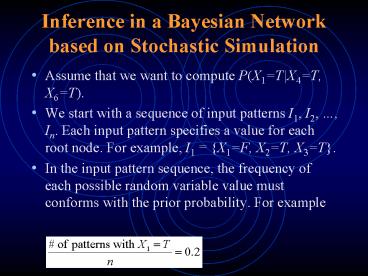
X2T, X3T. - In the input pattern sequence, the frequency of
each possible random variable value must conforms
with the prior probability. For example
2
- Let us use the pattern X1F, X2T, X3T to
illustrate the process. - We start from the root nodes and walk down.
- When the parents of a node are all instantiated,
the node is ready for being instantiated. - Since X2T, X3T, the probability that X5T is
0.1. We can invoke a random number generator to
give us a number between 0 and 1. If the number
generated is less than 0.1, then we set X5T.
Otherwise, we set X5F.
3
- Once all simulation runs have been completed, we
calculate
4
Learning in Bayesian Network
- In general, people employ the cause-and-effect
reasoning to determine the structure of a
Bayesian network. - If the training samples contain observations at
each node, then the learning process is
straightforward.
5
- However, it is common that we do not have
observations of all the nodes.Therefore, we want
to find a setting of the conditional probability
tables so that is maximized, whereis a set of
training samples. - We assume that the training samples are collected
from independent runs of the corresponding
experiment. Therefore,
6
- Since ln(x) is a monotonic increasing function,
is maximized if and only if is
maximized. - For each entry in the conditional probability
tables that is yet to be determined, we compute
k-th column
where wijk is the entry at row j,column k of the
conditionalprobability table of node Xi.
j-th row
7
(No Transcript)
8
- Therefore,
- Furthermore,
9
- The learning process begins wih an initial guess
of all unknown wijk.For each unknown wijk,
computeand set new - Normalize wijk by setting normalized
- If each wijk converges, then terminate.
Otherwise, report the process again.
Recommended

