

Building a Quality Arizona Statewide Transportation Planning Framework PowerPoint PPT Presentation
1 / 27
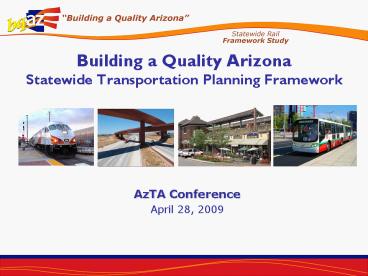
Title: Building a Quality Arizona Statewide Transportation Planning Framework
1
Building a Quality ArizonaStatewide
Transportation Planning Framework
- AzTA Conference
- April 28, 2009
2
What does it mean to Build a Quality Arizona?
- We look far into the future (2050)
- We look at actual needs, not just what we think
we can afford (traditional planning is fiscally
constrained) - We consider the relationships between land use,
economic vitality and transportation - We work with our partners and the public around
the state for a collaborative vision that
reflects our values as Arizonans - We think carefully about what type of lifestyle
we want to create and what kind of legacy we want
to leave for future generations
3
Southwest Region Year 2050 Estimated Population
Density
Increase was calculated based on Year 2005
Population
4
Arizonas Potential for Growth
2005 Growth Areas Population 5.1 million
2050 Growth Areas Population 14.1 million
5
A process for the future . . .
- Vision (2050)
- Statewide travel demand model
- Statewide rail framework
- Future guidance for investment decisions
- Input to long-range transportation plan
6
Purpose
- Establish long-range vision for freight and
passenger rail in the state - Stimulate responsible economic growth
- Maximize use of existing rail infrastructure
through strategic investments - Partner with private railroads for mutual benefit
- Complement other existing and planned
transportation modes - Address related global and regional economic,
land use, environmental and energy issues
7
- Existing Conditions
- and Studies Review
8
Related Studies Review
- Summarized studies relative to the physical,
social, and economic conditions that affect the
rail environment in Arizona - Passenger Rail Studies
- Commuter Rail Studies
- Freight Rail Studies
- Port Logistics Studies
- Local Plans and Policies
- Provided input to preliminary key issues
identification
9
Case Studies Examined
- Comparative analysis of intercity rail systems
across the western United States - High-speed rail corridor designations
10
Statewide Inventory of Environmental Constraints
11
Environmental Context
12
- Passenger and Freight Demand Forecasting
13
Objectives of Freight Demand Analysis
- Key issues driving the direction of freight rail
- Challenges restricting the implementation of a
freight rail network - Potential opportunities to enhance a rail network
- Develop projections to 2050
- Screen commodities based on tonnage and value
- Identify commodities with value added
opportunities - Link rail freight to economic development
14
Sources of ExistingRail Passenger Forecasts
- 1998 Arizona High Speed Rail (HSR) Feasibility
Study - 2003 MAG High Capacity Transit Study
- 2007 High-Speed Passenger Rail Strategic Plan
- 2007 Arizona Public Transportation Response to
Executive Order (EO) - 2008 Transit Propensity and Regional Transit
Demand Working Paper
15
Potential Arizona Passenger Rail Corridors
- High-speed rail between Phoenix and major
metropolitan areas in bordering states - Intercity rail between Sun Corridor Megapolitan
activity centers - Commuter rail within metropolitan areas
16
Potential Arizona Rail Corridors
- Intercity Rail
- High-Speed Rail
- Commuter Rail
17
- Outreach Efforts
18
Stakeholder Interviews
- Union Pacific Railroad
- BNSF Railway
- Maricopa Association of Governments
- City of Phoenix Economic Development Department
- Amtrak
- Federal Railroad Administration
- Pima Association of Governments
- Border States Coordination
- California
- Nevada
- Utah
- New Mexico
- Sonora
19
Surveys/Focus Groups
- Survey of rail stakeholders conducted in March
- Nearly 30 response rate
- Analysis underway
- Focus Groups
- Central Area March 25
- Phoenix, AZ
- Southern Area April 16
- Tucson, AZ
- Northern Area April 24
- Flagstaff, AZ
20
- Preliminary Key Issues Identification and
Discussion
21
Key Issue Systems Planning
- Identification and distribution of demand
- Coordination with commuter rail planning
- Multimodal connections
- Mode shift
- Emerging new international markets
- Customs/Homeland Security
- Interstate coordination
- Right-of-way preservation
22
Key Issue Operations
- Safety
- Shared rights-of-way
- Motive power and technology Issues
- Positive Train Control (PTC)
- Noise
- Class I/Shortline railroads and branch connections
23
Key Issue Project Implementation
- Construction schedules/Implementation timeframes
- Funding sources
- Environmental clearance
- Economic development
- Authority and Responsibility
- Planned new facilities
- Public/Stakeholder support
24
Key Issue Sustainability
- Energy efficiency
- Clean technologies
- Focused growth
- Long-term viability
25
Key Issue Policy
- Rail as a transportation priority
- Passenger and freight relationship
- Federal and state oversight relationships
- Land use policy
- Cost allocation for rights-of-access
- Interstate operating agreements
- Competitive advantages
- Private sector investment
- Oversight and governance
26
Next Steps
- Review and incorporate survey findings
- Area Focus Groups
- Refine and finalize key issues
- Begin strategic concept development
- Ongoing coordination with stakeholders
27
Thank You! http//www.bqaz.gov
Thank You! http//www.bqaz.gov
Recommended

