

Air and Waste Management Association Professional Development Course AIR257: Satellite Detection of PowerPoint PPT Presentation
1 / 13
Title: Air and Waste Management Association Professional Development Course AIR257: Satellite Detection of
1
Air and Waste Management Association Professional
Development CourseAIR-257 Satellite Detection
of AerosolsIssues and Opportunities
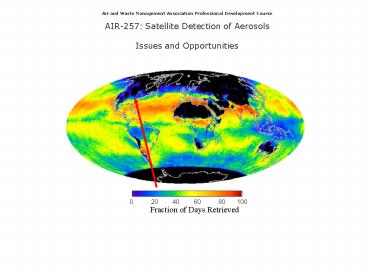
Fraction of Days Retrieved
2
Syllabus
- 900-930 Introduction to satellite aerosol
detection and monitoring - 930-1000 Satellite Types and their Usage
- 1000-1030 Satellite detection of aerosol
events fires, dust storms, haze - 1030-1045 Break
- 1045-1100 Satellite data and tools for the RPO
FASTNET project - 1115-1130 Satellite Data Use in AQ Management
Issues and Opportunities - 1130-1200 Class-defined problems, feedback,
discussion, exam(?)
3
Scientific Challenge Description of PM
Particulate matter is complex because of its
multi-dimensionality It takes at leas 8
independent dimensions to describe the PM
concentration pattern
- Gaseous concentration g (X, Y, Z, T)
- Aerosol concentration a (X, Y, Z, T, D, C, F,
M) - The aerosol dimensions size D, composition C,
shape F, and mixing M determine the impact on
health, and welfare.
4
Satellite Data Issue Bright Surface (Cloud,
Snow, Desert)
- Aerosol data are not retrievable over bright
surfaces - Thus half or more of the data are unavailable
(some could be the most significant - The data loss from clouds is sporadic,
unpredictable
5
Fraction of aerosol retrievals MODIS 2001
(June - August 2001)
(March - May 2001)
Spring
Summer
(December 2000 - January 2001)
(September - November 2001)
Autumn
Winter
20 (winter)-70(summer)
Kaufman, 2002
6
Vertical Distribution Aerosol
- Windblown Dust (crustal elements)
- Biomass Smoke (organics, H20 )
- Sea H20 salt (NaCl. H20)
- Stratospheric (Volcanic) (H2SO4)
- Biogenic (Non-sea salt sulfate, org)
- Urban-Industrial Haze (SO4, org. H20)
- Dust, smoke, volcanic aerosol and industrial haze
originate from land - The global aerosol concentration is highest over
land and near the continents over the oceans
(coastal regions) - Sea salt is significant over some of the windy
oceanic regions and biogenic sulfate and organic
aerosols also occur
7
July 2020 Quebec Smoke Event
- Superposition of ASOS visibility data (NWS) and
SeaWiFS reflectance data for July 7, 2002
- PM2.5 time series for New England sites. Note the
high values at White Face Mtn. - Micropulse Lidar data for July 6 and July 7, 2002
- intense smoke layer over D.C. at 2km altitude.
8
Remote sensing of Aerosol Open questions -
Where does aerosol begin and cloud ends?
- Does aerosol in cloud free area
represent the aerosol that interacts with clouds?
- How to handle the spatial
and temporal variability of aerosol properties?
Haze layer
Clean atmosphere
Haze layer
Toxic trucks Washington Post 11/19/00
Trouble in the greenhouse Nature, Sept., 2000
Y. Kaufman, 2002
9
Retrieved Optical Depth
2000.08.15
10
(No Transcript)
11
Information Refinery Value Chain (Taylor, 1975)
Organizing Grouping Classifying Formatting
Displaying
Analyzing Separating Evaluating Interpreting
Synthesizing
Judging Options Quality Advantages
Disadvantages
Deciding Matching goals, Compromising Bargaining
Deciding
e.g. CIRA VIEWS
e.g. Langley IDEA
RAW System e.g. WG Summary Rpt
e.g. RPO Manager
12
Future Observation and Information Systems
13
Question to Class Participants(Exam! ?)
- How do YOU see the incorporation of satellite
data into your activities? - Describe context (what kind of AQ-related
activity) - What problem could use satellite data?
- Specific satellite?
- Region of interest?
- Data products?
- Delivery (frequency, latency,
- What tools you whish you had for satellites?
- Assess and viewing/prowsing?
- Processing?
- Add and answer your own question
- (The quality of your question will determine your
final grade)
Recommended

