

TYPE TITLE IN ALL CAPS PowerPoint PPT Presentation
1 / 26
Title: TYPE TITLE IN ALL CAPS
1
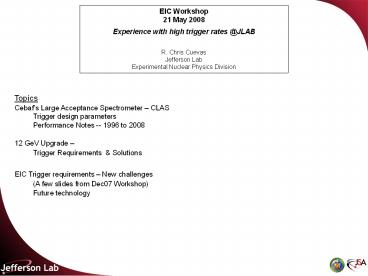
EIC Workshop 21 May 2008 Experience with high
trigger rates _at_JLAB R. Chris Cuevas Jefferson
Lab Experimental Nuclear Physics Division
Topics Cebafs Large Acceptance Spectrometer
CLAS Trigger design parameters Performance Notes
-- 1996 to 2008 12 GeV Upgrade Trigger
Requirements Solutions EIC Trigger
requirements New challenges (A few slides from
Dec07 Workshop) Future technology
2
6 Identical Sectors
- CLAS Trigger Design Parameters
- Photon Electron Experiments with
- polarized targets, polarized beam
- High Luminosities 1034cm-2s-1
- DAQ event rate designed to 10KHz
- Dead-timeless, low latency Level 1 (
- Pipelined (133MHz) clock
- Fast Level 1 for ADC Gate, TDC Start
- Level 2 (Drift Chamber) Pass/Fail
- Up to 32 Front End Readout Crates (ROC)
- Sector based, pattern recognition programming
- Implementation
- VXI 9U x 360mm sector modules (Level 1 Router)
- Event Processor ( Programmable sector
coincidences) - Very low propagation pipeline stage (15ns)
- ECLps technology for most logic
- Trigger Supervisor manages trigger signals and
- interrupts the front end crate ReadOut
Controllers.
TOF
Drift Chambers 3 Regions
ECal
Cerenkov
3
CLAS Overall Trigger Block Diagram
Forward Carriage Trigger Crate
Level 2 Pass
E V E N T P R O C
T R I G G E R
S U P E R V I S O R
S E C T O R 1
S E C T O R 3
S E C T O R 4
S E C T O R 5
S E C T O R 6
S E C T O R 2
TOF_D
Level 2 Fail
TOF_T
BUSY
EC
Level 1 Trigger Distribution
Level 1 Accept
CC
CLEAR
LEVEL2 LOGIC
DG535 DELAY DECK1
DG535 DELAY DECK2
DG535 DELAY DECK3
HBTG
LAC Not Shown HBTG L1 Accept
FC Rocs Start/Gate
Branch Cables to all ROCS
1877 ROCS STOPS Deck1
1877 ROCS STOPS Deck2
1877 ROCS STOPS Deck3
FROM Drift Chambers ADBs
OR B U S Y
Cuevas -- Electronics Group 18 May 1999
4
Level 2 Trigger Block Diagram Track Segment
Finders and Majority Logic
CPU
VME Control to Select Majority Function
Sector 1
142
R3Stereo
To TDC DC4
VME Majority Logic
NIM/ECL
R3Axial
To Forward Carriage Level 2 Latch
R2Stereo
R2Axial
R1Axial
e
Sector2 Sector3 Sector4 Sector5 Sector6
Segment Finders Each Superlayer
Drift Chambers
Segment Collectors
Majority Logic Boards designed on VME
Flexible I/O format Two NIM outputs per
board. Majority Logic function selected by
VME control. One output drives a local TDC and
the other output goes to the forward carriage
Latch module.
Space Frame Decks 1-3
Cuevas -- Electronics Group 18 May 1999
5
- CLAS Trigger Performance Notes (1996 ? Present)
- All FastBus front end modules 1872A TDC,
1877TDC, 1881 ADC - Struck FastBus Interface Motorola VME Cpu
- No Level 2 implemented
- Long conversion time (1.8us/chan 1872A single
hit TDC) limits trigger rate - Events NOT pipelined in the ReadOut Controller
(ROC) - ATM network to ROC
- Level 2 implemented - Drift Chamber regions
with majority logic - Electron(L1) and a track in a sector can be
combined for L2 pass or fail - Replace 1872A with VME pipeline TDC(CAEN)
- Upgrade Motorola Cpu (ROC)
- 100MB Ethernet network adapted to ROCs
- Other DAQ methods improve event trigger rate to
8KHz - LIMITATIONS
- Trigger Supervisor support of 32 crates Max
- Triggers are not pipelined ( 1 Trigger -1
Event readout cycle ) - Gated ADC (1881) Analog signal stored in
delay cable
6
- CLAS Trigger Performance Notes (1996 ? Present)
- Other Performance Notes
- Relatively low failure rate of FastBus
instrumentation - Aging BiRa FastBus crate power supplies will be
replaced with Wiener - product for 1877 TDC crates only
- Air flow cooling design has worked well
- Virtually no hardware failures for custom Level
1 Trigger System - VXI crate and power supply converted to
Wiener product - Virtually no hardware failures for custom Level
2 Trigger modules (400 ) - Very recent implementation of VME CAEN
programmable (FPGA) logic - modules for the g12 photon beam experiment.
Photon trigger hardware - is coupled to original Level 1 modules to
create triggers for CLAS. In use - since April 2008, with excellent results and
new trigger GUI.
7
- 12 GeV Trigger Requirements
Hall D
Hall B
8
- 12 GeV Trigger Requirements
Hall D
- Reduce total hadronic rate from 350KHz to true
tagged hadronic rate of 14KHz - Use Level1 hardware trigger and Level 3 farm to
achieve this 251 reduction - Level 1 hardware trigger efficiently cuts low
energy photon interactions - Level 1 trigger hardware design goal is 200KHz
- Level 1 uses
- Energy Sum from Barrel Calorimeter
- Energy Sum from Forward Calorimeter
- Charged track counts (Hits) from TOF
- Charged track counts (Hits) from Start Counter
- Tagger Energy (Hit counts)
- Simulations show that this Level1 cut method
achieves 150KHz trigger rate - Relatively open Level 1 trigger
Cut backround
Physics event
9
- 12 GeV Trigger Hardware
- Hall D How do you perform this Level1 cut with
hardware? - Use FLASH ADC for detector signals that are
included in the Level 1 trigger - Detector signals are stored in front end boards
- Energy Sum is computed at the board, crate, and
subsystem (BCAL,FCAL) - Synchronous system and Trigger Supervisor
performs event blocking at the ROC level - 8us buffer on front end boards allows for
trigger decision (latency) - Use high speed fiber optic/serial data transfer
between front end crates - Easily supports 64 readout crates and is easily
expandable
10
- 12 GeV Trigger Hardware
Block Diagram Hall D Level 1 Trigger
Trigger Supervisor
SubSystem
Global
Crate
11
Latest Designs
VXS High Speed Serial Backplane
16 channel 250 Msps Flash ADC
Energy Sum Module
12
- 12 GeV Trigger Requirements
Hall B
- Photon Electron Experiments with polarized
targets, polarized beam - Increase Luminosity to 1035cm-2s-1
- DAQ event rate increase 10KHz(25-30MB/s)
- Retain sector based trigger scheme
- Add PreCal, Low Threhold Cerenkov counter
- Add Silicon Vertex Tracker, and Central TOF
- Upgrade Drift Chamber Level 2 Hardware
- Replace FastBus ADC modules with FlashADCs
(Keep Multi-Hit 1877s TDC) - FlashADC design will be used for Calorimeter
Energy Sum and Cluster finding - Level 1 trigger will be promptly sent to SVT
and the Drift Chamber Level 2 hardware - Level 2 will employ a Road Finder to link all
three Drift Chamber regions per sector - FlashADC and custom trigger modules will be
identical to Hall D for cost savings and - efficient use of design and implementation
resources!
13
12 GeV Front End Electronics Level 1 Trigger
Modules
Trigger Supervisor Crate
VXS Crate
VXS Crate
Fiber Optic Clock/Trigger Distribution
Detector Signals
TD
TS
TS
(12)
(1)
Clock
Crate Trigger Processor Fiber Optic Distribution
VXS Crate
( Boards)
- (400) FADC250
SSP
GTP
- (140) F1TDC
(8)
- (
(2)
Global Trigger Processor Crate
- (80) Trigger Interface
- (80) Signal Distribution
Standard VXS Crate Implement GTP on two Switch
Slots
Cuevas Updated 28MARCH08
14
- 12 GeV Trigger Hardware
A few other nice features of JLAB custom Trigger
Modules Collaborative efforts of JLAB Fast
Electronics, JLAB DAQ, and Christopher Newport
University groups.
15
Subsystem Processors (SSPs)
- All subsystem processors reside in Global Trigger
Crate - All subsystem processors are same physical PC
boards! - Each SSP receives up to eight four-lane crate
data links - Some SSPs divided into two boards (because of
crate count) - If so both board Partial Results sent to
global processor - Eight SSPs are needed
- Two for BCAL Energy Subsystem Processor (ESP)
- Two for FCAL Energy Subsystem Processor (ESP)
- One for Start Counter Hit Subsystem Processor
(HSP) - One for TOF Hit Subsystem Processor (HSP)
- One for Tagger Tagger Subsystem Processor
- One spare!
- Each subsystem processor sends time-stamped
Subsystem Event Reports (SER) to all Global
Trigger Processors (as in CTP-SSP link)
16
SSP
17
The Global Trigger Crate
- Eight SubSystem Processors (SSPs) on one logical
Side - One or more Global Trigger Processors (GTPs) on
other Side - SSPs are connected to the GTPs via a
partial-mesh backplane - 8 x 2 Mesh Initially (VXS!)
- Each SSP talks to each GTP via a four-lane Aurora
Backplane Link - Each SSP sources two four-lane links to the
backplane - Each GTP sinks eight four-lane links from the
backplane
18
The Global Trigger Crate (logical view)
bcal ESPs
fcal ESPs
tof HP
strt HP
phot EP
VME/ VXS
Clk/ Trig In
GTP Array
SSP Array
19
GTP Logic
2-8 Trigger Bits
8 Trigger Bits
20
Example GTP Trigger Equation Implementation
Z TFMHTOF EFMEFCal RM((EFCal 1)/(EBCal
1)) HTOF - Hits Forward
TOF EFCal - Energy Forward Calorimeter EBCal -
Energy Barrel Calorimeter
- Equation was implemented in VHDL using Xilinx
synthesis tools and Virtex 5 LX220 FPGA - All computing done in pipelined, 32bit floating
point arithmetic - Subsystem processor data was converted from
integers to floating point - Equation is computed every 4ns and trigger bit
is updated if Z is above a programmable threshold - Each coefficient is variable can be changed
very quickly without having to reprogram FPGA - Used Xilinx specific math libraries (, -, , /,
sqrt) - Synthesis and implementation resulted in using
3 of LX220 FPGA - Latency was 69 clock cycles 276ns delay
introduced for forming L1 trigger - Algorithm was targeted to run at a 300MHz clock
speed without significant effort.
21
- EIC Trigger Hardware Goals
- (Copied Slides)
22
- EIC Trigger Hardware Goals
- (Copied Slides)
23
Summary
- CLAS high rate trigger system has been very
reliable for over a decade - Evolution of improvements to trigger rate by
upgrading aging hardware - FLASHADC used for detector signals that
create the trigger - 250MHz sample rate(4ns) with 8us data buffer
- Energy summing and other trigger logic created
from detector signals - Elegant VXS backplane implementation takes
advantage of high speed serial links - Latest Field Programmable Gate Arrays used to
implement trigger equations - Full synchronous system managed by Trigger
Supervisor - Trigger distribution
- Event data blocking and ReadOut Controller
interupts - Flexible system design (same module designs)
used for two complex experimental Halls - New FPGA inputs can accept very high (1.2Gbps)
input data from higher speed - ADC chips.
24
Questions? Discussion?
25
Other Stuff
26
- Examples of physical rack layout drawings
- ALL equipment must be shown to identify rack
space issues - (i.e. Network gear, patch panels, splitter
panels, etc.) - Airflow/Cooling issues will need to be
identified and resolved
36 Deep 19 Standard JLAB Rack
- VXS Crate with
- (16) FADC-250
- Sum Board
- (1) Clock/Trig/Sync
- Cpu not shown
Fan Tray/Crate control
Recommended

