

7' Correlation of Liquid Phase Data SVNA 12'1 PowerPoint PPT Presentation
1 / 9
Title: 7' Correlation of Liquid Phase Data SVNA 12'1
1
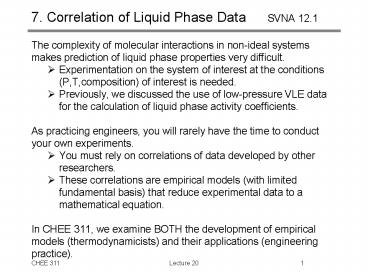
7. Correlation of Liquid Phase Data SVNA 12.1
- The complexity of molecular interactions in
non-ideal systems makes prediction of liquid
phase properties very difficult. - Experimentation on the system of interest at the
conditions (P,T,composition) of interest is
needed. - Previously, we discussed the use of low-pressure
VLE data for the calculation of liquid phase
activity coefficients. - As practicing engineers, you will rarely have the
time to conduct your own experiments. - You must rely on correlations of data developed
by other researchers. - These correlations are empirical models (with
limited fundamental basis) that reduce
experimental data to a mathematical equation. - In CHEE 311, we examine BOTH the development of
empirical models (thermodynamicists) and their
applications (engineering practice).
2
Correlation of Liquid Phase Data
- Recall our development of activity coefficients
on the basis of the partial excess Gibbs energy - where the partial molar Gibbs energy of the
non-ideal model is provided by equation 10.42 - and the ideal solution chemical potential is
- Leaving us with the partial excess Gibbs energy
- (11.21)
3
Correlation of Liquid Phase Data
- The partial excess Gibbs energy is defined by
- In terms of the activity coefficient,
- (11.96)
- Therefore, if as practicing engineers we have GE
as a function of P,T, xn (usually in the form of
a model equation) we can derive ?i. - Conversely, if thermodynamicists measure ?i, they
can calculate GE using the summability
relationship for partial properties. - (11.99)
- With this information, they can generate model
equations that practicing engineers apply
routinely.
4
Correlation of Liquid Phase Data
- We can now process this our MEK/toluene data one
step further to give the excess Gibbs energy, - GE/RT x1ln?1 x2ln?2
5
Correlation of Liquid Phase Data
- Note that GE/(RTx1x2) is reasonably represented
by a linear function of x1 for this system. This
is the foundation for correlating experimental
activity coefficient data
6
Correlation of Liquid Phase Data
- The chloroform/1,4-dioxane system exhibits a
negative deviation from Raoults Law. - This low pressure VLE data can be processed in
the same manner as the MEK/toluene system to
yield both activity coefficients and the excess
Gibbs energy of the overall system.
7
Correlation of Liquid Phase Data
- Note that in this example, the activity
coefficients are less than one, and the excess
Gibbs energy is negative. - In spite of the obvious difference from the
MEK/toluene system behaviour, the plot of
GE/x1x2RT is well approximated by a line.
8
8.4 Models for the Excess Gibbs Energy
- Models that represent the excess Gibbs energy
have several purposes - they reduce experimental data down to a few
parameters - they facilitate computerized calculation of
liquid phase properties by providing equations
from tabulated data - In some cases, we can use binary data (A-B, A-C,
B-C) to calculate the properties of
multi-component mixtures (A,B,C) - A series of GE equations is derived from the
Redlich/Kister expansion - Equations of this form fit excess Gibbs energy
data quite well. However, they are empirical and
cannot be generalized for multi-component (3)
mixtures or temperature.
9
Symmetric Equation for Binary Mixtures
- The simplest Redlich/Kister expansion results
from CD0 - To calculate activity coefficients, we express GE
in terms of moles n1 and n2. - And through differentiation,
- we find
Recommended

