

Guidelines for use of Cell Culture Core facility PowerPoint PPT Presentation
1 / 18
Title: Guidelines for use of Cell Culture Core facility
1
Guidelines for use of Cell Culture Core facility
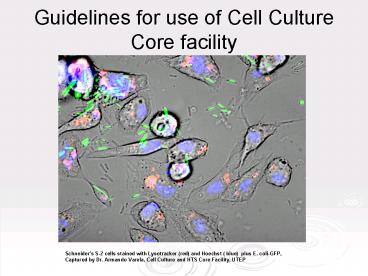
Schneiders S-2 cells stained with Lysotracker
(red) and Hoechst ( blue) plus E. coli-GFP,
Captured by Dr. Armando Varela, Cell Culture and
HTS Core Facility, UTEP
2
Content
- General rules
- Pointers for aseptic technique
- Work area and equipment
- Safety considerations
3
General rules
- Everything brought to and stored in facility must
be labeled with your name, PIs initials and
date. Culture flasks must also have name of cell
line. - Always sign equipment logs when using core
equipment. - Do not share you access code.
- Deposit waste in proper containers.
4
Aseptic Technique
- What is it?
- Aseptic technique is everything you do to reduce
the probability of contamination.
5
Important Pointers for Aseptic Techniques
- Clean Work Area a clean hood and well organized
work area. - Personal Hygiene good hand washing habits , use
of gloves and other personal protective equipment
such as caps ,lab coats and face mask. - Sterile handling Swabbing ,capping and flaming
- Handling bottles and flasks culture flasks
should be laid down horizontally and like
bottles, held at an angle during manipulations.
Do not let your hands or any item come between an
open vessel or sterile pipette and the HEPA air
filter. Never reach over any open container. - Pipetting Disposable plastic pipettes come in a
convenient size range (e.g.. 1 ml, 5 ml ,10 ml
and 25ml)
6
Work area and equipment
- Biosafety Laminar air flow hoods
- Types
- Horizontal air flow Provides no protection to
user. Air flow is towards user - Vertical air flow Protects users and is -used
mainly for potentially hazardous materials( any
primate, including human, cell lines, virus
producing cultures, radioisotopes, carcinogenic
and toxic drugs.) Usually equipped with UV light
7
Horizontal Vs Vertical
Horizontal air flow used for media preparation
and other sterile reagents and for culture of
non primate cell lines. Provides no protection
to user. Air flow is towards user
8
Horizontal Vs Vertical
Vertical air flow -used mainly for potentially
hazardous materials ( any primate, including
human, cell lines, virus producing cultures,
radioisotopes, carcinogenic and toxic drugs.)
Usually equipped with UV light.
9
A Class II Vertical Type A2 laminar flow hood
10
Incubators
- For most mammalian cells
- -Temperature at 37C
- -Humidity at 95
- -Carbon Dioxide at 5
- Water is heated in a jacket to distribute
- Heat evenly to the interior of the chamber
- A water pan is placed with treated water
- to maintain humidity.
11
Inverted microscope
- Specially designed for viewing living cells
- Light source is above and phase objectives
- of 4X, 10X, 20X and 40X are located
below. - It is vital to look at cultures regularly
- to evaluate growth, deterioration
- or microbiological infection.
12
Equipment for Cryopreservation
- The cell core facility has two ultra low
temperature freezers and one low temperature
freezer . -140ºC freezer - -80ºC freezer
13
Rational for Cryopreservation
- Cross contamination of other cell lines
- Senescence and the resultant extinction of cell
line - Genetic drift due to genetic instability
- Contamination of microorganisms
- Need for distribution to other users
14
Basic safety considerations
- Minimum standard applied to any cell culture lab
is category 2 containment. - Safety applies both ways
- -protect your cells and protect yourself
- General safety rules
- Aseptic vs. antiseptic technique
15
Safety hazards of the cell culture lab
- Broken glass
- Electrical
- Radiation
- Frost bite
- Chemical toxicity
- Infection
- Biohazards
16
Basic safety procedures for cell culture
- Assume that all culture are hazardous
- Use of proper personal protective equipment
(PPE). - Wash hands before handling cultures and before
leaving the lab - Decontaminate work surface before and after use
- Properly dispose of biological and chemical waste
17
Questions
- True or False
- The microscope used to see live cells is the
phase contrast converted type. - The advantage of maintaining a clean hood and
well organized area of work is to reduce the
probability of contamination. - Reagents and cultures are to be labeled only
with initials. - The horizontal air flow hoods give more
protection to the operator than the vertical flow
hoods. - Entry codes can be shared with someone you trust.
- Multiple choice
- PPE that should be used in the cell core lab
include the following - a) lab coat,
pipettes, goggles and gloves - b) Face mask,
gloves and lab coat - c) Laminar airflow
hood, gloves and pipetting aid - d) all of the
above - Washing hands before handling cultures and before
leaving the lab is a good example of
18
(No Transcript)
Recommended

