

Advances in Fuel Cell Modeling for Control System Development PowerPoint PPT Presentation
Title: Advances in Fuel Cell Modeling for Control System Development
1
Advances in Fuel Cell Modeling for Control System
Development
EPFL Laboratoire d Electronique Industrielle
F. Grasser Prof. A. Rufer
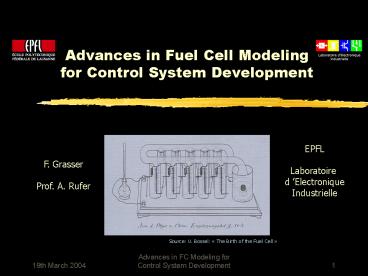
Source U. Bossel The Birth of the Fuel Cell
2
Outline
- Introduction / Goals
- Modeling Concept
- Stack Modeling
- Goals
- Examples Voltage, Gas Composition, Water
Transfer - Outlook
- Questions
3
Goals
- Intelligent System Control
- Controller maximizes power/efficiency by
adjusting operating parameters (lambda, pressure,
etc.) - State estimation
- Reduce sensor requirements through estimation
techniques - Estimate non-measureable system parameters
4
Modeling Concept
5
Stack Modeling Goals
- Describe overall voltage
- Model average cell
- Lumped / averaged parameter description of
processes in cell - Describe membrane water content
- Average description of water fluxes across cell
- Describe water uptake dynamics (currently steady
state)
6
Stack Modeling Voltage Losses
- Equilibrium Voltage
- Nernst equation
- Activation overpotential
- Tafel equation
- Neglect anode side
- Concentration overpotential
- Describe one dimensionaldiffusion in the GDL
- Ionic overpotential
- Ohms Law for membrane resistance (fit against
water content) - Ohmic overpotential
- Ohms Law for GDL and BIP
Partial reactant pressures at the reaction site
? describe gas composition and diffusion
Current density
Included in Nernst potential ? describe
gas composition and diffusion
Membrane water content ? describe water
transport
Current density
7
Stack Modeling Average Gas Composition
- Mass balance for each species
- Average molar flowrate
- Average molar fractions (H20, O2, N2)
- Problem H2O, GDL needs to be known
- Assume a (a H20,MEM / H2O,REACT)
8
Stack Modeling Average Gas Composition
9
Stack Modeling Reactant Transport
- Transport GC - GDL
- Sherwood analogy
- Transport within GDL
- Diffusion
- Account for gas composition in diffusivity
- Assumptions
- Constant pressure in the z-direction
- Constant diffusivity (based on GC gas
composition) - Transport to catalyst layer
- Dissolution in ionomer-water mixture
- Henrys Law
10
Reactant TransportAveraging Considerations
11
Stack Modeling Water Transport
In this figure proportional to
Problem no analytical solution
? f(H2O,mem)
H2O,mem f(? )
12
Outlook
- Experimental work
- parameter identification
- model verification
- Further modeling of the stack region
- Get analytical expression for steady-state water
management - Extend to describe membrane water uptake dynamics
- Designing control strategies
13
Questions ?
Recommended

