

Summary Session 7: Acceleration, Storage, and Polarimetry of Polarized Protons PowerPoint PPT Presentation
1 / 81
Title: Summary Session 7: Acceleration, Storage, and Polarimetry of Polarized Protons
1
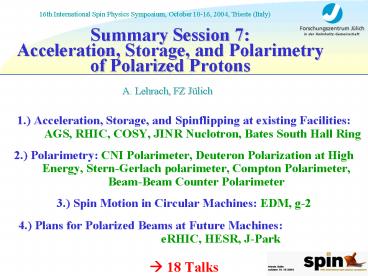
Summary Session 7 Acceleration, Storage, and
Polarimetry of Polarized Protons
16th International Spin Physics Symposium,
October 10-16, 2004, Trieste (Italy)
A. Lehrach, FZ Jülich
- 1.) Acceleration, Storage, and Spinflipping at
existing Facilities AGS, RHIC, COSY, JINR
Nuclotron, Bates South Hall Ring - 2.) Polarimetry CNI Polarimeter, Deuteron
Polarization at High Energy, Stern-Gerlach
polarimeter, Compton Polarimeter, Beam-Beam
Counter Polarimeter - 3.) Spin Motion in Circular Machines EDM, g-2
- 4.) Plans for Polarized Beams at Future
Machines eRHIC, HESR, J-Park - ? 18 Talks
2
Polarized Protons at the AGS
Acceleration of Polarized Protons in the AGS
with a Helical Partial Snake
H. Huang et al.
ACCELERATION OF POLARIZED BEAMS USING MULTIPLE
STRONG PARTIAL SIBERIAN SNAKES
T. Roser L.A. Ahrens, M. Bai, E. D. Courant,
J.W. Glenn, R. C. Gupta, H. Huang, A.U. Luccio,
W.W. MacKay, N. Tsoupas, E. Willen
(Commissioning FY05)
3
AGS Helical Warm Snake
- 8 and 5.9 partial snake
- 1.) Less coupling
- Stronger snake less concern about the coupling
resonances. - 2.) Less effect from horizontal dimension
- ? Less parameters to worry about (horizontal
emittance, horizontal tunes).
4
Ramp Measurement
Polarization loss 10 at 0 ? 6 at 24
? 12 at 48- ? 10 at 36 ? (18 last year)
24 ?
36 ?
Break down the gain factor 1.25 (40-gt50) 1.09
at 0 ? 1.09 at 36 ? 1.08 higher source pol.
48 - ?
36 - ?
50 polarization at AGS extraction with AC
Dipole warm helical partial snake
2003 ramp measurement 28 pol.
2004 ramp measurement 43 pol.
5
Strong Partial Siberian Snake for AGS
- A strong partial Siberian snake generates large
spin tune gap for G? n. With strong enough
snake, gap is large enough to cover both
imperfection and intrinsic spin resonances. - Note With a strong snake, the stable spin
detection will deviate from vertical direction
(18 degree for 20 snake).
Imperfection resonance
Intrinsic resonance
6
30 AGS super-conducting helical snake
Completed helical dipole coil
Correction solenoid and dipoles
Measured twist angle 2 deg/cm in the middle 4
deg/cm at ends
7
AGS strong snake orbit and optics matching
Cold snake
4 quadrupoles for optics matching
8
Two partial snakes in the AGS
E20 5
A20 15
Deviation from integer
If vertical tune and super-periodicity have
common factor that is odd multiple partial
snakes can be used to give larger effective
strength
Gg
Injection
First intrinsic resonance (0n)
9
Polarized Protons at RHIC
RHIC Polarized Proton New Working Point
Commissioning
M. Bai L. Ahrens, K. Brown, A. Drees, C. J.
Gardner, J. W. Glenn, W. Fischer, H. Huang, Y.
Luo, F. Pilat, W. W. MacKay, G. Marr, C. Montag,
V. Pitisyn, T. Roser, T. Satogata, R. Tomas, S.
Tepikian, N. Tsoupas, J. Van Zeijts
Snake depolaring resonance observed in RHIC
V.Ptitsyn M. Bai, H. Huang, W. W. MacKay, T.
Roser, S. Tepikian
Status of proton polarization in RHIC and AGS
(Invited)
W.W. MacKay et al.
10
RHIC Layout
11
RHIC intrinsic spin depolarization resonance
spectrum
achieved
Intrinsic spin resonance Qx28.73, Qy29.72,
emit 10
12
Experiment results
- Both working points
- around 0.735 and
- 0.685 demonstrated
- similar effect on the
- beam lifetime in the
- beam-beam presence
- working point around
- 0.685 yielded better
- beam polarization
- transmissmion
- effciency.
- 0.685 88
- 0.735 75
13
Snake resonances
First discovered and studied by S.Y.Lee and
S.Tepikian
- Two types
- m odd.
- Caused by an intrinsic resonance alone.
- m even
- Caused by an interference between
imperfection and intrinsic resonances.
leads to resonance splitting
Resonances of interest. Before Run4 0.2,0.25
bet.tune working area -gt Qb 1/4 3/14
Run 4 0.68,0.75 bet.tune working
area -gt Qb 3/4 7/10
14
Run 4. Betatron tune scan
Yellow vertical tune scans were done at the
injection energy at different snake current
settings. They showed clear depolarization effect
of ¾ resonance, which also depended on the snake
current. No clear effect from 7/10 resonance was
seen (both at the injection and store energies).
Snake inner current at 326A
Snake inner current at 321A
15
Snake current scan
Done at the injection energy. Changing inner
snake current effectively shifts the spin tune
(and the position of the snake resonance). Qy0.
74
323 A optimum
321 A optimum
16
Conclusion
- Two new working points were explored during the
FY04 RHIC pp run. Both demonstrated better
luminosity performance. Working point around
0.685 yielded higher polarization transmission
efficiency as well as better polarization
lifetime.
17
(No Transcript)
18
(No Transcript)
19
Spin Flipping Vector and Tensor Polarized
Deuterons
Spin Flipping Vector and Tensor Polarized
Deuterons
20
Spin Flipping Vector and Tensor Polarized
Deuterons
21
Higher-Order Spin Resonances
Third order spin resonances are strong !
22
Spin Flipping Polarized Protons
23
Spin Flipping Polarized Protons
- Frequency sweep parameter
- ?f/2 6 KHz
- ?t 0.1sec
- Fit to Pf Pi (-?)n gives ? 99.920.04.
24
POLARIZED DEUTERONS AT THE JINRACCELERATOR
NUCLOTRON
- Yu.K.Pilipenko, S.V.Afanasiev, L.S.Azhgirey,
A.Yu.Isupov, V.P.Ershov, V.V.Fimushkin,
L.V.Kutizova, V.F.Peresedov, V.P.Vadeev,
V.N.Zhmyrov, L.S.Zolin - Joint Institute for Nuclear Research
25
POLARIZATION at the NUCLOTRON
- 20 years of intensive study of polarization
phenomena in high energy spin physics with the
Dubna 10 GeV synchrophasotron - In fall of 2002 last polarized beam run, the old
historical machine was shutdown
Test run at the new SC accelerator nuclotron has
been done to get polarized beam and continue
spin physics program
26
?D- CHARGE EXCHANGE IONIZER
- To reach the accelerated polarized beam
intensities up to 0.7-11010 d/pulse - ? multi-turn charge exchange injection (20-30
turns) by stripping injection of ?D- ions - Polarized ?D- beam is required ? existing ?D
plasma charge exchange ionizer has been modified
into ?D- ionizer using an external
converter-emitter. - At output of the H plasma generator, a
molybdenum converter is placed to produce H-
ions. Cesiated molybdenum surfaces of the
converter are exposed to an intense flux of
superheated hydrogen atoms, positive ions and
effectively generate H- ions. - H- ions, generated inside the converter, space
charge compensated by residual H ions, are fill
up a charge exchange space of the HV pipe. - The reaction ?D0H- ?D- H0 takes place.
27
TEST RUN at the NUCLOTRON
- Simulation shows that depolarizating resonances
are absent under polarized deuteron acceleration
almost at all energy range of the machine. A
special test run has been done at the nuclotron
using the existing ?D source POLARIS with
Penning ionizer to check the polarization of low
and high energy beams during acceleration. - The results of measurements are
- Pz(1-4)
Pz(3-6) - 1. Beam polarization measured
-0.56/-0.07 0.62/-0.07 - behind the linac
- 2. Internal target measurements
- at 3.5 GeV/c -0.58/-0.04
0.59/-0.04 - at 5.0 GeV/c -0.56/-0.03
0.60/-0.03 - 3. Polarization of the extracted beam
- at 3.5 GeV/c -0.54/-0.02
0.56/-0.02 - at 5.0 GeV/c -0.66/-0.02
0.60/-0.02 - The vector polarization of the deuteron beam
during acceleration is saved and confirmed by all
polarimeters. - As expected due to one turn injection mode an
intensity of the polarized deuteron beam is
observed as 1.3?108d/pulse. The charge exchenge
miltyturn injection is required.
28
The Bates South Hall Ring A Unique Instrument
for Studying Polarization D. Cheever, K.Dow, M.
Farkhondeh, W. Franklin, D. Hasell, E. Ihloff, S.
Krause, L.Longcoy, C. Tschalaer, E.
Tsentalovich, J. van der Laan, F. Wang, A.
Zolfaghari, T. Zwart
The MIT-Bates Compton Polarimeter for the South
Hall Ring
W.A. Franklin for the BLAST Collaboration
29
MIT-Bates Linear Accelerator Center
Three distinct modes of operation driven by
needs of experiments
- Standard Linac and recirculator provide intense
polarized electron beams up to 1 GeV at 600 Hz,
low duty cycle - Pulse Stretcher (OOPS) Limited turns in South
Hall Ring before gradual extraction to external
target - Storage (BLAST) Gradual stacking of electron
pulses in South Hall Ring for long-lived CW beam
30
Polarization in the South Hall Ring
Monitoring beam polarization in the ring.
Compton polarimeter
- Inject beam for peak longitudinal polarization
at internal target (Wien filter in polarized
source)
Full Siberian Snake (Budker) restores
longitudinal beam polarization at target
Spin Flipper
- Spin-flipping RF dipole allows dynamic spin
reversal of stored beams (Michigan)
31
Siberian Snake Calibration
- Siberian Snake strength determined by electron
energy, solenoidal field - Spin flip resonant frequency provides sensitive
measurement of spin tune as function of Siberian
Snake current
- Nominal current-based calibration corrected to
Siberian Snake by 0.4.
32
Compton Polarimetry Below 1 GeV
- Compton polarimetry is well established at high
energy accelerators (Apol0.5) - Different challenges exist in applying at
energies below 1 GeV. - Analyzing power falling with energy (Apol lt
0.05) - Interaction mechanism varies with gamma ray
energy - Broader angular distribution for photons
- Background from low energy photons
- Beam lifetime less than 1 hour
Compton Analyzing Power
532 nm laser light
HERA
Apol
JLab
Bates
Electron Energy (MeV)
- Bates seeks precise polarization measurement for
each ring fill (15 minutes) for experiments with
BLAST.
33
Fill-by-Fill Polarization Results
Polarization
Time (hours)
- Polarization reversed in electron source on
fill-by-fill basis - Polarization monitored continuously
- Typical precision of 4-5 for 15 minute fill
- Gaussian profile to results
34
South Hall Ring Polarization
- Compton polarimeter data from Dec. 2003
Sept.2004 - Mean polarization of 66.3 during BLAST
experiments
35
Polarization and Tune Spreading
PL
ny
- Initially, large losses of P for high I,
restored by changing ring lattice. - Effect linked to betatron tune shifts and
spreading from trapped ions - Practical solution operate away from expected
spin-orbit resonances, empirical hunt for max
polarization - Limited study of polarization as function of
current, storage time, and tune - Relevant issue for high luminosity devices
(Electron-Ion Collider)
36
BLAST Experiment
Measure asymmetries using polarized beams and
targets
- South Hall Ring Intense (175 mA) stored CW
polarized electron beams in at 850 MeV - BLAST Atomic Beam Source (E. Tsentalovich, 10/15
Session 8) - BLAST Symmetric detector with wide momentum
transfer bite
- Beam-target polarization product from BLAST
asymmetry. - Need rapid nondestructive measurement of beam
polarization. - Laser backscattering can provide.
37
Summary Session 7 Acceleration, Storage, and
Polarimetry of Polarized Protons
16th International Spin Physics Symposium,
October 10-16, 2004, Trieste (Italy)
A. Lehrach, FZ Jülich
- 1.) Acceleration, Storage, and Spinflipping at
existing Facilities AGS, RHIC, COSY, JINR
Nuclotron, Bates South Hall Ring - 2.) Polarimetry Compton Polarimeter, CNI
Polarimeter, Deuteron Polarization at High
Energy, Stern-Gerlach polarimeter, Beam-Beam
Counter Polarimeter - 3.) Spin Motion in Circular Machines EDM, g-2
- 4.) Plans for Polarized Beams at Future
Machines eRHIC, HESR, J-Park
38
Spin Dependence in Elastic Scatteringin the CNI
Region pp pp pC pC
- A. Bravar, I. Alekseev, G. Bunce, S. Dhawan, R.
Gill, H. Huang, W. Haeberli, G. Igo, - O. Jinnouchi, A. Khodinov,K. Kurita, Z. Li, Y.
Makdisi, A. Nass, H. Okada, S. Rescia, N. Saito,
H. Spinka, E. Stephenson, D. Svirida, D.
Underwood,C. Whitten, T. Wise, J. Wood, A.
Zelenski
p-Carbon CNI Polarimeters at BNL the Fastest
Physics Setup in the World.
D. Svirida I.Alekseev A.Bravar G.Bunce
S.Dhawan R.Gill H.Huang W.Haeberli G.Igo
O.Jinnouchi V.Kanavets K.Kurita A.Khodinov
Z.Li Y.Makdisi A.Nass W.Lozowski
W.W.MacKay H.Okada S.Rescia T.Roser
N.Saito H.Spinka E.Stephenson D.Underwood
C.Witten T.Wise J.Wood A.Zelenski
39
RHIC pp accelerator complex
RHIC pC CNI polarimeters
absolute pH polarimeter
BRAHMS PP2PP
PHOBOS
RHIC
PHENIX
Siberian Snakes
STAR
Siberian Snakes
Spin Rotators
5 Snake
LINAC
BOOSTER
AGS quasi-elastic polarimeter
AGS
Pol. Proton Source
AGS pC CNI polarimeter
200 MeV polarimeter
Rf Dipoles
20 Snake
40
The Very Low t Region
around t -10-3 (GeV/c)2 Ahadronic
ACoulomb Þ INTERFERENCE CNI Coulomb Nuclear
Interference
scattering amplitudes modified to include also
electromagnetic contribution hadronic
interaction described in terms of Pomeron
(Reggeon) exchange electromagnetic
single photon exchange s Ahadronic
ACoulomb2 unpolarized Þ clearly visible in
the cross section ds/dt charge polarized Þ
left right asymmetry AN magnetic moment
g
P
41
AN Coulomb Nuclear Interference
the left right scattering asymmetry AN arises
from the interference of the spin non-flip
amplitude with the spin flip amplitude
(Schwinger) in absence of hadronic spin
flip contributions AN is exactly calculable
(Kopeliovich Lapidus) hadronic spin- flip
modifies the QED predictions interpreted in
terms of Pomeron spin flip
and parametrized as
µ(m-1)p µspphad
AN (t)
42
Some AN measurements in the CNI region
pC Analyzing Power
E950_at_BNL p 21.7 GeV/c PRL89(02)052302
pp Analyzing Power
E704_at_FNAL p 200 GeV/c PRD48(93)3026
no hadronic spin-flip
with hadonic spin-flip
AN()
no hadronic spin-flip
r5pC µ Fshad / Im F0had Re r5 0.088
0.058 Im r5 -0.161 0.226 highly
anti-correlated
-t
43
The Atomic H Beam Source
H2 dissociator
H p e-
separation magnets (sextupoles)
RF transitions
focusing magnets (sextupoles)
OR
Pz OR Pz-
recoil detectors
record beam intensity 100 eff. RF
transitions focusing high intensity B-R
polarimeter
Breit-Rabi polarimeter
holding field magnet
44
JET target polarization performance
- the JET ran with an average intensity of 11017
atoms / sec - the JET thickness of 1 1012 atoms/cm2
record intensity - target polarization cycle
- /0/- 500 / 50 / 500 sec
- polarization to be scaled down due to a 3 H2
background - Ptarget 0.924 0.018
- (current understanding)
- no depolarization from beam
- wake fields observed !
minus polarization
0.94 0.96 0.98 pol.
plus polarization
time
2.5 h
45
Recoil Si spectrometer
ANbeam (t ) - ANtarget (t ) for elastic
scattering only! Pbeam - Ptarget . eNbeam /
eNtarget
6 Si detectors covering the blue beam gt MEASURE
energy (res. lt 50 keV) time of
flight (res. lt 2 ns) scattering angle (res.
5 mrad) of recoil protons from pp pp elastic
scattering
- HAVE design
- azimuthal coverage
- one Si layer only
- smaller energy range
- reduced bkg rejection power
46
AN for pp pp _at_ 100 GeV
data (from this expt. only) fitted with CNI
prediction sTOT 38.5 mbarn, r 0, d
0 fitted with N f CNI N
normalization factor N 0.98 0.03 c2 5 / 7
d.o.f. the errors shown are statistical
only (see previous slide)
no hadronic spin-flip
preliminary
data in this t region being analyzed
no need of a hadronic spin flip contribution to
describe these data however, sensitivity on f5had
in this t range low
47
Setup for pC scattering the RHIC polarimeters
beam direction
inside RHIC ring _at_IP12
Ultra thin Carbon ribbon Target (3.5mg/cm2 ,10mm)
1
6
5
2
Si strip detectors (ToF, EC)
3
4
30cm
RHIC 2 rings
- recoil carbon ions detected with Silicon strip
detectors - 2 72 channels read out with WFD (increased
acceptance by 2) - very large statistics per measurement ( 20 106
events) allows detailed analysis - bunch by bunch analysis
- channel by channel (each channel is an
independent polarimeter) - 45o detectors sensitive to vertical and radial
components of Pbeam - unphysical asymmetries
48
AN for pC pC _at_ 100 GeV
statistical errors only
preliminary
no hadronic spin-flip
with hadronic spin-flip
best fit with hadronic spin-flip Kopeliovich
Truemann model PRD64 (01) 034004 hep-ph/0305085
systematic uncertainty
forbidden asymmetries
49
A RIKEN BNL Research Center Workshop A RIKEN BNL
Research Center Workshop A RIKEN BNL Research
Center Workshop
RHIC Polarization History in pp Run04
- SPIN'04
Change in Si dead layer parameters
ONLINE
little loss or none at the ramp
switch to horizontal target
Polarization
Results from O. Jinnouchi
Days from April 1st
Polarization
Data Points Black 24GeV Color 100GeV
Days from April 1st
D.Svirida (ITEP/BNL)
50
A RIKEN BNL Research Center Workshop A RIKEN BNL
Research Center Workshop A RIKEN BNL Research
Center Workshop
AGS Asymmetry during the Ramp
- SPIN'04
0.015
1 ms bin width
0.01
Raw asymmetry AN ? Pbeam
0.005
0
-0.005
-0.01
-0.015
G?
25
30
35
40
45
Ebeam
12
14
16
18
20
22
24
Asymmetry flips sign at every G? n
Results from J. Wood
D.Svirida (ITEP/BNL)
51
(No Transcript)
52
(No Transcript)
53
t 0
t 0.214-0.054i
54
- Design and Test of a Prototype Cavity for a
Stern-Gerlach Polarimeter - P. Cameron1, M. Conte4, N. DImperio1, W.
Franklin6, D.A.Goldberg3, A. Luccio1, M.
Palazzi4, M. Pusterla5, R. Rossmanith2, W.
MacKay1, T. Zwart6 - 1Brookhaven National Laboratory, Upton, NY 11973,
USA - 2Forschungszentrum Karlsruhe GmbH, D-76021
Karlsruhe, Germany - 3Lawrence Berkeley National Laboratory, Berkeley,
CA 94720 USA - 4Universita and Sezione INFN di Genova, 16146
Genova, Italy - 5Universita and Sezione INFN di Padova, 35131
Padova, Italy - 6MIT-Bates Laboratory, Boston MA 01949 USA
55
Conte et al - Transverse
- Reference LANL preprint 0003069
- Transverse magnetic moment is invariant
- BUT - interaction of moment with appropriate TE
cavity mode goes as g2 - analogous to inverse Compton scattering,
FELs,??? - Second proposal for a longitudinal spin splitter
kick g2 - Second proposal for polarimeter at MIT-Bates -
signal g4 - Cheap, fast, accurate, non-destructive
polarimeter - Possibility of calibration from first principles
(straightforward EM calculations, comparison with
signal from charge) - We learn a lesson - the Italians (Waldo MacKay is
an honorary Genoese) are both smart and tenacious
56
Prototype Cavity
- Refine frequency calculations to include
beampipe perturbation - Determine probe length for optimal coupling
- Determine optimal coupling for TM mode dampers
- Investigate need for tuners
TE011 on-axis Fields
57
Bates S/N
- TE011 mode
- Signal strength is good
- Schottky -150dBm
- Charge background requires alignment at the
level of a few mrad - First choice is motion control, cheapest is beam
steering
-50dBm
Bates
signal -60dBm
bkg
-80dBm
0
mrad
25
58
(No Transcript)
59
(No Transcript)
60
(No Transcript)
61
(No Transcript)
62
Summary Session 7 Acceleration, Storage, and
Polarimetry of Polarized Protons
16th International Spin Physics Symposium,
October 10-16, 2004, Trieste (Italy)
A. Lehrach, FZ Jülich
- 1.) Acceleration, Storage, and Spinflipping at
existing Facilities AGS, RHIC, COSY, JINR
Nuclotron, Bates South Hall Ring - 2.) Polarimetry CNI Polarimeter, Deuteron
Polarization at High Energy, Stern-Gerlach
polarimeter, Compton Polarimeter, Beam-Beam
Counter Polarimeter - 3.) Spin Motion in Circular Machines EDM, g-2
- 4.) Plans for Polarized Beams at Future
Machines eRHIC, HESR, J-Park
63
(No Transcript)
64
(No Transcript)
65
Suppression of Coherent Betatron Oscillations in
muon (g-2) experiment
- Yu.M.Shatunov
- I.A.Koop, A.V.Otboev, E.A.Perevedentsev,
P.Yu.Shatunov
Budker Institute of Nuclear Physics, Novosibirsk,
Russia
66
Scheme and parameters
R 7.112 m B 1.45 T ?B/B 10-6 Nµ (t 0)
5000 t ?t0 6.510-5 sec Eµ 3.096
GeV (magic energy ) electrostatic focusing!
?
e
µ
detectors
67
CBO damping with nonlinear fields
gradient (Gauss/cm3)
0.00 0.15 0.40 0.85
turns
68
Octupole coil and parameters of generator
2.5 kA
I(t)
1.25
injection
µsec
Coil length 162 m Current 2.5
kA Capacitor 1 µF Voltage 1.3
kV Energy 1.0 J Half period
10 µsec
-
-
69
Summary Session 7 Acceleration, Storage, and
Polarimetry of Polarized Protons
16th International Spin Physics Symposium,
October 10-16, 2004, Trieste (Italy)
A. Lehrach, FZ Jülich
- 1.) Acceleration, Storage, and Spinflipping at
existing Facilities AGS, RHIC, COSY, JINR
Nuclotron, Bates South Hall Ring - 2.) Polarimetry CNI Polarimeter, Deuteron
Polarization at High Energy, Stern-Gerlach
polarimeter, Compton Polarimeter, Beam-Beam
Counter Polarimeter - 3.) Spin Motion in Circular Machines EDM, g-2
- 4.) Plans for Polarized Beams at Future
Machines eRHIC, HESR, J-Park
70
(No Transcript)
71
(No Transcript)
72
(No Transcript)
73
(No Transcript)
74
(No Transcript)
75
Polarized Beams in the High-Energy Storage Ring
of the Future GSI Project
A. Lehrach, R. Maier, D.Prasuhn, Jülich A.U.
Luccio, Brookhaven I. Koop, A. Otboyev, Yu.M.
Shatunov, Novosibirsk
HESR Polarimeter
HESR 1.5-15GeV/c
Snake
AP 0.24 1.5GeV/c
30 MeV Linac
Snake
LE Polarimeter
AP Polarimeter
76
Siberian Snake for HESR(Solution I)
Solenoid
Helical dipoles
77
Partial Snake for HESR (Solution II)
- In addition to the 15 Tm Cooler solenoid add four
more solenoids with the same total integral field
in the same straight. - From injection up to about 7.5 GeV/c both
solenoid will provide a full spin flip. - At higher momenta they will work as partial
snake with about 50 snake at top energy ? .75
lt Qfrac lt .25 - To compensate coupling from solenoids eight quads
are needed, rotated by
Wy
78
Polarized Proton Acceleration at the J-PARC
Accelerator Complex
SPIN2004, Trieste Italy, October 10-16, 2004
Hikaru SATO, KEK-PS J-PARC
C. Ohmori, T. Toyama, Y. Mori, KEK-PS J-PARC K.
Hatanaka, RCNP M. Okamura, RIKEN
SPIN2004_at_TRIESTE Oct. 10-16, 2004 Hikaru
Sato, KEK-PS J-PARC
79
Configuration of the accelerator complex
SPIN2004_at_TRIESTE Oct. 10-16, 2004 Hikaru
Sato, KEK-PS J-PARC
80
Summary of Calculation Result
? 3 GeV ring (a) intrinsic resonances Emittance
should be large. (200 p mmmrad at 0.4 GeV)
(b) imperfection resonances Closed orbit
distortion should be small. (0.1 mm)
(b) imperfection resonances Closed orbit
distortion shoul be small. Partial snake.
? 50 GeV ring (a) intrinsic resonances Tune
jump is needed. Siberian Snake does not
work. Strong solenoid field (type 1
snake). Large orbit excursion
(Steffen Sake, Helical Snake).
by K. Hatanaka
SPIN2004_at_TRIESTE Oct. 10-16, 2004 Hikaru
Sato, KEK-PS J-PARC
81
Issues
Polarized ion source Low intensity beam
operation Polarimeter Injector RCS or LINAC or
FFAG Cure of depolarizing resonance Fast
tune jump Coherent betatron motion excitation
COD harmonic correction or excitation Partial
Siberian snake Full snake ??
Spin rotator Spin flipper Spin tracking simulation
SPIN2004_at_TRIESTE Oct. 10-16, 2004 Hikaru
Sato, KEK-PS J-PARC
Recommended

