

Adaptive, Optimal and Reconfigurable Nonlinear Control Design for Futuristic Flight Vehicles PowerPoint PPT Presentation
1 / 46
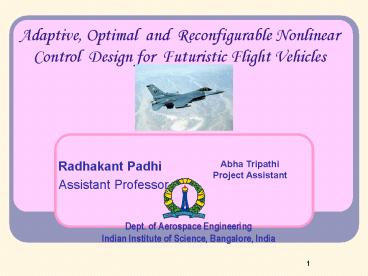
Title: Adaptive, Optimal and Reconfigurable Nonlinear Control Design for Futuristic Flight Vehicles
1
Adaptive, Optimal and Reconfigurable Nonlinear
Control Design for Futuristic Flight Vehicles
- Radhakant Padhi
- Assistant Professor
Abha Tripathi Project Assistant
Dept. of Aerospace Engineering Indian Institute
of Science, Bangalore, India
2
Project Plan
- Date of Commence 1st October 2006
- Project duration 2.5 Years
- Staff members
- Shree Krishnamoorthy, Project Assistant, Oct-Dec
2006. - Kaushik Das, Ph.D. student, January-July, 2007.
- Abha Tripathi, Project Assistant,
Aug.2007continuing. - Apurva chunodhkar, a B. Tech. student from
IIT-Bombay and Siddharth Goyal, a B.E. student
from Punjab Engineering College have worked in
sporadic engagements - Jagannath Rajshekharan, Project Assistant, has
also worked in sporadic engagements
3
Summary
- Two parallel directions have been explored in
this project. - Firstly, a new dynamic inversion approach
has been developed and is experimented on a
low-fidelity model of a high performance aircraft
(F-16). Comparatively, it leads to some potential
benefits - Elimination of non-minimum phase behavior of the
closed loop response - Less oscillatory behavior
- Lesser magnitude of control
- Robustness study was carried out for the above
approach with uncertainties in aerodynamic force
and moment coefficients and inertia parameters
4
Summary
- Secondly, a structured neuro adaptive control
design idea has been developed which treats the
kinematics and dynamics of the problem
separately. - Modeling and parameter inaccuracies are
considered by using neural network which
dynamically capture the unknown functions that
are used to design a model-following adaptive
controller. - Sigma correction was done in the weight update
rule. - This idea is found to be successful on a
satellite attitude problem.
5
Command Tracking in High Performance Aircrafts A
New Dynamic Inversion Design
6
Airplane Dynamics(F-16) Six Degree-of-Freedom
7
Definitions and Goal
- Total Velocity
- Roll Rate (about x-axis)
- Roll Rate (about velocity vector)
- Normal Acceleration
- Lateral Acceleration
- Goal
where are pilot commands
P, Pw, nz, ny, VT
8
Control Synthesis Procedure
- Define new variables
- Key observation
- Known
9
Control Synthesis Procedure
- Longitudinal Maneuver
- Pilot commands
- Roll Rate (bank angle rate)
- Normal Acceleration
- Lateral Acceleration
- Total Velocity
- Lateral Maneuver
- Pilot commands
- Roll Rate (bank angle rate)
- Normal Acceleration
- Lateral Acceleration
- Total Velocity
10
Control Synthesis Procedure
- Combined Longitudinal and Lateral Maneuver
- Pilot commands
- Roll Rate (about velocity vector)
- Normal Acceleration
- Lateral Acceleration
- Total Velocity
11
Control Synthesis Procedure
- Design a controller such that
- After some algebra, Finally
12
Results Longitudinal
Control Variables
Tracked Variables
13
Results Lateral Mode
Tracked Variables
Control Variables
14
Results Combined Longitudinal and Lateral
Tracked Variables
Control Variables
15
Summary
- Existing Method
- Assumption
- Need of integral control
- More number of design parameters (10-12)
- Works
- New Method
- Assumption
- No such need (No wind-up)
- Less number of design parameters (5-7)
- Works better...!
- Lesser control magnitude
- Smoother transient response
- Better turn co-ordination
16
Robustness Study
- Nominal Controller given to the actual system
having uncertainties - Perturbation assumed in the inertia parameters
and aerodynamic force and moment coefficients - Normal distribution used for introducing
randomness in the parameters with mean value as
the nominal value of the parameters and standard
deviation as 1/3 of maximum allowed perturbation
in that parameter.
17
Robustness Study
- Inertia parameters varied from 5 to 10
- Aerodynamic coefficients varied from 1 to 10.
- Simulation were carried out for 50 cases in each
mode. - In each simulation study, the aim was to declare
it as a success or failure
18
Longitudinal Mode
19
Longitudinal Mode
20
Lateral Mode
21
Lateral Mode
22
Lateral Mode
23
Lateral Mode
24
Lateral Mode
25
Combined Mode
26
Conclusion
- When aerodynamic coefficients are perturbed by 5
and the inertia parameters by 10, the controller
is robust - Increase in inertia parameters does not affect
the percentage success - Aerodynamic coefficients are more sensitive than
inertia parameters
27
Enhancement of Robustness
- Augment Dynamic inversion with Neuro -Adaptive
Design
28
Adaptive Approach(Lateral case)
- Nominal Outputs
- Actual Outputs
- Approximate Outputs
29
Adaptive Approach
- Goal
- Strategy
- Steps for assuring
- Solve for adaptive controller
30
Adaptive Approach
- Steps for assuring
- Error
- Error Dynamics
31
Adaptive Approach
- Error Dynamics
- NN Training
- Lyapunov Function Candidate
32
Adaptive Approach
- Weight Update Rule
- Condition For stability
33
A STRUCTURED Approach forAttitude Maneuver of
Spacecrafts
34
Neuro-adaptive Control Generic Theory
- Actual plant
- Total tracking error
- Tracking error dynamics
Assumption
Unknown function
35
Neuro-adaptive Control Generic Theory
- Objective of adaptive controller
- Approximate System
- Model-following strategy
36
Step I Assuring
- Universal approximation property
- Error
- Error dynamics for the individual i th error
channel
Weight vector
Basis function vector
37
Neural Network Training by Lyapunov Analysis
Lyapunov function candidate
38
Neural Network Training with Stability
- Weight Update Rule
- Sufficient condition
- where
39
SATELLITE Attitude Dynamics
- Attitude kinematics
- Angular rate dynamics
Nominal Dynamics
Actual Dynamics
- Objective of Control Design
,
40
Nominal Control Problem Specific Formulation
- Tracking error for nominal system
- Tracking error dynamics
- Solving for nominal control
41
Neuro-adaptive Control Problem Specific
Formulation
- Tracking error for actual plant
- Expanding the following terms as
- Tracking error dynamics
- Basis
- function
- selection
42
Simulation ResultsNominal vs. Adaptive Control
for actual system
(I) Constant disturbances parameter
uncertainties
MRPs
Angular rates
43
Simulation ResultsNominal vs. Adaptive Control
for actual system
(II) Constant disturbances parameter
uncertainties
Unknown function capture
Control
44
Publications
- Conference Publications
- Radhakant Padhi, Narayan P. Rao, Siddharth Goyal
and S.N. Balakrishnan, Command Tracking in High
Performance Aircrafts A new Dynamic Inversion
Design, 17th IFAC Symposium on Automatic control
in Aerospace, Touolose, France. - Apurva Chunodkar and Radhakant Padhi, Precision
attitude Manoeuvers of Spacecrafts in Presence of
Parameter Uncertainities and disturbances A
SMART Approach, 17th IFAC Symposium on Automatic
Control in Aerospace, Touolose, France. - Radhakant Padhi and Apurva Chunodkar,
Model-Following Neuro - adaptive Control Design
for attitude maneuvers for rigid bodies in
Presence of Parametric Uncertainties and
disturbances", International Conference on
advances in Control and Optimization of Dynamical
Systems, Bangalore, India, 2007. - Abha Tripathi and Radhakant Padhi ,Robustness
Study of A Dynamic Inversion Control Law For A
High Performance Aircraft, International
Conference on Aerospace Science And Technology,
to be held on 26 28 June 2008, Bangalore,
India.
45
Publications
- Journal Publications
- Radhakant Padhi, Siddharth Goyal, Narayan P. Rao
and S.N. Balakrishnan, A Direct Approach for
Nonlinear Flight Control Design of High
Performance Aircrafts, Submitted to Control
Engineering Practice. - Jagannath Rajsekaran, Apurva Chunodkar and
Radhakant Padhi, Precision Attitude Maneuver of
Spacecrafts Using Structured Model-Following
Neuro -Adaptive Control, Submitted to Control
Engineering Practice. - Radhakant Padhi and Apurva Chunodkar, Precision
Attitude Maneuver of Spacecrafts Using Model -
Following Neuro Adaptive Control, To appear in
Journal of Systems Science Engineering.
46
Questions And comments
Recommended

