

Radio Pulsars and Gravity Studies Jim Cordes Cornell PowerPoint PPT Presentation
1 / 40
Title: Radio Pulsars and Gravity Studies Jim Cordes Cornell
1
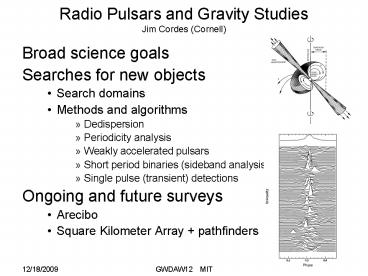
Radio Pulsars and Gravity StudiesJim Cordes
(Cornell)
- Broad science goals
- Searches for new objects
- Search domains
- Methods and algorithms
- Dedispersion
- Periodicity analysis
- Weakly accelerated pulsars
- Short period binaries (sideband analysis)
- Single pulse (transient) detections
- Ongoing and future surveys
- Arecibo
- Square Kilometer Array pathfinders
2
Pulsar Science Drivers
- Extreme matter physics
- Neutron star masses to lt 1
- Equation of state for x10 nuclear density
- High-temperature superfluid superconductor
- Relativistic plasma physics
- B Bq 4.4 x 10¹³ Gauss
- Voltage drops 1012 volts
- FEM 109Fg 109 x 1011FgEarth
- Magnetospheres
- Radiation mechanisms
- Tests of theories of gravity
- Precision timing of binary pulsars
- NS-WD, NS-NS, NS-BH
- nHz gravitational wave detection
- precision timing of millisecond pulsars
- Probes of turbulent and magnetized ISM ( IGM)
- End states of stellar evolution
- Massive stars ? neutron stars or black holes
3
Pulsar Populations to Search For
- Sub-millisecond pulsars
- Plt0.5 ms rules out all equations of state would
require strange stars vs. neutron stars. - Millisecond pulsars
- Pulsar timing array nHz gws
- Slow-pulsars
- Pgt 5 sec requires Bgt1013 G
- Pulsars ? magnetars?
- High-velocity pulsars
- How high? 2000 km s-1?
- Relativistic binaries
- NS-NS with Porblt hours
- NS-BH with Porb lt hours
- Pulsars orbiting the Galactic center
- Sgr A MBH 3?106 M?
log Period derivative (s s-1)
1 ms
1 sec
10 s
Period (sec)
4
Differential rotation, superfluid vortices
Uncertainties in planetary ephemerides and
propagation in interplanetary medium
Interstellar dispersion and scattering
Glitches Spin noise
Emission region beaming and motion
GPS time transfer Additive noise Instrumental
polarization
5
- Worst timing
- Long periods
- Large fields
- Fast spindown
- Issues
- Differential rotation between crust and
superfluid - Torque variations
- Accretion events?
- injected asteroids
log Period derivative (s s-1)
- Best timing
- Short periods
- Small fields
- Slow spindown
Period (sec)
6
MSP J1909-3744 P3 ms WD Jacoby et al.
(2005) Weighted ?TOA 74 ns
Shapiro delay
7
A Single Dispersed Pulse from the Crab Pulsar
S 160 x Crab Nebula 200 kJy Detectable to
1.5 Mpc with Arecibo
8
DedispersionTwo methods
- Coherent
- operates on the voltage proportional to the
electric field accepted by the antenna, feed and
receiver - computationally intensive because it requires
sampling at the rate of the total bandwidth - exact
- for narrow bandwidths, is a dechirping process
- Post-detection
- operates on intensity voltage2
- computationally much less demanding
- an approximation
9
Dispersed Pulse
Coherently dedispersed pulse
?t 8.3 ?s DM ?-3 ??
10
Coherent Dedispersionpioneered by Tim Hankins
(1971)
- Dispersion delays in the time domain represent a
phase perturbation of the electric field in the
Fourier domain - Coherent dedispersion involves multiplication of
Fourier amplitudes by the inverse function, - For the non-uniform ISM, we have
- which is known to high precision for known
pulsars. - The algorithm consists of
- Application requires very fast sampling to
achieve usable bandwidths.
11
Crab 0.4-ns resolutionHankins Eilek 2006
12
Basic data unit a dynamic spectrum
106 108 samples x 64 ?s
- Fast-dump
- spectrometers
- Analog filter banks
- Correlators
- FFT (hardware)
- FFT (software)
- Polyphase filter bank
64 to 1024 channels
P
Current PALFA correlation spectrometers 100
MHz total bandwidth 256? x 4Mt x 7 beams New
polyphase filter bank spectrometer (early
2008) 300 MHz 1024? x 4Mt x 7 beams
13
Pulsar Periodicity Search
1300 trial values of DM
Dedispersion (unknown DM) Power spectrum of each
time series Harmonic summing Threshold
analysis Synchronous sum at candidate P DM
FFT each DMs time series
FFT(f)
14
Pulsar Periodicity Search
1300 trial values of DM
Dedispersion (unknown DM) Acceleration search
(300 values) Power spectrum of each time
series Harmonic summing Threshold
analysis Synchronous sum at candidate P DM
FFT each DMs time series
FFT(f)
15
Example Time Series and Power Spectrum for a
PALFA discovery
Time Series
DM 0 pc cm-3
DM 217 pc cm-3
Where is the pulsar?
16
Example Time Series and Power Spectrum for a
recent PALFA discovery (follow-up data set shown)
Time Series
DM 0 pc cm-3
DM 217 pc cm-3
Here is the pulsar
17
Survey Selection Against Binaries
NS-NS binary
Pulse shape
Phase perturbation
FFT harmonics
Harmonic Sum
18
Dealing With Orbital Motion
- Orbital acceleration reduces the S/N of the
conventional FFT harmonic sum approach
- Long-period binaries T data span length ltlt
Porb - Do nothing different
- Intermediate-period orbits T lt 0.1 Porb
- Acceleration search compensate the time domain
or match filter in the frequency domain according
to an acceleration parameter - Adds another search parameter DM, P, W, a
- Very short period orbits T gt Porb (potentially
gtgt Porb) - Do conventional FFT but search for orbital
sidebands
Ransom, Cordes Eikenberry 2004
19
PMB Single Pulse SearchMcLaughlin et al. (2006)
- Roughly 1/3 of all psrs
- detected with FFT also
- detected in SP search (very few detected with
higher SNR in SP search) - Wide range of single-pulse properties apparent
J18400815 P 1.1 s DM 225 pc cm-3
J18400809 P 0.96 s DM 353 pc cm-3
20
Nature 2006
- 11 sources found in reanalysis of Parkes MB
survey - missed in periodicity search
- Pulse rates 0.3 to 20 pulses hr-1
- Extreme cases of pulse nulling?
- Implied Galactic population normal pulsar
population (i.e. 2?105 objects)
21
7 ALFA Beams Pulsar found through single-pulses,
not periodicity algorithm Algorithm matched
filtering in the DM-t plane. ALFAs 7 beams
provide powerful discrimination between celestial
and RFI transients
22
Science Express 27 Sep 2007
W 4.6 ms (? / 1.4 GHz)-4.8?0.4 DM 375 pc
cm-3 Steep spectrum (?-4)
23
Parkes SP (if Dgt500 Mpc)
Hansen Lyutikov 2000
? Prompt GRBs and GRB afterglows easily seen to
cosmological distances
Giant pulses detectable to Virgo cluster Radio
magnetars detectable to Virgo ET radar across
Galaxy
24
Pulsar Search Domains
25
Birth Rates and Population Numbers(Excludes
transients)
- full Galactic census of these NS sub-
populations - Arecibo 10 SKA in A/T
- The SKA will provide the ultimate NS census in
the Galaxy
26
Pulsars vs DM and Galactic Longitude
Contours based on Galactic electron density model
NE2001 (Cordes Lazio 2002)
27
Parkes Multibeam Galactic Plane Pulsar Survey
- Most successful survey to date
- 800 new pulsars
- Gain 0.7 K Jy-1
- 1.4 ? 0.144 GHz
- -100? lt l lt 50? and b lt 5?
- 13 ? 14 arcmin beams
- ?t 250 ?s, ?? 3 MHz, T 2100 s
- Data sets 96 channels x 8.4?106 s ? 1 bit /beam
- 3100 total pointings
- Raw data (mostly) saved 4 TB
Also, high-latitude survey for MSPs, binaries
28
(No Transcript)
29
First Double Pulsar J0737-3039
Lyne et al.(2004)
- Pb2.4 hrs, d?/dt17 deg/yr
- MA1.337(5)M?, MB1.250(5)M?
Now to 0.05
30
Globular Cluster Pulsars
Disproportionate ratio of MSPs/binaries to
canonical pulsars due to exchange reactions in
dense clusters
Terzan 5 33 pulsars, mostly MSPs Ransom et al.
2005, Science, 307, 892 PSR J1748-2446ad fastest
spin (716 Hz) (Hessels et al. 2006)
Ransom 2007
31
Arecibo Pulsar and Transients Survey using ALFA
- ALFA Arecibo L-band Feed Array (1.4 GHz, 7
beams) - Galactic plane survey initially
- Higher latitudes (MSPs, BNSs) later
- 5 year
- 103 pulsars to be detected
- Transient detection
- Commensal HI, SETI surveys
32
(No Transcript)
33
PALFA Survey Goals
- Arecibo can provide the most sensitive
high-frequency surveys until the SKA (but c.f.
sky coverage) - 500 - 103 pulsars
- Galactic plane survey blt5?, 32? lt l lt 77?,
300s dwell times - Intermediate latitude survey 5? lt b lt 15? for
MSPs, NS-NS - 64 ?s, 256 channels across 100 MHz with current
spectrometers - Reach edge of Galactic population for much of
luminosity function - High sensitivity to millisecond pulsars (smearing
120 ?s for DM 100) - Dmax 2 to 3 times greater than for Parkes MB
- Sensitivity to transient sources (algorithms)
- Data management
- Keep all raw data
- 1 Petabyte after 5 years at the Cornell Center
for Advanced Computing - Database of raw data, data products, end products
- Virtual observatory linkage eventually
34
Some PALFA Survey Results
- Pulsars and Gravity
- Relativistic binaries (NS-WD, NS-NS, NS-BH) as
laboratories for testing GR in the strong-gravity
limit - J19060746 (second born NS in NS-NS system)
- 144 ms, 3.98 hr orbit
- Paper in preparation (Kasian et al.)
- Pulsar timing array objects millisecond pulsars
with low timing noise that allow detection or
strong limits on nHz gravitational-wave
backgrounds - J190303, 2.15 ms (Champion et al.)
- High-energy/radio-pulsar synergies
- J19281746 (68 ms pulsar in EGRET error box)
- Intermittent pulsars (RRAT like)
- J062809 7 others
- Galaxy/Interstellar Medium
- Large number of pulsars allows modeling of
electron density and magnetic field (DM, SM, RM
multi-? obs)
35
Arecibo transient object
36
Matched filtering in the time-frequency domain
Allow more signal classes than is typically
looked for in radio pulsar searches ( SETI)
Post-detection dedispersion sum intensity along
dispersion path Coherent dedispersion unwrap
phases
37
Galactic Center Search
- GBT pathfinder
- EVLA better for targeted search
- SKA may be required to reap the full benefits
(timing precision, relativity, etc.) of GC
pulsars - ? gt 10 GHz ?? gt 1 GHz
- Fast dumps (0.1 to 1 ms)
- Moderate channelization
- ??ch 10 MHz (?/10 GHz)3
- Single-pixel ok
- GBT current programs use the GBT correlator (0.8
GHz bw at 5 and 9 GHz) - Higher frequencies better, more bandwidth needed
- Zpectrometer with 10 GHz bandwidth between 10
and 20 GHz may be optimal if dump times can be
shortened to 1 ms
38
Timeline
MeerKAT
10 SKA Phase I
ATA
LOFAR
MIRA ? ASKAP
MWA/LFD
Full SKA
LWA
39
Size
ATA
LOFAR
MeerKAT
Full SKA
ASKAP
SKA Phase I
40
Wide FoV Non-Imaging Surveys
- Pixelization of the field of view
- Correlation approach favored over beam forming
- Number of pixels
- Number of operations to form pixels petaops
- Sky coverage
- Raster scanning (slow transients)
- Staring (fast transients)
- Analysis
- Full search analysis on each pixel
- Extensive for pulsars and fast transients
- E.g. 1024 frequency channels ? 64 ?s samples from
each pixel - Frequency-time plane analysis for all cases to
discriminate RFI from celestial signals
41
Summary/Comments
- The pulsar yield will continue to grow
- 104 pulsars or bust by 2020
- 300 pulsars are routinely timed
- Jodrell Bank, Parkes, Nancay
- Arecibo, GBT for weaker pulsars
- Allen Telescope Array (SKA precursor) ramping up
- Pulsar distances
- VLBI parallaxes to 4 kpc, can expect 10 kpc in
future - Galactic electron density models NE2001 ? NE2007
- Radio pulsar connectivity to program of
gravitation science - Obvious radio discovered targets (MSPs,
binaries) - Open ended transient radio sources
- Algorithm development
- Budget-cut vulnerability to budget cuts similar
to LISA - Importance of Decadal Survey for existing radio
facilities follow-ons (SKA pathfinders, SKA)
42
Extra Slides
43
astro-ph/0605145
- Asteroid disk from SN fallback material
- Only 10-4 Earth masses needed to provide
enough material to perturb coherent radiation
from a pulsar over its 10 Myr lifetime - Asteroids evaporate at 109 cm from the NS and
trigger or quench pair production from gaps in
the magnetosphere - Expect induced torque fluctuations
44
Asteroids around Pulsars
Asteroid belts can produce significant timing
noise in MSPs from orbital recoil, influencing
the convergence of relativity tests, mass
determinations, etc.
Long-P pulsars accreted asteroids will produce a
random walk in spin phase from torque pulses
Direct detection of tenuous disks is difficult
with current telescopes but may be likely with
the SKA
Recommended

