

Hand in packet W'S' 1'4 before the bell rings please PowerPoint PPT Presentation
1 / 19
Title: Hand in packet W'S' 1'4 before the bell rings please
1
Class Topics
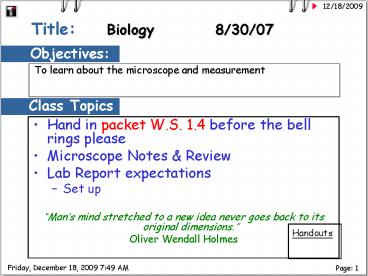
Title Biology 8/30/07
Objectives
- To learn about the microscope and measurement
- Hand in packet W.S. 1.4 before the bell rings
please - Microscope Notes Review
- Lab Report expectations
- Set up
- Mans mind stretched to a new idea never goes
back to its original dimensions. - Oliver Wendall Holmes
Handouts
Friday, December 18, 2009 749 AM
2
Class Assignments
By When
What
- Packet W.S. 1.4 8/30/07
- Microscope Prelab set up 8/31/07
- Microscope Lab report 9/4/07
- Due this class period
- Due next class period
- Due in the future
3
Characteristics of Microscopes
- Magnification
- Image appears larger than it is
- Eyepiece 10x
- Objectives 4x, 10x, 40x
- Resolution
- Clarity of the image
- Gets poorer with increased magnification
4
Microscopes
- Simple light microscope
- One lens
- Living or dead specimen
- Compound light microscope
- more than one lens
- resolution is a problem
- Must be transparent
- (very thin)
- Living or dead specimen
5
Microscopes
- Electron microscopes - use a beam of electrons
(dead specimen) - Transmission (TEM)- electrons pass through - very
thin specimen - Scanning (SEM)- electrons bounce off and get an
image from the outside - Scanning tunneling
- Uses a microprobe
- Can be used on living or dead organisms
6
Magnifications
- Simple light 5-25x
- Compound light 2000x
- Electron microscopes
- SEM 200,000x
- TEM 2,000,000x
- Scanning tunneling 1,000,000,000x
7
Compound Light Microscope Parts
- Eyepiece
- Tube
- Revolving Nosepiece
- Objectives
- Base
- Stage
- Stage clips
- Diaphragm, iris, condenser
8
Mitochondrion
Parasitic insect emerging from host
9
Mouse lung
DNA
10
Examples from light microscopes
Pseudostratified ciliated columnar epithleium
Simple columnar epithelium
11
Lab Reports
- Lab Journal
- Table of contents
- Experiment number, title of experiment, and page
number in the notebook - Use on front sides of pages, do not skip pages
12
Prelab Preparations
- List your name, your partners name, and class
period in the upper right hand corner of the page
- First section
- Purpose/Question
- Typically a single sentence
- Hypothesis
- What do you think the answer to your questions
is? - Rationale
- Why do you think your hypothesis is correct?
- Skip a line between each answer and three between
section 1 and section 2
13
Second Section
- Materials
- List all materials used
- Procedure
- Summarize the procedure used for the
investigation - Can be a list or flow chart needs to be easily
read - Getting Ready
- 1. What potential procedural problems do I want
to avoid to eliminate error? - 2. What safety precautions must be taken?
- 3. How will I analyze the data?
- Be specific
Skip a line between each answer and three between
section 2 and section 3
14
Prelab preparation
- Sections 1 and 2 can (and should) be completed
prior to coming to class - They must be initialed by a teacher as completed
before you can start the lab! - Section 3 can be prepared before class, but not
completed
15
Third Section
- Results
- Dominated by tables/drawings
- Construct the table clearly (use a ruler)
- Information should be written as collected
- Not copied from lab partner at a later time
- Must be clearly labeled and include units
- Statements for observations
16
Third Section
- Analysis
- Show your work from Statement 3 of getting
ready - Sample calculation
- Word equation
- Quantatitive equation
- Graphs (of data in tables)
- Number and title graphs
- Neat and sized appropriately
- Axis labeled with units
- Independent on x an dependent on y
17
Fourth Section
- Conclusion
- What is the significance or meaning of the
results? - Written in third person passive
- Summarize the results
- Detailed discussion of the results
- How do the results compare to what you expected?
- Can compare with results of others
- What factors might have contributed to errors in
the results - Analyze experimental error
18
The Parts of a Light Microscope
- eyepiece (ocular lens)
- body tube
- objectives- High, Low, Medium
- diaphragm
- base
- arm
- stage
- slide clips
- focus knobs- coarse adjustment, fine adjustment
- light source
19
(No Transcript)
Recommended

