

Problems with Isomap, LLE and other Nonlinear Dimensionality Reduction Techniques PowerPoint PPT Presentation
1 / 19
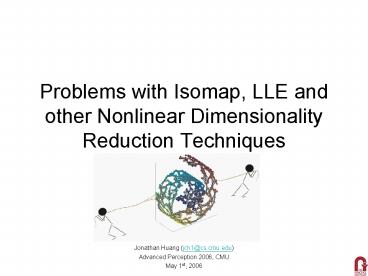
Title: Problems with Isomap, LLE and other Nonlinear Dimensionality Reduction Techniques
1
Problems with Isomap, LLE and other Nonlinear
Dimensionality Reduction Techniques
- Jonathan Huang (jch1_at_cs.cmu.edu)
- Advanced Perception 2006, CMU
- May 1st, 2006
2
ISOMAP Algorithm Review
- Connect each point to its k nearest neighbors to
form a graph - Approximate pairwise geodesic distances using
Dijkstra on this graph - Apply Metric MDS to recover a low dimensional
isometric embedding
3
Questionable Assumptions
- ISOMAP can fail in both of its steps, (during the
geodesic approximation and during MDS) if the
assumptions which guarantee success are not met - Geodesic Approximation
- Points need to be sampled uniformly (and fairly
densely) from a manifold with no noise - The intrinsic parameter space must be convex
- MDS
- There might not exist an isometric embedding (or
anything close to one)
4
ISOMAP Topological Instabilities
- ISOMAP is prone to short circuits and topological
instabilities - Its not always clear how to define neighborhoods
- We might get a disconnected graph
5
ISOMAP Convex Intrinsic Geometry
- Image databases (Donoho/Grimes)
Input Data
ISOMAP output
6
ISOMAP Nonconvex Intrinsic Geometry
- Problems in estimating the geodesic can arise if
the parameter space is not convex - Examples (S1 topology, Images of a rotating
teapot)
Input Data
ISOMAP output
eigenvalues
Images by Lawrence Saul and Carrie Grimes
7
ISOMAP Nonconvex Intrinsic Geometry
- ISOMAP can fail for
- Occlusions
- Periodic Gaits
(Is this guy wearing clothes???)
Images by Lawrence Saul and Carrie Grimes
8
ISOMAP Complexity
- For large datasets, ISOMAP can be slow
- k-nearest neighbors scales as O(n2 D) (the naïve
implementation anyway) - Djikstra scales as O(n2 logn n2 k)
- Metric MDS scales as O(n2 d)
- One solution is to use Nystrom approximations
(Landmark ISOMAP) - But we need lots of points to get an accurate
approximation to the true geodesic!
9
ISOMAP Dimensionality Estimation
- Preserving distances may hamper dimensionality
reduction! - Gauss Theorema Egregium says that some objects
just cant be embedded isometrically in a lower
dimension - (The intrinsic curvature of a surface is
invariant under local isometry) - It is sometimes possible to figure out the
intrinsic dimension of a surface by looking at
the spectrum given by MDS. This will not work
for a large class of surfaces though.
Fish Bowl Dataset
ISOMAP embedding
A Better embedding
10
ISOMAP Weakness Summary
- Sensitive to noise (short circuits)
- Fails for nonconvex parameter spaces
- Fails to recover correct dimension for spaces
with high intrinsic curvature - Slow for large training sets
11
LLE Algorithm Review
- Compute the k nearest neighbors
- Solve for the weights necessary to reconstruct
each point using a linear combination of its
neighbors - Find a low dimensional embedding which minimizes
reconstruction loss
12
LLE
- LLE has some nice properties
- The result is globally optimal
- The hardest part is a sparse eigenvector
problem - Does not worry about distance preservation (this
can be good or bad I suppose) - But
- Dimensionality estimation is not as straight
forward - There are no theoretical guarantees
- Like ISOMAP, it is sensitive to noise
13
LLE Estimating Dimension
- The eigenvalues of the matrix do not clearly
indicate dimensionality!
14
LLE
- Dependency on the size of the neighborhood set
(ISOMAP also has this problem)
15
LLE Alternative
- In contrast to ISOMAP, LLE does not really come
with many theoretical guarantees - There are LLE extensions that do have guarantees
e.g. Hessian LLE
16
LLE
- Versus PCA on Digit Classification
- Is Dimensionality Reduction really the right
thing to do for this supervised learning task? - Does the space of handwritten digits have
manifold geometry?
17
General Remarks
- ISOMAP, LLE share many virtues, but they are also
marred by the same flaws - Sensitivity to noise
- Sensitivity to non-uniformly sampled data
- No principled approaches to determining intrinsic
topology (or dimensionality for that matter) - No principled way to set K, the size of the
neighborhood set - Dealing with different clusters (connected
components) - No easy out-of-sample extensions
18
More General Remarks
- Manifold Learning is not always appropriate!
- Example PCA is often bad for classification
- When does natural data actually lie on manifold?
- How do we reconcile nonlinear dimensionality
reduction with kernel methods? - There is very little work thats been done on
determining the intrinsic topology of high
dimensional data (and topology is important if we
hope to recover natural parameterizations)
19
References
- J. B. Tenenbaum, V. De Silva, and J. C. Langford.
A global geometric framework for nonlinear
dimensionality reduction. Science, 2902319-2323,
2000. - Sam Roweis Lawrence Saul. Nonlinear
dimensionality reduction by locally linear
embedding. Science, 2902323-2326, 2000. - David Donoho and Carrie Grimes. Hessian
Eigenmaps New Locally-Linear Embedding
Techniques for High-Dimensional Data. PNAS 100
(2003) 55915596. - David Donoho and Carrie Grimes. Image manifolds
which are isometric to Euclidean space. TR2002-27
(Dept. of Statistics, Stanford University,
Stanford, CA). 2002. - Lawrence K. Saul Sam T. Roweis. Think Globally,
Fit Locally Unsupervised Learning of Low
Dimensional Manifolds. JMLR, v4, pp. 119-155,
2003.
Recommended

