

Chapter 11 The Islamic World Section 1: The Rise of Islam PowerPoint PPT Presentation
1 / 21
Title: Chapter 11 The Islamic World Section 1: The Rise of Islam
1
Chapter 11 - The Islamic WorldSection 1 The
Rise of Islam
2
- The Story Continues
- By the end of the a.d. 400s, the Western Roman
- Empire had collapsed. In the eastern part of the
- empire, the Byzantine culture thrived and
- preserved the learning and scholarship of
- ancient Greece and Rome. Meanwhile, south and
- east of the Byzantines, another vast empire was
- developing in the Arabian Peninsula. It had its
- own thriving economy based on trade. In this
- chapter you will learn about a new religion that
- inspired this empire and encouraged its growth.
- You will also learn about the achievements of
- this culture in the arts and sciences.
3
I. Arabia Its Geography and People
- The Arabian Peninsula is bordered by the
- Arabian Sea, the Persian Gulf, the Red Sea,
- and the Syrian Desert
4
I. Arabia Its Geography and People
- Except for a narrow strip along the coasts,
- most of the Arabian Peninsula is desert
5
I. Arabia Its Geography and People
- Bedouins herded sheep and camels and were
- organized into tribes led by a sheikh
6
I. Arabia Its Geography and People
- Along the coasts towns grew up and the
- townspeople became traders
7
I. Arabia Its Geography and People
- One important trade center was Mecca,
- located on a caravan route running north
- across the desert to Syria
8
II. The Prophet Muhammad
- About A.D. 570, Muhammad was born in
- Mecca and made a living as a caravan trader
Birth of the Prophet Muhammad
9
II. The Prophet Muhammad
- When he was about 40, the angel Jibreel
- (Gabriel) appeared and told him that he was
- to be a prophet of Allah
Muhammad's Call to Prophecy and the First
Revelation
10
II. The Prophet Muhammad
- The rulers of Mecca opposed Muhammads
- teaching because his ideas threatened their
- authority
11
II. The Prophet Muhammad
- They feared that his monotheistic teachings
- might stop pilgrimages to the Kaaba
12
II. The Prophet Muhammad
- In A.D. 622, Muhammad and his followers
- moved from Mecca to Yathrib - the hijrah
13
II. The Prophet Muhammad
- Yathrib was renamed Medina and the year of
- the hijrah became the first year of the Muslim
- calendar
14
II. The Prophet Muhammad
- Muhammad gained many followers and
- tensions between Mecca and Medina led to
- war
Muhammad and his companions advancing on Mecca.
The angels Gabriel, Michael, Israfil and Azrail,
are also in the painting
15
II. The Prophet Muhammad
- In A.D. 630 Mecca was defeated and
- Muhammad destroyed the idols in the Kaaba
- and dedicated it to Allah
Muhammad re-dedicating the Black Stone at the
Kaaba
16
II. The Prophet Muhammad
- By 632, many Arabs had become followers of
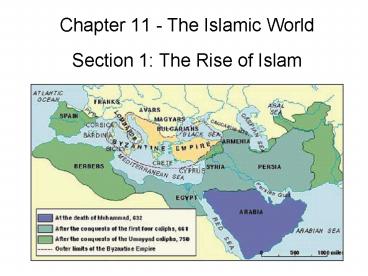
- Islam, which spread across the Middle East
- and into North Africa
17
III. The Faith of Islam
- Islam is based on the beliefs that there is only
- one God (Allah) and each believer must obey
- Gods will
Allah is One
18
III. The Faith of Islam
- Followers of Islam are called Muslims and
- their holy book is the Quran (Koran)
19
III. The Faith of Islam
- The Quran contains the Five Pillars of Islam
- and the importance of the jihad
20
III. The Faith of Islam
- The Quran was written only in Arabic because
- Muslims believed that Gods revelations might
- be lost or changed
21
III. The Faith of Islam
- Arabic became the common language of
- Muslims in religion, law, literature and trade
Recommended

