

Objectives: Eigenfunctions Fourier Series of CT Signals Trigonometric Fourier Series Dirichlet Condi PowerPoint PPT Presentation
1 / 13
Title: Objectives: Eigenfunctions Fourier Series of CT Signals Trigonometric Fourier Series Dirichlet Condi
1
LECTURE 08 FOURIER SERIES
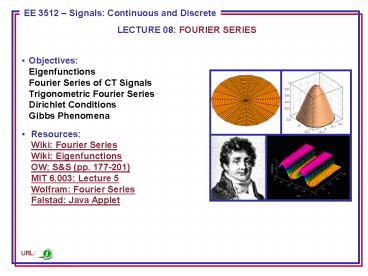
- ObjectivesEigenfunctionsFourier Series of CT
SignalsTrigonometric Fourier SeriesDirichlet
ConditionsGibbs Phenomena - ResourcesWiki Fourier SeriesWiki
EigenfunctionsOW SS (pp. 177-201)MIT 6.003
Lecture 5Wolfram Fourier SeriesFalstad Java
Applet
2
Representation of CT Signals (Again!)
- What is an example of a function when applied to
an LTI system produces an output that is a
scaled version of itself? - The scale factor, ?k, is referred to as an
eigenvalue. The function, ?k, is referred to as
an eigenfunction. - Using the superposition property of LTI systems
- This reduces the problem of finding the response
of any LTI system to any signal to the problem of
finding the ?k. - What types of things influence the values ?k?
We will soon see that the frequency response of
this LTI system is one thing that will influence
the shape of the output. - We will later generalize this concept of
eigenvalues and eigenfunctions to many types of
engineering systems and analyses. - The Fourier series is one of many ways to
decompose a signal.
3
Eigenfunctions and LTI Systems
4
Response of a CT LTI System
- Complex exponentials are always eigenfunctions
for an LTI system and extremely useful because
the output is a scaled version of the input
5
(Complex) Fourier Series Representations
- What types of signals can be represented as sums
of complex exponentials? - CT s j? (Fourier Transform) ? signals of the
form ej?t - DT z ej? (z-Transform) ? signals of the form
ej?n - These representations form the basis of the
Fourier Series and Transform. - Consider a periodic signal
- Consider representing a signal as a sum of these
exponentials - Notes
- Periodic with period T
- ck are the (complex) Fourier series
coefficients - k 0 corresponds to the DC value k 1 is the
first harmonic
6
Alternate Fourier Series Representations
- For real, periodic signals
- These are essentially interchangeable
representations. For example, note - The complex Fourier series is used for most
engineering analyses. - How do we compute the Fourier series
coefficients? - There are several ways to arrive at the equations
for estimating the coefficients. Most are based
on concepts of orthogonal functions and vector
space projections.
7
Vector Space Projections
- How can we compute the Fourier series
coefficients? - One approach is to use the concept of a vector
projection - How do we find the components
- We project the vector onto the
correspondingaxis using a dot product. - Note that this works because the three axesare
orthogonal - We can apply the same concept to signals using
the notion of a Hilbert space in which each axis
represents an eigenfunction (e.g., cos() and
sin())
8
Computation of the Coefficients
- We can make use of the principle of orthogonality
in the Hilbert space - (This can be thought of as an inner product.)
- We can apply this to our Fourier series
- Using the inner product
- This gives us our Fourier series pair (?02?/T)
(synthesis)
(analysis)
9
Example Periodic Pulse Train
10
Convergence of the Fourier Series
- How can a series composed of continuous functions
(e.g., sines and cosines) approximate a
discontinuous function, such as a square wave? - Conditions for which the error in this
approximation will tend to zero - x(t) is absolutely integrableover one period
- In a finite time interval, x(t)has a finite
number of maxima and minima. - In a finite time interval, x(t) has a finite
number of discontinuities. - These are known as the Dirichlet conditions. They
will be satisfied for most signals we encounter
in the real world. This implies
11
Gibbs Phenomena
- Convergence in error can have some interesting
characteristics - This is known as Gibbsphenomena and was
firstobserved by Albert Michelsonin 1898. - The Fourier series of a squarewave is plotted as
a function ofN, the number of terms in
thefinite series. - The limit as N?? is the averagevalue of x(t) at
the discontinuity. - The squared error does converge
12
Summary
- Introduced the concept of eigenvalues and
eigenfunctions. - Developed the concept of a Fourier series.
- Discussed three representations of the Fourier
series. - Derived an expression for the estimation of the
coefficients. - Derived the Fourier series of a periodic pulse
train. - Introduced the Dirichlet conditions and Gibbs
phenomena. - Discussed convergence properties.
13
Appendix Nonlinear Amplifier
- Assume we apply a sinewave input to avoltage
amplifier under two conditions - Linear
- In this case, the output is
- The output is a scaled version of the input.
- Nonlinear
- Hence, the output signal is at a frequency twice
that of the input, which clearly makes this a
nonlinear system. - In practice, amplifiers, such as audio power
amplifiers, are characterized using a power
series - A single sinewave input generates many
frequencies, all harmonically related to the
input frequency. This distortion is characterized
by figures of merit such as total harmonic
distortion and intermodulation. See audio system
measurements for more information.
vout
vin
Recommended

