

33 Miles 9 SE Wisconsin stops PowerPoint PPT Presentation
1 / 23
Title: 33 Miles 9 SE Wisconsin stops
1
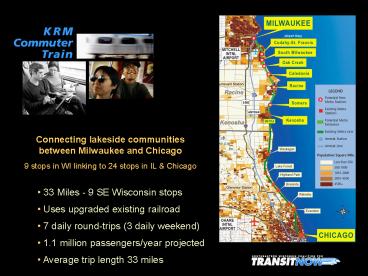
Connecting lakeside communities between
Milwaukee and Chicago 9 stops in WI linking to 24
stops in IL Chicago
- 33 Miles - 9 SE Wisconsin stops
- Uses upgraded existing railroad
- 7 daily round-trips (3 daily weekend)
- 1.1 million passengers/year projected
- Average trip length 33 miles
2
How is commuter rail different from other forms
of rail?
- Commuter Rail
- Frequent stops
- Connects urban areas in local region
- Diesel locomotives
- Several passenger coaches
- Shared right-of-way
- Board from platforms
- Typical trip is 10 minutes - 1 hour
3
How is commuter rail different from other forms
of rail?
- Light Rail
- Very frequent stops
- Connects neighborhoods and immediate suburbs to
densely populated central city - Generally runs on rails in streets or
right-of-way, and is powered by overhead
electrical wires. - Board from the curb or platform
- Typical trip is 5 minutes to 20 minutes
4
How is commuter rail different from other forms
of rail?
- High speed rail
- Very infrequent stops, speed is priority
- Connects large cities in region and nation.
- Diesel locomotives
- Dozens of passenger coaches
- Shared right-of-way
- Luggage storage, food service, sleeping cars
- Board from platforms
- Typical trip is from 1 hour to a day or more
5
PotentialFares,Travel Times
- Fares potentially similar to bus
- One way fares from 1.80 - 8.20
- Milwaukee to Chicago 8.20
- Milwaukee to Kenosha 4.20
- Milwaukee to Racine 3.40
- Discounts on 10-ticket packages, week end
passes, and 1 month passes are typical
- Trip times similar to driving
- Milwaukee to
- Chicago 215
- Kenosha 57
- Racine 42
- Cudahy (airport stop) 15
6
Catalyzing a Globally Competitive Region
Connecting multiple metro areas in a bi-state
region
- Access to jobs, employees, and customers
- Build Competitive Advantage Attract retain
talent, businesses jobs - Revitalize cities, generate urban investment
- Improve property values tax base
- Serve unemployed/underemployed people
- Reduce congestion, improve air quality
7
Catalyzing a Globally Competitive Region
Role of Cities
- Changing real estate market.
- Mixed use and access to rail transit are big
attractors - High quality urban lifestyle in high demand
- Site selection criteria for new economy companies
- Connectivity 85
- Proximity to transit 77
- Proximity to clients 50
- Changing demographics of metro areas
- Single person households, couples with no
children, creative class, and empty nesters are
on the rise and want urbanity
8
Catalyzing a Globally Competitive Region
City/Suburb Economic Link
- Increases in city economic gain accelerate
suburban economic gain. - Commuter rail provides easy access to suburban
and urban living that increases metro regions
overall attractiveness. - The regional economy is larger than the sum of
its parts.
Graph source American Public Transportation
Association
9
Catalyzing More OpportunityBetter Return on
Investment
TOD is the key to higher returns
- Walkable, pedestrian friendly
- Connected to surrounding areas
- Moderate or higher Density
- Mixed Uses, mixed income
- Diversity of housing types
- Street orientation of housing/retail
- Shared parking
- Both origins and destinations
10
Catalyzing More OpportunityBetter Return on
Investment
Trend toward urbanism and transit connectivity
- Weve seen astonishing growth along commuter
rail lines nationally. The opportunity for
housing, commercial, and mixed use development is
at an all-time high. Transit-oriented development
is one of the best available investment
opportunities. - Jon M. Roberts, Managing Director, TIP
Strategies, Inc., Austin, TX
Federal Transit Administration Number of buyers
and renters seeking housing near public
transportation will rise to almost 15 million by
2025.
11
Catalyzing More OpportunityBetter Return on
Investment
National stats on property values, investment
opportunity
- San Diego 47 premium for condos near Coaster
stations - 17 premium for single-family and
multi-family homes - 70-91 premium for parcels near downtown
Coaster stations - Boston 6.7 increase in value of single
family homes in communities w/commuter rail - Chicago area 36,000 premium on homes within a
half mile of Metra station. - Portland Over 1.3 billion worth of
development exceeding ten million
sf are under construction or completed,
adjacent to new MAX line. - Dallas 800M in development, 3.7B in
economic activity
12
Catalyzing More OpportunityBetter Return on
Investment
- Example Kenosha
- 175 mil. in 5 new developments w/in 1 mile of
Metra station - HarborPark, 100 mil, 69 acre, 250 units
- Residential unit resale prices have increased 50
in 5 or less years - High demand Most units were pre-sold
- Over 100,000 sf of redevelopment opportunities
near station on the cusp - Proximity of the lake, Metra
station, and downtown amenities are a
powerful draw. Zohrab Khaligan, City of
Kenosha Community Development Specialist
13
Catalyzing More OpportunityBetter Return on
Investment
- Example Racine, Pointe Blue
- 200 mil., 500 unit mixed-use near station
- 900,000 - 200,000, pre-selling briskly
- Interest high from entire corridor
- Phenomenal responsetheres tremendous pent-up
demand Scott Fergus - KRM is the largest single factor for the future
vibrancy and growth of Racine. When people hear
that they could have a boat, live on the lake and
be within minutes of commuter rail, they just
light up! That's an unbeatable package.
John
Dickert, Lead Broker
14
Catalyzing More OpportunityBetter Return on
Investment
- National Perspective The KRM corridor has a rare
and dynamic convergence of major
selling points
For KRM the national perspective is critical.
Youve got a truly rare combination of commuter
rail accessibility, a prime lakefront, excellent
land availability and redevelopment potential
in a dense economic corridor connected to
Chicago, and increasing TOD and urban
desirability. Its a golden opportunity. Jon
M. Roberts, Managing Director, TIP Strategies,
Inc., Austin, TX Consultant for Racine County
Strategic Economic Development Plan
15
Catalyzing More OpportunityBetter Return on
Investment
- Oak Creek Lakeview Village Master Developer
Agreement - Public/private partnership
- IRG (Industrial Realty Group), CA
- 470 acres, including brownfield areas
- Adjacent to planned train station
- Moving Lakeview project forward
- Unified master plan and timeline
- Brownfield remediation and support
- Partner with developers to ensure plan fit
- Purchase and develop some parcels
- Increase value of all parcels and projects
Original plan. New plan to come
16
Catalyzing More OpportunityBetter Return on
Investment
- Example Milwaukee, opportunity is ripe
- KRM will fuel Milwaukees urban renaissance
- Businesses want commuter rail connectivity
and access to the regional labor market - Commuter rail is a strong selling point for
urban residential buyers, commercial
businesses - Dedicated shuttle is planned to circulate
key destinations
Milw. Intermodal Station
By 2020 KRM could help spur 450,000 sf of new
retail 1 mil. sf of offices 4,520 new housing
units Daily Reporter July 26, 2006
17
Where are we?
- The process
- Feasibility Study
- Detailed Planning Study Alternatives Analysis
- Environmental Impact Study and Federal
Evaluation - Preliminary Engineering
- Final Engineering Design
- Construction, Equipment Acquisition
- Operation (2010/11)
18
Catalyzing More OpportunityBetter Return on
Investment
- TOD Planning, 9 station areas
- Public involvement and consensus
- Unified master plans
- Clarity and consensus on vision and policies
- TOD-supporting policies and regulations
- Real estate market analysis
- Land assembly in some cases
- Official TOD plan endorsements in Fall 06
19
Catalyzing a Globally Competitive Region
U.S. Cities over 300,000 (In addition to New
York, Los Angeles, Chicago)
- Houston
- Philadelphia
- Phoenix
- San Diego
- Dallas
- San Antonio
- Detroit
- San Jose
- Indianapolis
- San Francisco
- Jacksonville
- Long Beach
- Columbus
Austin Baltimore Memphis Milwaukee Boston Washingt
on D.C. El Paso Seattle Denver Nashville Charlotte
Fort Worth
Portland Oklahoma City Tucson New Orleans Las
Vegas Cleveland Long Beach Alburquerque Kansas
City Fresno Virginia Beach Atlanta
Sacramento Minneapolis Santa Ana Honolulu Miami Co
lorado Springs St. Louis Wichita Pittsburgh Tampa
Cincinnati Anaheim
20
Catalyzing a Globally Competitive Region
6 Large U.S. Cities without Rail Transit (or rail
transit in development)
- Houston
- Philadelphia
- Phoenix
- San Diego
- Dallas
- San Antonio
- Detroit
- San Jose
- Indianapolis
- San Francisco
- Jacksonville
- Columbus
Austin Baltimore Memphis Milwaukee Boston Washingt
on D.C. El Paso Seattle Denver Nashville Charlotte
Fort Worth
Portland Oklahoma City Tucson New Orleans Las
Vegas Cleveland Long Beach Alburquerque Kansas
City Fresno Virginia Beach Atlanta
Sacramento Minneapolis Santa Ana Honolulu Miami Co
lorado Springs St. Louis Wichita Pittsburgh Cincin
nati Anaheim Tampa
21
Key Milestones
- Fall 06 TOD plans endorsed at all station
communities - Early 07 Financing and management recommendation
(RTA)Early-Mid 07 Public dialog and consensus
building on KRM funding/structure - Early 07 KRM Public Hearings
- Spring 07 State budget process
- Summer 07 Capital funding application to Federal
Transit Administration - Mid/late 07 Federal response to capital funding
request, next step begins
22
Building Broad-BasedSupport and consensus
OrganizationsWorkforce Development Chambers of
CommerceBIDsMinority Realtors
EnvironmentalTransportationLand useDisability
Convention and Visitors HomelessNeighborhood
AssociationsTaxpayers Associations
- Business
- Economic Development Interests
- Elected Officials
- Labor
- Education
- Community Activists
- Environmental
- Faith-Based
Public hearings 1300 in favor of commuter rail,
20 opposed
23
Building Broad-BasedSupport and consensus
- Transit NOWs Unique Role
- Public outreach and consensus building - critical
to KRM success - Coordinate stakeholders and champions
- Regional communications hub
- Bring stakeholder views to the table
- Proactive technical and strategy advisement
Recommended

