

Introduction To Particle Filtering: PowerPoint PPT Presentation
1 / 23
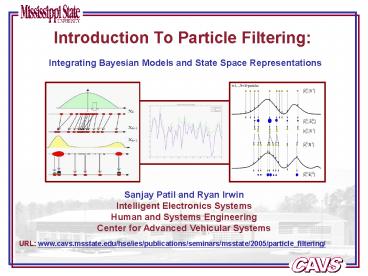
Title: Introduction To Particle Filtering:
1
Introduction To Particle Filtering
Integrating Bayesian Models and State Space
Representations
Sanjay Patil and Ryan Irwin Intelligent
Electronics Systems Human and Systems
Engineering Center for Advanced Vehicular
Systems URL www.cavs.msstate.edu/hse/ies/publica
tions/seminars/msstate/2005/particle_filtering/
2
Abstract
- Conventional approaches to speech recognition
use - Gaussian mixture models to model spectral
variation - Hidden Markov models to model temporal variation.
- Particle filtering
- is based on a nonlinear state space
representation - does not require Gaussian noise models
- can be used for prediction or filtering of a
signal - Approximates the target probability distribution
(e.g. amplitude of speech signal) - also known as survival of the fittest, the
condensation algorithm, and sequential Monte
Carlo filters.
3
- State-Space Representation
General discrete-time nonlinear, non-Gaussian
dynamic system
? State equation
? Observation (measurement) equation
- Where,
- Xt ? state vector
- Yt ? noisy observation vector
- Ut, Vt ? noise vectors
- Nt ? input (usually, not considered)
- ft(.) ? system transition function (state
transition matrix) - gt(.) ? measurement function (observation
matrix)
4
- Nonlinear State Space Model Phase Lock Loop
A device which continuously tries to track the
phase of the incoming signal
- Nonlinear feedback system
- Consider a first order PLL,
AKsin( )
-
5
- Hidden Markov Model and Nonlinear State-Space
Model
Nonlinear State-Space Model
Hidden Markov Model
Both involve Bayes rules for state computation
- .Generalization of HMM
- The calculation from X1, to X2 to Xn goes through
a prediction and update stage with observation
used to update the (predicted value) states - Use of particles to approximate the target
distribution (if particle filtering is
implemented). - Output depends on prob. formulation
- Can involve variable length of observations
- Models Gaussian Mixtures.
- The calculation is based on forward-backward
algorithm for evaluation (scoring) - Finite number of means and covariance used to
model the target distribution. - Output depends on prob. formulation
- Most of the times, HMMs work on a uniform length
of frame (data)
6
- Particle Filtering various terms
What is a particle?
p(X) ? continuous probability distribution of
interest (blue)
? probability
distribution of interest (blue)
where,
? the particles
? weights of the particles
? the Dirac delta function
? number of particles
where,
? approximating random measure
7
- Nonlinear State-Space Model particle filter
- Two stages
- 1. Predict stage (using prior equation,
transition matrix)
- solution
- approximate representation ? particle filter
2. Update stage (using filtering equation, prior,
observation matrix)
8
- Nonlinear State-Space Model particle filter
- Particle filter is
- A method to approximate the continuous pdf
- A method to sample the pdf to help compute the
(intractable) integrals - Generalization of HMM.
- Steps in particle filtering algorithm (similar
to Viterbi algorithm) - Generate samples to represent the initial
probability - Using the prior equation, predict the next state
- Using the observation, get the weights for the
states computed. Predicted states (from step 2)
along with the weights collectively represent the
state distribution - Resample it so as to have the uniformly
distributed current state omitting the
least-significant representation - Continue steps 2 through 4, till all the
observations are exhausted
9
- Applications
- Most of the applications involve tracking
- Ice Hockey Game tracking the players demo
Ref. Kenji Okuma, Ali Taleghani, Nando de
Freitas, Jim Little and David Lowe. A Boosted
Particle Filter Multitarget Detection and
Tracking. 8th European Conference on Compute
Vision, ECCV 2004, Prague, Czech Republic.
http//www.cs.ubc.ca/nando/publications.html
- At IES NSF funded project, particle filtering
has been used for - Time series estimation for speech signal
Ref.M. Gabrea, Robust adaptive Kalman
Filtering-based speech enhancement algorithm,
ICASSP 2004, vol 1, pp I-301-4, May 2004. K.
Paliwal, Estimation of noise variance from the
noisy AR signal and its application in speech
enhancement, IEEE transaction on Acoustics,
Speech, and Signal Processing, vol 36, no 2, pp
292-294, Feb 1988.
- Speaker Verification
- Speech verification algorithm based on HMM and
Particle Filtering algorithm.
10
- Time Series Prediction
Implementation Problem statement in presence
of noise, estimate the clean speech signal. Order
defines the number of previous samples used for
prediction. Noise calculation is based on
Modified Yule-Walker equations. yt speech
amplitude in presence of noise, xt cleaned
speech signal.
part of the figure (ref) www.bioid.com/sdk/docs/
About_Preprocessing.htm
11
- Particle filter Detailed step by step analysis
- Set-up
- Speech signal is sampled at regular intervals
Observations - Idea to filter the speech signal by particle
filters - For every frame of signal, LP coefficients and
noise covariance for calculated - After this is particle filtering algorithm
Assume order 4, particles 5
Five Gaussian particles
samples
process noise
predicted state
X(k) A X(k-1) V(k)
Observation data
12
- Speaker Verification
Hypothesis Particle filters approximate the
probability distribution of a signal If large
number of particles are used, it approximates the
pdf better Attempt will be made to use more
Gaussian mixtures as compared to the existing
system Trade-off between number of passes and
number of particles
13
- Pattern Recognition Applet
- Java applet that gives a visual of algorithms
implemented at IES - Classification of Signals
- PCA - Principal Component Analysis
- LDA - Linear Discrimination Analysis
- SVM - Support Vector Machines
- RVM - Relevance Vector Machines
- Tracking of Signals
- LP - Linear Prediction
- KF - Kalman Filtering
- PF Particle Filtering
URL http//www.cavs.msstate.edu/hse/ies/projects/
speech/software/demonstrations/applets/util/patter
n_recognition/current/index.html
14
- Classification Algorithms Best Case
- Data sets need to be differentiated
- Classifying distinguishes between sets of data
without the samples - Algorithms separate data sets with a line of
discrimination - To have zero error the line of discrimination
should completely separate the classes - These patterns are easy to classify
15
- Classification Algorithms Worst Case
- Toroidals are not classified easily with a
straight line - Error should be around 50 because half of each
class is separated - A proper line of discrimination of a toroidal
would be a circle enclosing only the inside set - The toroidal is not common in speech patterns
16
- Classification Algorithms Realistic Case
- A more realistic case of two mixed distributions
using RVM - This algorithm gives a more complex line of
discrimination - More involved computation for RVM yields better
results than LDA and PCA - Again, LDA, PCA, SVM, and RVM are pattern
classification algorithms - More information given online in tutorials about
algorithms
17
- Signal Tracking Algorithms Kalman Filter
- Predicts the next state of the signal given prior
information - Signals must be time based or drawn from left to
right - X-axis represents time axis
- Algorithms interpolate data ensuring periodic
sampling - Kalman filter is shown here
18
- Signal Tracking Algorithms Particle Filter
- The model has realistic noise
- Gaussian noise is actually generated at each step
- Noise variances and number of particles can be
customized - Algorithm runs as previously described
- State prediction stage
- State update stage
- Each step gives a collection of possible next
states of signal - The collection is represented in the black
particles - Mean value of particles becomes the predicted
state
19
- Summary
- Particle filtering promises to be one of the
nonlinear techniques. - More points to follow
20
- References
- S. Haykin and E. Moulines, "From Kalman to
Particle Filters," IEEE International Conference
on Acoustics, Speech, and Signal Processing,
Philadelphia, Pennsylvania, USA, March 2005. - M.W. Andrews, "Learning And Inference In
Nonlinear State-Space Models," Gatsby Unit for
Computational Neuroscience, University College,
London, U.K., December 2004. - P.M. Djuric, J.H. Kotecha, J. Zhang, Y. Huang, T.
Ghirmai, M. Bugallo, and J. Miguez, "Particle
Filtering," IEEE Magazine on Signal Processing,
vol 20, no 5, pp. 19-38, September 2003. - N. Arulampalam, S. Maskell, N. Gordan, and T.
Clapp, "Tutorial On Particle Filters For Online
Nonlinear/ Non-Gaussian Bayesian Tracking," IEEE
Transactions on Signal Processing, vol. 50, no.
2, pp. 174-188, February 2002. - R. van der Merve, N. de Freitas, A. Doucet, and
E. Wan, "The Unscented Particle Filter,"
Technical Report CUED/F-INFENG/TR 380, Cambridge
University Engineering Department, Cambridge
University, U.K., August 2000. - S. Gannot, and M. Moonen, "On The Application Of
The Unscented Kalman Filter To Speech
Processing," International Workshop on Acoustic
Echo and Noise, Kyoto, Japan, pp 27-30, September
2003. - J.P. Norton, and G.V. Veres, "Improvement Of The
Particle Filter By Better Choice Of The Predicted
Sample Set," 15th IFAC Triennial World Congress,
Barcelona, Spain, July 2002. - J. Vermaak, C. Andrieu, A. Doucet, and S.J.
Godsill, "Particle Methods For Bayesian Modeling
And Enhancement Of Speech Signals," IEEE
Transaction on Speech and Audio Processing, vol
10, no. 3, pp 173-185, March 2002. - M. Gabrea, Robust Adaptive Kalman
Filtering-based Speech Enhancement Algorithm,
ICASSP 2004, vol 1, pp. I-301-I-304, May 2004. - K. Paliwal, Estiamtion og noise variance from
the noisy AR signal and its application in speech
enhancement, IEEE transaction on Acoustics,
Speech, and Signal Processing, vol 36, no 2, pp
292-294, Feb 1988.
21
- References (for PLL)
- Modern Digital and Analog Communication Systems
B.P. Lathi, Oxford University Press, Second
Edition. - Andrew J. Viterbi, Phase-Locked Loop Dynamics
in the presence of noise by Fokker-Planck
Techniques, Proceedings of the IEEE, 1963.
22
- References (HMM and particle)
- M. Andrews, Learning and Inference in Nonlinear
State- Space Models, (in preparation). - V. Digalakis, J. Rohlicek, and M. Ostendorf, ,
IEEE transactions on Speech and Audio
Processing, vol 1, no 4, October 1993, pp
431-434.
23
- State-Space Equation and State-Variable Equation
State-Space Equation
State-Variable Equation
Both involve matrix algebra, carry same names,
similar meanings
- Parameters required are
- F, H, G, X0, p(X0), noise statistics, covariance
terms, - Vk and Ek are noise terms
- The calculation from X1, to X2 to Xn goes through
a prediction and update stage with observation
used to update the (predicted value) states. - Output term Xk (hidden / unknown)
- Parameters required are
- F, H, G, X0, U0(?input)
- The calculation from X1, to X2 to Xn goes through
only one stage. Idea is to find observations Yk. - Output term Yk (output / not hidden)
Recommended

