

Microstructural Analysis of Steel from the World Trade Center Buildings 7, PowerPoint PPT Presentation
Title: Microstructural Analysis of Steel from the World Trade Center Buildings 7,
1
Microstructural Analysis of Steel from the World
Trade Center Buildings 7, 1 or 2
MCSI Higgins Armory/WPI June 15, 2004
Ronald R. Biederman, WPI
2
Microstructural Analysis of Steel from the World
Trade Center Buildings 7, 1 or 2
- -The Role of Heat and Hot Corrosion in the Failure
MCSI Higgins Armory/WPI June 15, 2004
Ronald R. Biederman, WPI
3
FEMA 403 /May 2002
4
Geography of the World Trade Center Complex
September 11, 2001
From FEMA 403 /May 2002
5
Geography of the World Trade Center Complex
WTC 7 47 Stories Built 1987 Modified After 1993
Attack
From FEMA 403 /May 2002
September 11, 2001
6
8.5hrs after initial incident
7
Important Observations by FEMA Concerning WTC 7
1. The collapse of WTC 7 is of significant
interest because it appears that the collapse was
due primarily to fire, rather than any impact
damage from the collapsing WTC 1 tower. There is
no history or record of a fire induced collapse
in a fire protected steel building prior to this
event.
8
Important Observations by FEMA Concerning WTC 7
1. The collapse of WTC 7 is of significant
interest because it appears that the collapse was
due primarily to fire, rather than any impact
damage from the collapsing WTC 1 tower. There is
no history or record of a fire induced collapse
in a fire protected steel building prior to this
event. 2. Collapse is consistent with an
initial failure that occurred internally in the
lower floors toward the east side of the
building. Fire ignition likely started as a
result of falling debris from WTC 1 damaging the
south face of WTC 7 (Floors 6,7, 8, 10, 11, 19).
The building main structural support members are
located in the 5th to the 7th floors.
9
Important Observations by FEMA Concerning WTC 7
1. The collapse of WTC 7 is of significant
interest because it appears that the collapse was
due primarily to fire, rather than any impact
damage from the collapsing WTC 1 tower. There is
no history or record of a fire induced collapse
in a fire protected steel building prior to this
event. 2. Collapse is consistent with an
initial failure that occurred internally in the
lower floors toward the east side of the
building. Fire ignition likely started as a
result of falling debris from WTC 1 damaging the
south face of WTC 7 (Floors 6,7, 8, 10, 11, 19).
The building main structural support members are
located in the 5th to the 7th floors. 3. The
fire progressed throughout the day, virtually
unimpeded by manual or automatic fire suppression
systems. The fire got hotter as time progressed.
There is no physical, photographic or other
evidence to either substantiate or refute the
discharge of fuel oil from the piping system.
Although the total diesel fuel on the premises
contained massive potential energy, the best
hypothesis has only a low probability of
occurrence
10
Can a microstructural examination of the steel
give insight into why WTC 7 collapsed ?
First question ask by FEMA
11
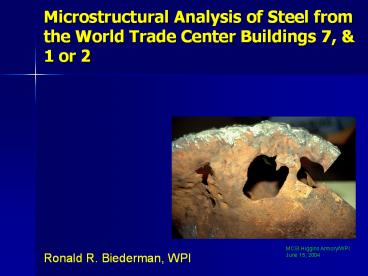
Severely Eroded ½ Wide Flange Beam from WTC 7
Nominal Composition () of the A36 Steel Plate
is (0.29C max, 0.80-1.2Mn, 0.04P, 0.05S,
0.15-0.3Si bal Fe)
12
Typical Cross Sectional Metallurgical Mount
13
- FEMAs Request
14
- FEMAs Request
- Can we determine the maximum temperature that
this A36 steel beam encountered?
15
- FEMAs Request
- Can we determine the maximum temperature that
this A36 steel beam encountered? - What caused the observed severe erosion of the
steel?
16
WPI Team
- Professor J. R. Barnett, Fire Protection
Engineering, WPI and FEMA - Professor R. D. Sisson, Jr., Materials Science
and Engineering - Professor R. R. Biederman, Materials Science and
Engineering - Jeremy Bernier, Undergraduate Student in
Mechanical Engineering - Marco Fontecchio, Undergraduate Student in
Mechanical Engineering - Erin Sullivan, Graduate Student in Materials
Science and Engineering - Dr. Sumanth Shanker, Postdoctoral Researcher
MPI/ACRC
Special Contributions from George VanderVoort,
Buehler, Ltd.
17
WTC 7 - Microstructural Observations
18
(No Transcript)
19
(No Transcript)
20
(No Transcript)
21
Microstructure of Unaffected A36 Steel
Pearlite Region
4 Nital Etch
White - Ferrite, Dark - Banded Pearlite
Pearlite forms in bands due to manganese
segregation and prior hot working
22
Iron Iron Carbide Equilibrium Phase Diagram
23
Iron Iron Carbide Equilibrium Phase Diagram
A 36
24
Iron Iron Carbide Equilibrium Phase Diagram
A 36
Carbide Spheroidization
25
Typical Microstructural Changes That Occur When
A36 Steel is Heated to the Vicinity of the
Eutectoid Reaction 727C (1340F), Held for a
Short Time, and Cooled to Ambient Temperature
Partial Carbide Spheroidization
26
Typical Microstructural Changes That occur When
A36 Steel is Heated to the Vicinity of the
Eutectoid Reaction 727C (1340F), Held for a
Short Time, and Cooled to Ambient Temperature
Partial Carbide Spheroidization
27
Typical Microstructural Changes That Occur When
A36 Steel is Heated to the Vicinity of the
Eutectoid Reaction 727C (1340F)and cooled to
Ambient Temperature
A Typical Region Where Conversion to an Austenite
Matrix (on Heating) Occurred Followed by a
Retransformation to a Ferrite Matrix on Cooling
28
Typical Microstructural Changes That Occur When
A36 Steel is Heated to the Vicinity of the
Eutectoid Reaction 727C (1340F)and cooled to
Ambient Temperature
Conversion to Austenite Matrix (on heating) and
Return to Ferrite Matrix (on Cooling)
29
Iron Iron Carbide Equilibrium Phase Diagram
A 36
Transformations From Austenite
30
Iron Iron Carbide Equilibrium Phase Diagram
A 36
CA
Transformations From Ferrite Austenite
CF
31
Schematic Isothermal Carbon Diffusion Profile
for the Two Phase Temperature Region in A36
CA
CF
32
Schematic Isothermal Carbon Diffusion Profile
for the Two Phase Temperature Region in A36
Austenite
CA
Austenite Ferrite
CF
Ferrite
33
Decarburization in the Two Phase Region
CF
C
CA
34
Iron Iron Carbide Equilibrium Phase Diagram
A 36
CA
Transformation From Austenite
35
Schematic Isothermal Carbon Diffusion Profile for
the Single Phase Austenite Temperature Region in
A36
For Austenite Above 912C
36
4 Nital Etch
37
(No Transcript)
38
(No Transcript)
39
(No Transcript)
40
(No Transcript)
41
BEI Image
42
Oxidation and Intergranular Attack
Unetched
43
4Nital Etch
44
EDX Analysis of Eutectic Region
S
Fe
FeS
Fe
Fe
FeO
O
Fe
Fe
Mn
Ca
45
Digital X-Ray Map of the Eutectic Reaction
Product
Fe
S
Image
O
Si
46
Digital X-Ray Map of the Eutectic Reaction
Product
Fe
S
Image
Carbon, Silicon and Sulfur are Segregated at
Interfaces
O
Si
47
Analysis
Environment
Steel
48
Analysis
FeS
FeO
49
Analysis
FeS
FeO
Eutectic Mixture
50
Analysis
FeS
FeO
Eutectic Mixture
Liquid
FeO FeS
940C
51
Analysis
FeS
FeO
Eutectic Mixture
Liquid
FeO FeS
940C
52
Summary
53
Summary 1. Rapid deterioration of the A36 steel
was a result of hot corrosion.
54
Summary 1. Rapid deterioration of the A36 steel
was a result of hot corrosion. 2. Heating in
an environment containing oxygen and sulfur
resulted in intergranular melting which
transformed to an Iron Oxide and Iron Sulfide
eutectic mixture on cooling .
55
Summary 1. Rapid deterioration of the A36 steel
was a result of hot corrosion. 2. Heating in
an environment containing oxygen and sulfur
resulted in intergranular melting which
transformed to an Iron Oxide and Iron Sulfide
eutectic mixture on cooling . 3. The reaction
that results in the formation of this eutectic
lowers the temperature at which liquid can form
in this steel to about 940C or lower depending on
Silicon and Carbon effects at the reaction
interfaces.
56
Where did the Sulfur come from?
57
Where did the Sulfur come from?
Did a similar deterioriation occur in steel from
WTS 1 or WTS 2 ?
58
A Section from a HSLA steel Column thought to be
from either WTC building 1 or 2.
Column Section Showing Region with Severe Thinning
59
Microstructure of a Typical Region Showing
the Surface and Grain Boundary Corrosion
Attack of the HSLA Steel
60
Sulfidation Attack at Grain Boundary
FeO
FeS
Etch with 4 Nital
Higher Magnification of the Surface Reaction
Region
61
Fe
Cu
Image
S
O
Si
62
.8
.7
.6
.4
.5
.3
.2
.1
Locations where Qualitative Chemical Analysis
was performed
63
X
Spot Location 1 in Figure 5
64
X
65
X
X
66
X
67
X
68
X
69
Hot Corrosion of the HSLA Steel
Manganese, Carbon, Silicon, Copper, and Sulfur
Segregate at Interfaces where Reaction is Severe
Gradient of Sulfides into the Steel from the
Oxide-Metal Interface
70
Summary
71
Summary
1. The severe thinning of the HSLA steel occurred
by high temperature corrosion due to a
combination of oxidation and sulfidation.
72
Summary
1. The severe thinning of the HSLA steel occurred
by high temperature corrosion due to a
combination of oxidation and sulfidation.
- Sulfidation of the grain boundaries in
the HSLA steel accelerated the corrosion
and erosion of the steel.
73
Summary
1. The severe thinning of the HSLA steel occurred
by high temperature corrosion due to a
combination of oxidation and sulfidation.
- Sulfidation of the grain boundaries in
the HSLA steel accelerated the corrosion
and erosion of the steel.
3. The high concentration of sulfides in the
grain boundaries in the corroded regions of the
steel occurs due to copper diffusing from the
HSLA steel combining with iron, manganese and
sulfur making both discrete and continuous
sulfides in the steel grain boundaries.
74
How much sulfur is necessary ?
75
Where did the sulfur come from?
76
We can speculate and never know the answers to
these questions.
or
Probably, we can answers many of these questions,
by developing models and running controlled
laboratory experiments in realistic atmospheres
for these steel.
77
1st Experiment Isothermal Reaction of Compacted
FeS Powder on the Ground Surface of A36 In Air
for 12 Hours at 1100C.
From Erin M. Sullivan
78
FeS
A36 Steel
79
(No Transcript)
80
Spot A
Si
O
Fe
Fe
Fe
Mn
Fe
P
S
Spot I
O
Spot J
Fe
Fe
Fe
Fe
Fe
Fe
Cu
Cu
Cu
81
Spot K
Cu
S
Fe
Fe
O
Cu
C
Fe
Cu
Spot F
Fe
Fe
Voids
Fe
C
Mn
82
Did the eutectic mixture form before the
buildings collapsed, or later as the remains
smoldered on the ground for months ?
83
At This Time We dont Know !
84
Could the source of the sulfur be as simple as -
-acid rain ?
85
Could the source of the sulfur be as simple as -
-acid rain ?
Did the ingredients come from building contents,
high sulfur fuel oils etc. ?
86
Could the source of the sulfur be as simple as -
-acid rain ?
Did the ingredients come from building contents,
high sulfur fuel oils etc. ?
Could nearby ocean salts such as sodium sulfate
play a role ?
87
Building Safety
Building safety requires a reliable sprinkler
system that will suppress fire temperatures so
that no phase transformations in the steel can
occur.
88
(No Transcript)
89
(No Transcript)
Recommended

