

The Moon as Detector for UltraHigh Energy Cosmic Neutrinos PowerPoint PPT Presentation
1 / 36
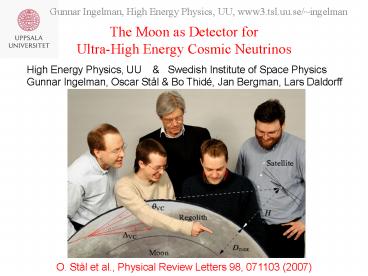
Title: The Moon as Detector for UltraHigh Energy Cosmic Neutrinos
1
The Moon as Detector for Ultra-High Energy
Cosmic Neutrinos
Gunnar Ingelman, High Energy Physics, UU,
www3.tsl.uu.se/ingelman
High Energy Physics, UU Swedish Institute
of Space Physics Gunnar Ingelman, Oscar Stål Bo
Thidé, Jan Bergman, Lars Daldorff
O. Stål et al., Physical Review Letters 98,
071103 (2007)
2
Why? How? When?
- Intro cosmic rays, GZK cut-off
- ? sources, fluxes x-section
- Askaryan radio emission
- Existing experiments
- Lunar satellite experiment
- Prospects
- Ultra-high energy ?s are messengers from cosmic
sources - Extremely low flux cross-section
- huge detector volume needed
- Use Moon as target and detect via radio signal !?
3
Ultra-High Energy Cosmic Rays (UHECR)
- energy up to 1020 eV (at least)
- mostly protons nuclei (?)
- isotropic (?)
- flux obfuscated by B-fields
- sources/acceleration not known
- - bottom-up acceleration by
- large-scale shocks (AGN )
- - top-down decay products of
- super-massive X-particles
- (topological defects,
- cosmic strings, monopoles)
? E-2.75
E-3.1
LHC
HERA
E eV
1017
109
1021
4
The GZK cut-off
Greisen-Zatsepin-Kuzmin CR with E gt 51019 eV
interact with CMB photons
Space no longer transparent GZK horizon of
order 50 Mpc spectrum should drop BUT AGASA
Fly's Eye show excess ! Debated ! Similarly for
E? gt 1015 eV ? Universe opaque
E3-weighted CR flux
5
Particle physics sources of UHE neutrinos
- GZK-process ? neutrinos
- Z-bursts, ? ?(relic) ? Z Post-GZK CR through Z
decay Detect relic neutrinos Probe neutrino
masses, - kinematic threshold
- E? gt 1022 eV for highest m?
- allowed by cosmology
- Topological Defects GUT-monopoles, cosmic
strings, - domain walls etc. Remnant X-particles with
MX gt EGZK - decays into neutrinos
E2-weighted ?-flux
GZK R. Engel, D. Seckel, T. Stanev, PRD 64,
093010 (2001) TD, Z-BURST D.V. Semikoz, G.
Sigl, JCAP 4 (2005)
6
Astrophysics sources of UHE neutrinos
Shaded band atmospheric ?s
Stanev, astro-ph/0511641
- Point sources
- Sun
- Supernova remnant IC443
- Mrk501 ?-ray burster
- Core of 3C273 (min-max)
- Jet of 3C279
- Diffuse fluxes
- Central Galaxy
- Cores of AGN (Active Galactic Nuclei)
- Jets of AGN
- Gamma Ray Bursts (GRB)
- Cosmogenic GZK
- Needed for Z-bursts ? UHECRs
?, ? of hadronic origin
7
Detection of UHE neutrinos
- ? has only weak interaction
- carry undisturbed information
- over cosmic distances
- not affected by B-fields,
- points back to source
- - low cross-section
- - flux at UHE
- extremely low
- ? HUGE detector needed
Radio
Optical
Acoustic
E? 1014 1015 1016 1017 1018 1019
1020 1021 eV
8
Acoustic detection
? Particle cascades produce pressure pulse ?
Pressure amplitude measures energy ? Pressure
distribution ? incoming direction ? Frequency
10-100 kHz
? abs(light) ? O(100m), ?abs(sound) ?
?abs(radio) ? (1000m)
Test _at_ Uppsala 180 MeV protons in bunch
?1016-1018 eV on ice at -40?C, piezo-ceramic
sensors Threshold energy 1015 eV 10 ?s pulse
up to 100 kHz Observable pressure 10 mPa,
Pice/Pwater 10 ? ice better than water
ice block
9
Radio detection using the Askaryan effect
- interaction ? cascade in the material strips off
electrons - that move with cascade ? 20-30 negative charge
excess - Cherenkov coherent radiation
- for wave length ? gt charge distr.
- shower Molière radius
- rM10 cm
- radio wave lengths
- power (N Qe)2 E2
- of primary energy
- dominates incoherent optical
- output above 1016-1018 eV
10
Radio-transparent material
Askaryan 1962 use ice, permafrost,
very dry rock Moon provides huge
target Can it be used ?
11
Askaryan effect experimentally confirmed
- Experiment at SLAC using 3.6 tons of Si sand
target - Bunches of GeV photons, total E 1019 eV
- All major radio emission properties confirmed
charge excess, coherence, pulse strength,
polarization - D. Saltzberg et al., Phys. Rev. Lett. 86 (2001)
2802-2805
12
Existing experiments ? flux limits RICE Radio
Ice Cherenkov Experiment
RICE CUBE 20??
- Dipole array _at_ Amanda
- in South pole ice
- ? Use AMANDA holes? 18 Receivers (10 cm dipole)
- ? 5 Transmitters
- ? 3 Horns (INR mark)? 100-300 m depth?
200x200x200 m3 cube - ? DAQ, PCs, Pulse Generator
- ? 1 dry hole
- Absorption function of temperatureFor cold ice
0.1-1.0 GHz bestAllows radio signal to travel gt
1 km - 3 years data taking
- ? ? flux limit
-500 m
-1000 m
-1500 m
-2000 m
-2500 m
Project under discussionholes may be separate
from IceCubeVeff growth 10-25
From talk by Nahnhauer / D. Besson
13
ANITA ANtarctic Impulsive Transient Antenna
Balloon circling at 37 km above Antarctica to
detect radio signals from the ice
- Flight Dec. 2006 ? result ?
- ANITA-lite test flight ? ? flux limit
- 18 days at float altitude ? 1.25 revolutions
From S. Barwick, APS talk 04/2004
14
FORTE Fast On-orbit Recording of Transient
Events
- Transient EM-signals from Earth in satellite
- Only 3 days net exposure
- Lightning, ionosphere, radio/TV
- Events from Greenland ice
- background maybe 1 candidate
- ? Flux limit
200 400 600 800 ?s
Lethinen et al., astro-ph/0309656
15
GLUE Goldstone Lunar Ultra-high energy neutrino
Experiment
34 70 m radio telescopes in Goldstone,
CA Observing the Moon in coincidence
effective target volume 100,000 km3 ! ?
limited primarily by live time (120 hours) No
events in 120 hrs observation ? ? flux limit
16
The Moon as particle detector
- Target material is regolith lunar soil
- with depth of 10100 m Radio wave
transparency Latt 10 ? m - from dielectric properties of Apollo samples
- GLUE used radio dishes on Earth
- Satellite closer to source
- ? 107 gain in signal power
- Absence of anthropogenic noise
- and atmospherics
- ? lower threshold
- Long observation time 1 year
Very radio-quiet on far side of Moon
17
Prospects for Lunar satellite detection of radio
pulses from UHE neutrinos interacting with the
Moon
O. Stål et al., Physical Review Letters 98,
071103 (2007) High Energy Physics, UU
Swedish Institute of Space Physics Gunnar
Ingelman, Oscar Stål Bo Thidé, Jan Bergman,
Lars Daldorff
18
Efficiency measure aperture
- Summarizes the total efficiency (effective area
and solid angle) - in a single quantity ?(E?,H,f,?f,...)
- Detecting 100 of incoming flux gives ?maxgt108
km2 sr - for one hemisphere of the Moon ? Huge detector
- Convolution with neutrino flux model gives
expected event rate, - assuming isotropic flux ?,
- A no-detection experiment ? model-independent
flux limit -
Poisson sup2.3 for 90 CL -
For sufficiently smooth fluxes
19
Monte Carlo simulation
- Isotropic distribution of incoming neutrinos
- No flavour sensitivity (hadron shower, flavour
mixing oscillations) - Satellite parameters fully variable, circular
orbit - Simulation include 1. Neutrino interaction
2. Generation of radio emission 3. Radio wave
propagation 4. Signal detection
4
3
2
1
20
1. Neutrino interaction
- Standard model neutrino-nucleon cross-sections ?
s?N log2(E) s0.363 - Interaction lengths of some 10 km ? Moon opaque
- Hadronic showers for both CC and NC DIS
events - Mean inelasticity ?y? 0.2 at the highest
energies - Secondary showers possible
- from ?e and ?? events
10
21
1. neutrino interaction becoming strong ?
May arise beyond pert. Standard Model
electroweak sphalerons (short-dashed) stri
ng excitations M70 TeV (dotted) branes
10D M300 TeV (long-dashed)
Fit to AGASA HiRes CR data CL 99, 95, 90
Ahlers, Ringwald, Tu, astro-ph/0512439
Steep increase above normal data OK and can fit
signal above GZK cut-off But, normal SM ?
cross-section used in the following !
10
22
2. Askaryan radio emission
- Zas-Halzen-Stanev (ZHS) parameterization of
spectral flux density - in Jansky (10-26 W/m2Hz)
- Decoherence sets in at ?02.5 GHz (? lt shower
dimension) - Spread of emission is frequency dependent close
to ?0 it is very sharp, around 100 MHz more
dipole-like - Gaussian spread around Cerenkov angle from
finite track-length - Linearly polarized
23
2. angular spread depends on frequency
- High frequency ?
- small angular spread ?VC
- e.g. 3.50 at 2.2 GHz
- Low detection probability
- Large internal reflection
- Low frequency ?
- large angular spread ?VC
- e.g. 750 at 0.1 GHz
- Larger detection probability
- Less internal reflection
From Scholten
24
2. angular spread depends on shower length
For L(Es)?? , then ?VC? 0 , i.e. Cherenkov
emission on cone Shorter shower ? larger angular
spread ?VC Long EM shower ? LPM effect ? less
radiation
25
3. Radio wave propagation
- Ray-tracing algorithm
- Frequency dependent attenuation, Latt 10 ?
m, approx constant - over relevant depths
- Refraction and total internal reflection
- Power spreading from refraction
- ? increased acceptance
26
4. Radio antenna and receiver
- Sensitivity of radio equipment determines
threshold energy - signal noise
- effective antenna collection area Aeff
- Field-of-view and sensitivity are complementary
quantities - We have focused on two antenna configurations
isotropic tripole (3 crossed ?/2 dipoles)
beam-filling
27
ELectromagnetic Vector Information Sensor ELVIS
Three, 5 m long, orthogonal dipoles
(tripole) Fully digital receiver electronics
software radio 3D sampling of complete
E-field vector with selectable centre
frequency and BW Polarimetric measurements,
direction finding In operation at LOIS test
site in Växjö ELVIS flying now with Compass-2
approved for Obstanovka (ISS) ...
Vector sensors
GPS timing and fiber network connection
28
Simulation results
Fraction of ? events above Depth in the
regolith, as detected by tripole antenna
(frequency ?) in Moon-orbiting satellite at 100
km altitude
Events typically within 10-20 m from Moon
surface, where lunar material properties known
29
Resulting apertures up to 106 km2 sr
Bandwidth 100 MHzThermal threshold 5
sGalactic Noise temp 1.5106(10 MHz / ?)2.2
K System Noise temp 300 K
H100 km
500 km
100 MHz 500 MHz1000 MHz cf. Moon ?maxgt108 km2
sr
1000 km
30
Flux limits for isotropic tripole antenna in 1
year
O. Stål et al., PRL 2007
H km 100 250 1000 100 250 1000 For H ? obs.
area ? Eth ?
? GHz 1 0.1 For ? ? ?VCLatt ?
Better than ? limits
Competitive/better than ANITA, LOFAR
LORD is Russian Moon project of
this kind
31
Flux limits for beam-filling antenna in 1 year
O. Stål et al., PRL 2007
H km 100 250 1000 100 250 1000
? GHz 1 0.1
Beam-filling antenna observes full Moon ? higher
sensitivity Suppressed galactic noise ? optimum
at low observation frequency
32
Expected event rates
- Only with respect to a specific flux model
? - Optimal parameters from
- model-calculated event rates
- Exotic sources within reach
- GZK neutrinos extremely
- hard to catch
- Improvements
- Lower threshold energy by
- larger antenna area
- (multiple antennas) or
- noise reduction
TD with mX2?1013 GeV Z-burst rescaled to
ANITA-lite limit m?0.33 eV max for
cosmological data
33
Prospects for Moon satellite
- Electromagnetic Vector Information Sensor -
ELVIS Radio experiment with transient detection
capabilities for the Indian satellite
Chandrayaan-1. Proposal submitted May, 2005 - Lunar Orbiter Radio Detector - LORD Dedicated
UHE experiment along the lines presented here
- Lebedev Physical Institute Lavochkin Assoc.
(Moscow) - Swedish Institute of Space Physics
(Uppsala) Conceptual study performed entering
actual design phase - Included in Russian Lunar program for 2010 or
2012 (?) - G. A. Gusev et
al. (LORD collaboration), Cosmic Research 44, 19
(2006) - Piggyback launch of LORD with Russian Phobos
mission might be possible already in 2009
34
Prospects for Earth-based radio telescopes
NuMoon _at_ Westerbork radio observatory
NuMoon LOFAR
- 14 dishes of 25 m diameter
- 5? field of view
- 12-14 coincident receivers
- 117-175 Mhz band
- Low background noise
- 500 hours observation time
- Polarization information
- Total collecting area 0.5 km2
- Cover whole moon
- Sensitivity 25 times better
- Bands 30-80 MHz (600 Jy)
- 115-240 MHz (20 Jy)
35
Prospects for Earth-based radio telescopes
GMRT Giant Meterwave Radio Telescope _at_ Tata
inst., India
- 30 dishes of 45 m diameter spread over 25 km
distance - Correlation of antennas (interferometers) ?
single dish 25 km diameter ! - Six frequency bands 50, 153, 233, 325, 610 and
1420 MHz - High angular resolution 2 60 arcsec at 1.4
GHz 50 MHz - Uppsala-Madrid-India study of prospects for ?s
on the Moon
36
Conclusions
- UHE ?s interesting/important for particle
physics, - astrophysics cosmology at the high energy
frontier - Radio methods to detect low ?-flux beyond GZK
energy - Moon is useful target
- - Lunar satellite with radio instruments
competitive/feasible - ? chances of a real satellite mission
- - Earth-based radio telescopes useful
- if enough observation time
- Interesting future !
- Onwards and upwards
- - to the Moon !
Recommended

