

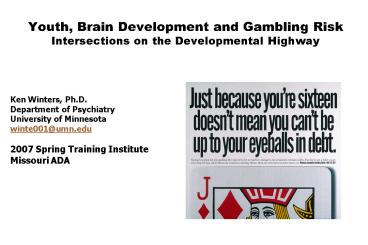
Youth, Brain Development and Gambling Risk Intersections on the Developmental Highway PowerPoint PPT Presentation
1 / 50
Title: Youth, Brain Development and Gambling Risk Intersections on the Developmental Highway
1
Youth, Brain Development and Gambling
RiskIntersections on the Developmental Highway
Ken Winters, Ph.D. Department of
Psychiatry University of Minnesota winte001_at_umn.ed
u 2007 Spring Training Institute Missouri ADA
2
1 Conclusion
- The emerging science of brain development
suggests that the maturing brain of the
adolescent does not give rise to optimal
assessment of risk and careful decision making.
3
2 Conclusion
- The adolescent developing brain, in conjunction
with the expanding gambling and e-gambling
environment, further reinforces the potential
health concerns of youth and gambling.
4
1. Background
5
Definitions
Gambling participation in games of chance in
which a wager is placed. gambling
machines lotteries bingo keno pull
tabs games of personal skill cards sports
betting social betting pari-mutuel
betting stock market
6
Youth Access to Gambling
- First generation of youth exposed to ready access
and varied gambling venues. - Minimum legal age to place a bet varies across
states, but many opportunities for 18-year-olds
in the United States.
7
Minimum Legal Age Gambling and the Law, Nelson
Rose, Whitier Law School
- 39 states with a lottery
- 37 states with 18 as legal age
- 3 states may switch to 21
- 31 states with casinos/slots
- 20 states with 18 as legal age
- 4 states may switch to 21
8
If you are 16 and want to betlegally, live in...
- Alabama Mississippi
- Delaware Montana
- Georgia New Mexico
- Idaho New York
- Iowa North Carolina
- Kentucky North Dakota
- Maine Pennsylvania
- Maryland Texas
- Virginia Washington
- Wisconsin
9
Internet Gambling in AmericaAnother Wave of
Gambling Expansion
10
University journalism student Mike Schneider won
top prize - 1 million - in the Limit Hold'em
PartyPoker.com Million V tournament.
Photo by Charlie Knutson, from The Minnesota
Daily, March 22, 2006
11
Weekly Card Playing for Money by Teenage
Boys(Romer, 2005)
Among weekly 12 on-line
Weekly Playing
12
Progress of Research on Adolescent Gambling
Most studies epidemiological and
cross-sectional psychosocial risk studies
Lacking longitudinal and clinical studies
13
Progress of Research on Adolescent Gambling
Most studies epidemiological and
cross-sectional psychosocial risk studies
Lacking longitudinal and clinical studies
14
Estimates of Problem Gambling-Lifetime (National
Research Council, 1999)
Percentage Group Range
Median Adult 1.5 College 3 - 11 5
Adolescent 1 - 7 2.9
Estimates based on meta-analysis of surveys
conducted 1988-1997 (National Research Council,
1999). Problem gambling defined in most studies
by the SOGS/SOGS-RA.
15
Estimates of Problem Gambling-Past Year
(National Research Council, 1999)
Percentage Group Range
Median Adult 0.9 Adolescent 1 - 9 6
Adolescent-Drug Tx 9 - 13 11
Estimates based on meta-analysis of surveys
conducted 1988-1997 (National Research Council,
1999). Problem gambling defined in most studies
by the SOGS/SOGS-RA.
16
Adolescent Case Example
- Minnesota High School Football Star was an honor
student and had a football scholarship to a
Division I school. - Became an habitual blackjack player at the local
casino after he turned 18. - To finance his habit, he fenced stolen property.
- Was arrested for the thefts.
17
Youth Problem Gambling as a Component of
Problem Behaviors
sexual behavior
delinquency
smoking
Problem Behaviors
gambling
male
drug use
18
1. Background
2. Neuro- development
19
- Adolescence is a period of profound brain
maturation. - We thought brain development was complete by
adolescence - We now know maturation is not complete until
about age 24!!!
20
An Immature Brain Less Brakes on the Go
System
21
Construction Ahead
- Growth of the brains nerve cells (neurons)
occurs through late childhood - 1,000,000,000,000,000 possible connections.
- Around 11 GIRLS 12½ - BOYS
- Some of these connections are pruned off and
remaining ones are
strengthened.
22
Construction Ahead
- When the pruning is complete, the brain is faster
and more efficient. - But during the pruning process, the brain is not
functioning at full capacity
23
Neurological maturation starts at the back of the
brain, and moves to the front
Amygdala
Judgment
Emotion
Motivation
Physical coordination
Prefrontal Cortex
Nucleus Accumbens
Cerebellum
Notice Judgment is last to develop!
24
Judgment Gets Betterwith Age
- By age 18, the adolescents judgement for
structured challenges is roughly equal to that of
adults. - But judgement that involves resisting impulses or
delaying gratification is still under
construction during late adolescence and early
adulthood.
25
- The dopamine system is more robust during
- adolescence than in adulthood
- novel stimuli trigger firing of dopamine the
experience is rewarded by a dopamine burst - ?
- Compared to adults, the robust dopamine system of
adolescence will contribute to a more heightened
reward experience in the face of novel stimuli
26
Implications of Arrested Development for
Adolescent Behavior
- We can infer....
- Preference for physical activity
- Preference for high excitement and low effort
activities - Preference for novelty
- Poor planning and judgment
- Minimal consideration of negative consequences
- More risky, impulsive behaviors
- Some evidence that being in a group accentuates
risk taking
27
1. Background
2. Neuro- development
3. Neurodevelopment and gambling
- youth in general
- ADHD youth
28
Does normal brain development contribute to
adolescent susceptibility to gambling?
- INDIRECT SUPPORT
- risk taking (particularly in groups)
(gambling?) - propensity toward low effort - high excitement
activities (gambling?) - consequences (gambling?)
- sensitivity to novel stimuli (gambling?)
29
Are youth with ADHD at heightened risk? These
youth suffer from problems with judgment and
self-regulation, believed to be linked to
pre-frontal cortex deficits.
- ADHD, as defined by DSM-IV, is a constellation of
symptoms related to - Inattention
- Hyperactivity
- Prevalence about 3
- boys girls
30
- ADHD as heightened risk
- Growing evidence that ADHD .
- is a dysfunction in the brains regulatory
systems that manifests as a deficit in behavioral
dysregulation, - this dysregulation is mediated by deficits in the
pre-frontal cortex, and - these deficits in pre-frontal cortex contribute
to a disorder likely related to self-regulation -
drug abuse - (Barkley, 1997 Martin, Earlywine, Blackson et
al., 1994)
31
Link of ADHD and drug abuse
Among children with ADHD (some with CD
also), compared to comparison...... SUD
Elevated alcohol use Elevated marijuana
use Elevated tobacco use
OR 1.8 - 3.2
OR 2.2 - 4.6
adapted Molina et al., in press
32
Supportive Data
- The ADHD - PG connection adult data
- PG non-PG psych.
- Rate of childhood ADHD 15-36
4-8 (sig.) - (Carlton et al., 1987 Rugle Melamed, 1993)
33
Supportive Data
- The ADHD - PG connection adult data
- PG normals
- Rate of adulthood ADHD 21 (sig.)
- (Specker et al., 1995)
34
Suggestive Data
- The ADHD - PG connection adolescent and young
adult data
35
Association of Adolescent Gambling and
Dimensional Measures of Hyperactivity and
ADHD(Derevensky et al., submitted)
Note All one-way ANOVAs significant, p nearly all SNK sig. NGConners-Wells Adolescent Self-Report Scale Long
Version (Conners Wells, 1997)
36
Association of Adolescent Gambling and Probable
ADHD Status1(Derevensky et al., submitted)
- ADHD ADHD-
- (n 231) (n 2105)
- Groups (N 2336)
- Nongamblers (30) 6 94
- Social (54) 8 92
- At-Risk (8) 20 80
- Prob. Path. (5) 34 66
- 1 Based on the ADHD Index (Conners Wells, 1997)
- X2 113, p
37
Minnesota ADHD Study (Winters, Breyer, August,
Realmuto, submitted)
ADHD
Controls n 125 99 Gender (
male) 86.3 69.2 Mean age at last
follow-up 21.1 21.5 grad high
school or current 91.3 98.6 Mean IQ (KBIT)
(baseline) 102.1 106.7 Mean SES
(baseline) 44.1 50.4 (.01) single
parent family 25.1 7.1 (.01) Attrition
ADHD, 87 of eligible Controls, 91 of
eligible. Ethnicity 88 Caucasian
Hollingshead, 1975, (occupation code x 5) x
(education code x 3) Range 17 - 66
38
Prior Year Gamblers (Winters et al.,
unpublished)
ADHD Controls
n 115 n 81
sig.
Age of onset (mean) 13.6
16.9 .05 family hx PG
() 9.3 4.1
ns PG scale (mean)
2.1 0.7
.05 Weekly/daily ()
23.8 14.1
.05 Lost 100 ()
11.9 6.1
ns Casino prefer ()
61.5 21.2
.01 Lottery prefer ()
1.9 19.7
.05 ADHD gamblers, 92 Control
gamblers, 72.
39
1. Background
4. Summary
2. Neuro- development
3. Neurodevelopment and gambling
40
Summary
- This is the first generation of youth to be
exposed to relatively easy access to a variety of
gambling venues, widespread gambling advertising,
and to pervasive social approval for an
inherently risky activity. Only 20 years ago,
gambling in the U.S. was primarily limited Las
Vegas and Atlantic City.
41
Summary
- Evidence is accumulating that
- youth gambling occurs on a continuum
- most youth gamble, yet do so infrequently
- the prevalence of problem gambling is
noteworthy
42
Summary
- Possible links between neurodevelopment and
gambling behavior - Gambling may be a very attractive activity for
the developing brain - Deficits in brain structures responsible for
self-regulation may place certain youth (e.g.,
those with ADHD) at elevated risk for problem
gambling
43
Summary
- Relatively easy access to online gambling and
popularity of poker games and tournaments poses a
new risk for youth who are inclined to get
over-involved in gambling
44
Maryland CPA hit it big, but he worries about
those who wont(Jon Saraceno, USA Today, August
1, 2006)
- Steve Dannenmann, who honed his skills with
online poker-playing, won 4.25 million - as runner-up in the 2005 World Series of Poker
tournament. - This summer, while playing poker in Vegas for a
few weeks, he has made it his personal project to - quiz young people who have fallen for the allure
of the game and its potential financial bonanza. - Steve Ive met so many kids who have packed it
in and came out here with a 2,000-3,000 - bankroll thinking theyre going to make it big.
Theyve quit college or their jobs. I quiz them
like - I do my clients who come in with money concerns.
- Why did you quit school? Whats your bankroll?
What is your back-up plan? - If they dont give a good answer, I call their
bluff. - What are you thinking?
- Its absolutely crazy, and pretty sad.
45
Summary
- Clinical implications
- Screen target groups for gambling
- Drug-abusing youth
- Youth with ADHD
46
Lie/Bet Screen(Johnson et al., 1997)
- 2-question version of the DSM-IV criteria
- 1. Have you ever had to lie to people important
to you about how much you gambled? - 2. Ever felt the need to bet more and
more money?
47
Summary
- Clinical implications
- Treatment issues
- Drug-abusers
- raise insights that gambling is another source of
intoxication - educate that gambling may be a source of relapse
(gambling urges can be powerful)
48
Summary
- Clinical implications
- Treatment issues
- Youth with ADHD
- raise insights that gambling is a source of
excitement - teach limits, if the person gambles
49
Summary
- Prevention implications
- Get schools to integrate gambling prevention into
their drug prevention programs - Minnesota Institute on Public Health
- www.miph.org/gambling/
- International Centre for Youth Gambling
- www.youthgambling.com/
50
THANK YOU!winte001_at_umn.edu
Recommended

