

Unmanned Aerial Vehicle PowerPoint PPT Presentation
1 / 7
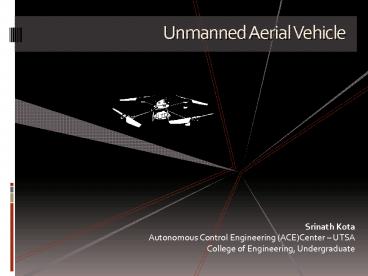
Title: Unmanned Aerial Vehicle
1
Unmanned Aerial Vehicle
- Srinath Kota
- Autonomous Control Engineering (ACE)Center UTSA
- College of Engineering, Undergraduate
2
Objective
- Objective
- Build an autonomous helicopter
- Will automatically fly to target, take picture,
fly back and land - Starting base is the Draganflyer V Ti
- RC helicopter
3
UAV Introduction
- Drive system upgrade
- Use DraganFlyer VTI as a model
- Sensor Addition
- GPS
- Thermal Sensors
- Sonar
- Accelerometers
- Gyros
- Camera Addition
- Image capture
4
Goals Achievements
- Goals
- Vertical Take off and Landing MAV
- Stable and Maneuverable
- Flight Time gt10 min
- Minimum Payload 250g
- As small as possible
- Design, construction, matlab simulation and
control - Achievements
- 4 propellers MAV, 6 DOF
- Visual Interface for Control and Monitoring
- Take off, stable hovering and landing
5
How does it fly ? Cont
- Power System
- This set of components is located on the
horizontal circuit board and is essentially a set
of 4 speed controllers one for each of the 4
motors with FET transistors. FET means Field
Effect Transistors. These devices act as
electronic valve. There are 3 wires on each FET.
Two of the wires supply voltage to its motor,
while the third wire (the trigger) is how the
valve is opened. Apply a small voltage, the
valve opens a little and the motors start to
turn. Apply a little more voltage, and the motor
turns faster still. - When a propeller, a force is generated by the
motor called Torque. The propeller wants to
turn one way and the motor, the other way. But
according to Newtons law, a force in one
direction will produce the same force in the
opposite direction.
Another force caused by uneven thrust of the
propellers at differing attitudes, is known as
P factor. in helicopters.
6
Future work _at_ UAV
- Implementation of Solar Panels
- Image Recognition
- More Payload capacity
- Sync with Land and underwater robots
7.2 V Solar Panel _at_ 200ma
7
Questions ?
Recommended

