

... the Last Supper when in the signs of bread and wine h PowerPoint PPT Presentation
1 / 41
Title: ... the Last Supper when in the signs of bread and wine h
1
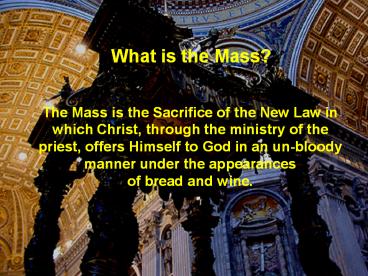
What is the Mass?
The Mass is the Sacrifice of the New Law in which
Christ, through the ministry of the priest,
offers Himself to God in an un-bloody manner
under the appearances of bread and wine.
2
The Name Mass
comes from the Latin word Missa meaning
dismissal. In the early days of the Church the
catechumens were asked to leave after the gospel
and sermon were finished. The faithful, however,
were dismissed after the sacrifice was completed.
Then, as now, this was done by saying or singing
Ite Missa Est. In the course of time the word
Missa, or dismissal, was used to designate the
entire sacrifice.
3
All parts of the Mass are important. However, the
most important part of the Mass is the
Consecration.
4
In the Consecration bread and wine are changed
into the body and blood of Christ who then is
really present on the altar. Through the priest
He offers Himself to God in commemoration of His
death on the cross.
5
The purpose of the Mass
- To adore God as our Creator and Lord
- To thank God for His many favors
- To ask God to bestow His blessings on all men
- To satisfy the justice of God for the sins
committed against Him
6
Structure of the Mass
- Introductory Rites
- Liturgy of the Word
- Liturgy of the Eucharist
- Concluding Rite
7
Entrance Procession
An Entrance Antiphon (music or song) helps to
deepen the unity of the people and introduces
those present to the mystery of the season or
feast that is being celebrated.
8
Venerating the Altar
Because the Eucharist is the summit of Catholic
worship, the altar is central within the liturgy.
The celebrant venerates the altar with a kiss.
Incense is also often used.
9
Penitential Rite
Because we should worship with a clean heart, we
ask for forgiveness for the things we have done
and those things we failed to do.
10
Praise to Christ
- The Lord have Mercy (Kyrie) is an acclamation
which praises the Lord and asks for his mercy. - The Glory to God (Gloria) is an ancient hymn
that praises the Father, Son and Holy Spirit.
11
Opening Prayer (The Collect)
The Introductory Rites conclude with a prayer
that expresses the theme of the celebration and
addresses a petition in the peoples name.
12
Liturgy of the Word
- The First major part of the Mass
- It consists of readings from
- Hebrew Scriptures
- A Responsorial Psalm
- Readings from the Christian Scriptures (New
Testament) - A Proclamation from the Gospel
13
Liturgy of the Word
The Proclamation of the Gospel is the culmination
of the Liturgy of the Word because it deals
directly with Gods manifestation in Jesus Christ.
14
Homily
The homily develops some point of the Bible
readings. The person who delivers the homily
should be well acquainted with Biblical theology
and prepare his sermons carefully, so that he may
apply the Bible message to the life situation of
the congregation.
15
Liturgy of the Word
- Finally, in the Profession of Faith we give our
assent to Gods word. - Through the Intercessions, we pray for all
mankind.
16
Liturgy of the Eucharist
The Liturgy of the Eucharist is the second major
part of the Mass. At the Last Supper, Christ
himself instructed us to do this in his memory.
17
Liturgy of the Eucharist
Christ took bread, gave thanks and praise to the
Father, broke it, and gave it to his disciples
saying Take this and eat it this is my body.
18
Liturgy of the Eucharist
Then he took the cup, again gave thanks, and gave
it to his disciples, saying Take this and
drink from it this is the cup of my blood. Do
this in memory of me.
19
Liturgy of the Eucharist Preparation of the Gifts
Bread, wine and water are brought to the altar
20
Liturgy of the Eucharist Presentation of the Gifts
Members of the congregation bring the gifts of
bread and wine that symbolize all of us, and our
desire to offer ourselves to God.
21
Eucharistic Prayer
A prayer of thanksgiving and sanctification. It
is here that the bread and wine become the body
and blood of Christ and are offered in sacrifice.
22
Parts of the Eucharistic Prayer
- Preface
- Epiclesis
- Narrative of the Institution and Consecration of
the Eucharist - Anamnesis
23
The Preface
A dialogue in which we are invited to give thanks
to God, and the acclamation, the Holy, holy . .
., is said or sung in union with all the angels
in heaven.
24
Epiclesis
The prayers before the Consecration in which the
priest and we with him invoke Gods power and ask
him to send his Spirit to transform the gifts
into the body and blood of our Lord.
25
Narrative of the Institution
We celebrate the sacrifice which Jesus Christ
instituted at the Last Supper when in the signs
of bread and wine he offered himself.
26
Words of Consecration
The day before he suffered he took bread in his
sacred hands and looking up to heaven, to you,
his almighty Father, he gave you thanks and
praise. He broke the bread, gave it to his
disciples, and said Take this, all of you, and
eat it this is my body which will be given up
for you. Eucharistic Prayer I
27
Words of Consecration
When supper was ended, he took the cup. Again he
gave you thanks and praise, gave the cup to his
disciples, and said Take this, all of you, and
drink from it this is the cup of my blood, the
blood of the new and everlasting covenant. It
will be shed for you and for all so that sins may
be forgiven. Do this in memory of
me. Eucharistic Prayer I
28
Anamnesis
We call to mind (remember) our Lords death,
resurrection, and ascension. We offer God the
sacrifice of his Son.
29
Final Doxology and Great Amen
A hymn of praise, which we confirm with our
Amen Through him, with him, in him. In the
unity of the Holy Spirit. All glory and honor are
yours Almighty Father, forever and ever.
30
Communion Rite
Participating in communion (the body and blood of
our Lord) is our participation in the new
Passover, and doing so we signify our oneness
with God in Jesus and all who partake of this
meal.
31
Communion Rite
- The Communion Rite consists of the following
parts - The Lords Prayer (The Our Father)
- Rite of Peace
- Breaking of Bread
- Communion Antiphon
- Silent Prayer
32
The Lords Prayer
This is a petition both for daily food
(Eucharist) and forgiveness. Not taking this
prayer seriously would make communion simply a
void symbolism.
33
Rite of Peace
Before sharing at the Lords table, sharing peace
becomes a sign of love, peace and unity in
Christs kingdom.
34
Breaking of Bread
For the early Christians the Eucharist was known
as The Breaking of Bread. Since a loaf of bread
was used, it was necessary to break it before
distributing it to the faithful.
35
Breaking of Bread
The symbolism of all partaking in one loaf of
bread (Jesus Christ) remains in the priests
action of breaking the large host while the
congregation prays/sings The Lamb of God.
36
Communion Rite
Communion Antiphon This verse expresses the
spiritual union of all who partake in the
Eucharistic banquet. To partake in the Eucharist
is to share in the meritorious death of Jesus
Christ.
37
Silent Prayer
Silence gives us the opportunity to reflect on
the wonderful gift of the Eucharist that has been
given to us by God the Father through Jesus
Christ as both nourishment for our journey
through life and forgiveness.
38
Concluding Rite
- The conclusion of the Mass consists of
- Prayer after Communion
- Concluding Rite
- Final Blessing and Dismissal
39
Prayer After Communion
The celebrant prays in our name that after being
strengthened by Christ himself, we may live the
life of faith. Our Amen makes the prayer our
own.
40
Final Blessing and Dismissal
After any announcements, the blessing and
dismissal follow.
41
Final Blessing and Dismissal
After any announcements, the blessing and
dismissal follow.
Recommended

