

Perceptual Learning on Melodic Palindromes: Evidence That Timbre Affects Pitch Memory PowerPoint PPT Presentation
1 / 1
Title: Perceptual Learning on Melodic Palindromes: Evidence That Timbre Affects Pitch Memory
1
Perceptual Learning on Melodic Palindromes
Evidence That Timbre Affects Pitch Memory
Nestor Matthews1, Kristin M. Reardon12,
Obiageli Uguru1
Department of Psychology, Denison University1,
The College of William Mary2
Poster 24
Results
Introduction
Palindrome A
Palindrome B
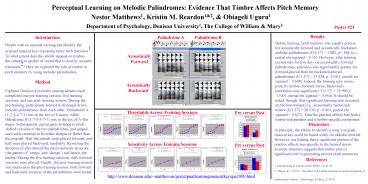
Before training, pitch memory was equally precise
for acoustically forward and acoustically
backward melodic palindromes (F(1,17) 1.882,
p.188, n.s., partial eta-squared 0.10).
However, after training exclusively for five days
on acoustically forward palindromes, precision
was significantly greater for forward-played than
for backward-played palindromes (F(1,17)
37.558, p lt0.001, partial eta squared 0.688).
Indeed, the training (pre versus post) by timbre
(forward versus backward) interaction was
significant ( F(1,17) 21.996 p lt0.001, partial
eta squared 0.564). It should be noted, though,
that significant learning also occurred on the
non-trained (i.e., acoustically backward) timbre
(F(1,17) 28.536, p lt0.001, partial eta squared
0.627). Thus the practice effects had both a
timbre-independent and a timbre-specific
component.
People with no musical training can identify the
original musical key of popular tunes with
precision1. To what extent does this ability
depend on timbre- the subjective quality of
sound that is cued by acoustic transients2? Here
we explored the role of timbre in pitch memory
by using melodic palindromes.
Acoustically Forward
Method
Acoustically Backward
Eighteen Denison University undergraduates each
completed one pre-training session, five training
sessions, and one post-training session. During
the pre-training, participants learned to
distinguish two melodic palindromes from each
other. Palindrome A (1-7-4-4-7-1) was in the key
of E major, while Palindrome B (1-7-5-5-7-1) was
in the key of A-flat major. Subsequently,
participants listened to pitch-shifted versions
of the two palindromes, and judged each such
variation to be either sharper or flatter than
the original. Half the stimuli were played
forward, and half were played backward, randomly.
Reversing the direction of play altered the
micro-acoustic structure (the pattern of ramps
and damps) and hence, the timbre. During the
five training sessions, only forward versions
were played. Finally, the post-training session
was identical to the pre-training session both
forward and backward versions of the palindromes
were tested.
Thresholds Across Training Sessions
Pre versus Post
Discussion
In principle, the ability to identify a songs
original musical key could be based solely on
melodic interval. However, our finding that a
significant portion of the practice effects was
specific to the trained micro-acoustic structure
suggests that timbre plays a significant role in
generating precise pitch memories.
Sensitivity Across Training Sessions
Pre versus Post
References
1.Schellenberg Trehub (2003) PMID 12741751
2. Thayer, R.J. (1974). The effect of the
attack transient on aural recognition of
instrumental timbres. Psychology of Music, 2,
39-52.
http//www.denison.edu/matthewsn/percetpuallearni
ngmusicalkeyepa2009.html
Recommended

