

Accuracy of the FreeStyle Navigator Continuous Glucose Monitor PowerPoint PPT Presentation
1 / 24
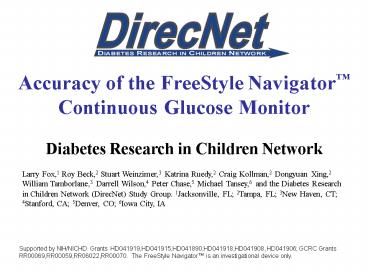
Title: Accuracy of the FreeStyle Navigator Continuous Glucose Monitor
1
Accuracy of the FreeStyle Navigator Continuous
Glucose Monitor
Diabetes Research in Children Network
Larry Fox,1 Roy Beck,2 Stuart Weinzimer,3 Katrina
Ruedy,2 Craig Kollman,2 Dongyuan Xing,2 William
Tamborlane,3 Darrell Wilson,4 Peter Chase,5
Michael Tansey,6 and the Diabetes Research in
Children Network (DirecNet) Study Group.
1Jacksonville, FL 2Tampa, FL 3New Haven, CT
4Stanford, CA 5Denver, CO 6Iowa City, IA
Supported by NIH/NICHD Grants HD041919,HD041915,HD
041890,HD041918,HD041908, HD041906 GCRC Grants
RR00069,RR00059,RR06022,RR00070. The FreeStyle
Navigator is an investigational device only.
2
Abstract
- The Freestyle Navigator Continuous Glucose
Monitoring System ("Navigator" Abbott Diabetes
Care, Alameda, CA) is a small, subcutaneous
glucose sensor with wireless transmission to a
monitor designed for continuous use. We
evaluated the accuracy of the Navigator in 30
children (mean age 11 years) with T1DM in
inpatient/outpatient settings. - During a 24h CRC admission, subjects used 2
Navigators and prior to and after the admission
used a single Navigator at home. Inpatient
sensor values (N1811) were paired with reference
values (analyzed at a central laboratory)
obtained every 30 minutes. Outpatient sensor
values (N6819) were paired with noncalibration
glucose values obtained with a Freestyle Flash
(Abbott Diabetes Care, Alameda, CA). For
inpatient use, the median absolute difference
during hypoglycemia (70 mg/dL) was 14 mg/dL and
the median relative absolute difference RAD was
13 during euglycemia (71-180 mg/dL) and 10
during hyperglycemia (180 mg/dL). Corresponding
values for outpatient use were 15 mg/dL, 14 and
12. - In the inpatient setting, the median RAD was 15
in daytime versus 11 in nighttime, 11 during
the first day versus 11 during the fifth day,
and 11 with an arm insertion versus 12 with a
hip and 13 with abdomen insertion. The median
RAD comparing the two simultaneous sensors was
13. - In conclusion, these data indicate that Navigator
sensor accuracy and precision are sustained for
up to 5 days, are not degraded overnight and are
similar in different insertion locations.
Randomized controlled studies are needed to
evaluate the clinical usefulness of this
promising device in the management of children
with T1DM.
3
Background
- The need for frequent blood glucose monitoring
remains a barrier to achieving excellent diabetes
control. - An accurate, real-time continuous glucose sensor
would provide valuable information in assessing
postprandial excursions and changes in blood
sugars during exercise.
4
FreeStyle Navigator Continuous Glucose
Monitoring System
- Measures interstitial glucose.
- Requires calibration using fingerstick blood
glucose at 10, 12, 24 and 72 hours after sensor
insertion. - After a 10-hr warm-up, provides glucose readings
every 60 seconds for up to 120 hours. - Values range from 20 to 500 mg/dL.
- Displays trend arrow indicating glucose rate of
change.
5
Study Aim
- This pilot study was designed to
- Assess the accuracy of the FreeStyle Navigator
Continuous Glucose Monitoring System (Abbott
Diabetes Care, Alameda, CA) in inpatient and
outpatient settings. - Assess Navigator accuracy during exercise and
during a missed bolus meal test.
6
Methods
- 30 children with T1D (4-17 yr old) were admitted
to one of the 5 DirecNet clinical research
centers (CRC). - Outpatient accuracy was assessed before and after
CRC admission. - Two simultaneous devices were placed during the
inpatient stay for assessment of precision one
device was inserted for subsequent outpatient
data collection. - Venous blood was obtained every 30 minutes during
the CRC stay for sensor-reference comparisons.
7
Methods (contd)
- For some subjects, inpatient sensor glucose
values were also compared with reference values
obtained for 2 hours during and following an
exercise session and every 10 minutes for 1 hour
following missed bolus breakfast test. - Inpatient sensor glucose values were compared
with reference values performed at the DirecNet
central laboratory, using a hexokinase enzymatic
method. - Outpatient sensor data were paired with
noncalibration glucose values obtained with the
FreeStyle glucose meter built into the Navigator.
8
Methods (contd)
- The following differences between sensor and
reference values were calculated - median absolute difference (MAD)
- median relative absolute differences (MRAD)
- The frequency of sensor values meeting ISO
criteria was also assessed - with reference glucose 75 mg/dL, sensor value
within 15 mg/dL - with reference glucose value 75 mg/dL, sensor
value within 20
9
Results
- No effect of gender or BMI on inpatient or
outpatient sensor accuracy (tables 2 3). - Sensor accuracy was better for adolescents during
home use (table 3) but was not affected by age
during inpatient analysis (table 2). - Inpatient and outpatient accuracy measures
improved using a 10-minute sensor lag (tables 2
3).
10
Results (contd)
- No effect of sensor location or sensor age (up to
5th day of use) on sensor accuracy during
inpatient analysis (tables 4 5). - Inpatient and outpatient sensor accuracy
decreased with lower reference glucose values
(tables 4 5). - Sensor accuracy was better at night than during
the day during inpatient and outpatient analyses
(tables 4 5).
11
Results (contd)
- MRAD was slightly higher during exercise (17 vs.
12), but this likely reflects the lower blood
sugars rather than sensor inaccuracy (table 4). - Tables 6 and 7 show inpatient and outpatient
sensitivity and specificity of the sensor during
hypoglycemia and hyperglycemia. - 70 of the missed bolus breakfast glucose levels
met ISO criteria, vs. 58 during exercise and 74
at other times.
12
Table 1. Demographics of study subjects
Age, HbA1c and T1D duration are mean S.D.
13
Table 2. Inpatient sensor accuracy effect of
age, gender, BMI, and lead/lag times.
No lag vs. 10 min lag comparison
14
Table 3. Outpatient sensor accuracy effect of
age, gender, BMI, and lead/lag times.
No lag vs. 10 min lag comparison
15
Table 4. Inpatient sensor accuracy effect of
reference glucose, sensor age, time of day and
sensor location. Exercise test and meal challenge
results are also shown.
16
Table 5. Outpatient sensor accuracy effect of
reference glucose, sensor age and time of day.
17
Table 6. Inpatient analysis of sensitivity and
specificity of sensor during hypoglycemia and
hyperglycemia.
a Percentage of hypo- or hyperglycemic events
defined by the reference glucose for which sensor
alarmed within 30 minutes. b Percentage of hypo-
or hyperglycemic events defined by the Navigator
with reference value within 30 minutes above or
below the threshold level denoted in column
heading and 10 mg/dL discrepant from the
concurrent Navigator reading.
18
Table 7. Outpatient analysis of sensitivity and
specificity of sensor during hypoglycemia and
hyperglycemia.
a Percentage of hypo- or hyperglycemic events
defined by the reference glucose for which sensor
alarmed within 30 minutes. b Percentage of hypo-
or hyperglycemic events defined by the Navigator
with reference value within 30 minutes above or
below the threshold level denoted in column
heading and 10 mg/dL discrepant from the
concurrent Navigator reading.
19
Table 8. Blood glucose levels during exercise
(N19)
Values are median (25th, 75th percentile). Rate
of change is mg/dL/min MAD Median Absolute
Difference (Navigator reference value).
20
Figure 1. Navigator vs. laboratory measured drops
in glucose (mg/dL) during exercise.
Navigator
Reference
21
Figure 2. Navigator vs. laboratory rate of change
in glucose (mg/dL/min) during exercise.
Navigator
Reference
22
Conclusion
- Navigator accuracy is similar during inpatient
use and when used at home. - The Navigator sensor is accurate during exercise
and during a missed bolus postprandial state. - Navigator sensor accuracy is sustained for up to
5 days, and is similar in different insertion
locations. - Randomized controlled studies are needed to
evaluate the clinical usefulness of this
promising device in the management of children
with T1DM.
23
- Stanford University
- Bruce Buckingham
- Darrell Wilson
- Jennifer Block
- Paula Clinton
- Yale University
- William Tamborlane
- Stuart Weinzimer
- Elizabeth Doyle
- Heather Mokotoff
- Melody Martin
- Amy Steffen
- Barbara Davis Center
- H. Peter Chase
- Rosanna Fiallo-Scharer
- Laurel Messer
- Barbara Tallant
- University of Iowa
- Eva Tsalikian
- Michael Tansey
- Linda Larson
- Julie Coffey
- Joanne Cabbage
- Nemours Childrens Clinic
- Tim Wysocki
- Nelly Mauras
- Larry Fox
- Keisha Bird
- Kim Englert
- Jaeb Center for Health Research
- Roy Beck
- Katrina Ruedy
- Craig Kollman
- Dongyuan Xing
- Cynthia Stockdale
24
(No Transcript)
Recommended

