

The bright surface of ice and snow cover reflects sunligh PowerPoint PPT Presentation
1 / 60
Title: The bright surface of ice and snow cover reflects sunligh
1
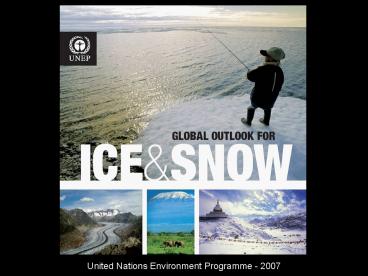
United Nations Environment Programme - 2007
2
Components of the Cryosphere
Introduction
- Snow
- Ice in the sea
- Ice on land
- huge ice sheets, and the smaller glaciers
and ice caps - Frozen ground
- River and lake ice
3
Why are Ice and Snow Important to Us?
- Ice and snow are important in many regions of the
world - for biodiversity, water supplies, livelihoods,
culture, recreation - because they influence flood risk, construction,
transportation, agriculture, resource extraction
Armin Rose/iStockphoto.com
4
Why are Ice and Snow Important to Us?
- Ice and snow are important factors in global
processes - Climate
- Carbon balance
- Sea level
5
Why are Ice and Snow Important to Us?
- Ice and snow affect the global distribution of
heat - Ocean currents distribute heat thermohaline
circulation depends on deep, cold water formed in
the polar regions. - Melting ice weakens this process.
6
Positive feedback of melting ice and snow
The bright surface of ice and snow cover reflects
sunlight and cools the planet.
Less ice and snow
More sunlight absorbed by land and sea
Melting of ice and snow speeds up global warming
(positive feedback).
Warmer temperatures
7
Why are Ice and Snow Changing?
- Temperatures are rising.
- Natural variability influences climate -
but most of the recent warming is very likely due
to increased greenhouse gas emissions.
8
2001-2005 temperatures compared with the
1951-1980 mean.
- The Arctic is warming at almost twice the rate of
the rest of the world. - In many areas the mountains are warming faster
than the lowlands.
9
Ian Britton/FreeFoto.com
- During the 21st century, increases in greenhouse
gas emissions will be the most important external
influence on ice and snow.
10
Artis Rams/iStock
Snow influences climate because of its insulating
properties and because it reflects sunlight. Less
snow leads to acceleration of global warming
Snow
11
Snow trends
- Snow cover has declined in the Northern
Hemisphere, especially in spring and summer. Mean
monthly snow cover is decreasing by about 1.3
per decade.
12
Snow outlook
Major reductions in snow cover are projected for
mid-latitudes by the end of the 21st century.
The snow line is projected to rise in many
mountain areas
Yellow to red is less snow Blue is increased snow
13
Snow impacts
- Changes in snow cover have a dramatic impact on
water resources. Snow in mountain regions
contributes to water supplies for almost
one-sixth of the worlds population. - Snow is an important ecological factor and
changes in snow affect plants and animals
Peter Prokosch
14
Snow impacts
Arctic ecosystems
Changes in snow affect reindeer and caribou and
the Arctic indigenous people who depend upon them.
Inger Marie Gaup Eira/www.ealat.org
15
Snow impacts
Winter recreation
Each degree warmer in the winter means poor snow
conditions for more ski resorts. Many will be
forced to shut down.
16
Jon Aars/NPI
Sea ice influences climate because it reflects
sunlight and because it influences ocean
circulation. Less sea ice leads to acceleration
of global warming
Ice in the Sea
17
Sea Ice trends
- Arctic sea-ice cover is shrinking by 8.9 per
decade in summer and 2.5 per decade in winter.
It is also becoming thinner and there is less
multi-year ice. - Antarctic sea-ice cover is not decreasing.
18
Sea Ice outlook
Arctic sea-ice extent and thickness are projected
to decline with a possibility of a mainly
ice-free Arctic Ocean in summer by 2100 or
earlier.
Antarctic sea ice is also projected to decline in
this century.
Mlenny/iStock
19
Sea Ice impacts
Don Perovich
- Melting sea ice, in combination with melting
glaciers and ice sheets, may cause major changes
to global patterns of ocean circulation. - As with snow, less sea ice increases absorption
of heat from the sun, resulting in increased
warming
20
Sea Ice impacts
Sea ice is habitat for many organisms from
bacteria, algae, sea worms and crustaceans to sea
birds, penguins, seals, walrus, polar bears and
whales.
Photos (1,2) Håkon Hop/NPI, (3)www.glaciers-onlin
e.net
21
Sea Ice impacts
Some sea-ice dependent animals are already at
risk and the predicted declines in sea ice may
lead to extinctions.
Photos (1) Jon Aars/NPI, (2) Georg Bangiord
22
Sea Ice impacts
Shrinking sea ice is affecting Arctic indigenous
people and further loss of sea ice threatens
livelihoods and cultures.
Bjørn Frantzen
23
Sea Ice impacts
More open water in polar regions will provide
easier access to oil and gas reserves and
increase shipping and tourism, with accompanying
benefits and risks.
24
Konrad Steffen
Greenland and Antarctica contain about 99 of the
freshwater ice on Earths surface. Meltwater from
ice sheets contributes to sea level rise.
Ice Sheets
25
Greenland recent changes
Ice Sheets trends
- Annual total loss of mass from the Greenland Ice
Sheet more than doubled in the last decade of the
20th century and may have doubled again by 2005. - Warmer summers are increasing melting and ice
discharge.
Ice on land
Yellow no or little change Blue snow
accumulation Red less mass (melting and
discharge of ice)
26
Ice Sheets trends
Antarctica recent changes
- There is uncertainty concerning recent overall
changes in ice mass in the Antarctic Ice Sheet,
but there is probably a decline in mass. - Ice shelves are thinning and some are breaking up.
Yellow no or little change Blue snow
accumulation Red less mass (melting and
discharge of ice)
27
Ice Sheets trends
Surprising changes that models cannot simulate,
including thinning of outlet glaciers and ice
shelves, have been observed over the past five
years.
Break-up of the Larsen B Ice Shelf, 2002
NSIDC
28
Ice Sheets outlook
Recent signs point to accelerating loss of ice in
both Greenland and Antarctica. Some of these
changes are not caused by melting but by changes
in glacier dynamics and are poorly understood.
Because of this it is not possible to predict
the future of the ice sheets with any confidence.
Konrad Steffen
29
Igor Smichkov/iStock
Glaciers and ice caps are important freshwater
resources, but also natural hazards. Glaciers
are close to the melting point and react strongly
to climate change.
Glaciers and Ice Caps
30
Glaciers trends
Over the past 100 years, and particularly since
the 1980s, there has been worldwide and dramatic
shrinking of glaciers, closely related to global
warming.
Jürg Alean, SwissEduc (www.swisseduc.ch)/Glaciers
online (www.glaciers-online.net)
31
Glaciers outlook
Projected increases in global air temperatures
will ensure the continuing shrinkage of glaciers
and may lead to their disappearance from many
mountain regions in the coming decades.
Fedchenko Glacier, Tajikistan
2006
1976
1933
V.Novikov
32
Glaciers impacts
Himalayas Hindu Kush major rivers draining
glaciers and populations in their basins
Disappearance of glaciers will have major
consequences on water resources, especially in
the Himalayas Hindu Kush, the Andes, Rocky
Mountains and European Alps.
33
Glaciers impacts
Shrinkage of glaciers leads to ice instability
and formation of ice and debris dams, resulting
in more flooding, debris flows and ice avalanches.
Ice avalanches of the Nevados Huascarán in Peru.
34
Bruce Richmond/USGS
Meltwater from ice sheets, glaciers and ice caps
contribute to sea-level rise. How much the sea
level rises relative to the adjacent coast varies
from place to place.
Sea-level Change
35
Sea Level Rise trends
Sea level is rising now by 3.1 mm per year,
double the average rate of the 20th century.
36
Sea Level Rise outlook
Contributions to sea-level rise
Greenland Ice Sheet
The contribution from meltwater to sea level rise
can be expected to accelerate as more land ice
melts.
In the long run, the ice sheets have the
potential to make the largest contribution to
sea-level rise.
37
Sea Level Rise outlook
For the next few decades the rate of sea-level
rise is partly locked in by past emissions.
Sea-level in the late 21st century and beyond is
critically dependent on future greenhouse gas
emissions.
IPCC projections are for a global sea level rise
of 20 to 80 cm over the 21st century. The upper
bound is very uncertain.
Bruce Miller
38
Sea Level Rise impacts
- The impacts of sea-level rise in any region will
depend on many interacting factors, such as - whether the coastal region is undergoing uplift
or subsidence - how much development has altered natural flood
protection, like coastal vegetation.
Bangladesh is made more vulnerable to flooding by
the expansion of aquaculture which results in
loss of mangroves.
A sea-level rise of 20 to 40 cm will drastically
reduce the number of annual rice crops in the
Mekong delta.
Island tourism in Malaysia is expected to be
compromised by rising sea level because of beach
erosion and salt contamination of water supplies.
39
Sea Level Rise impacts
Magnitude of the issue
Rising sea levels, combined with increased
extreme events, will potentially affect millions
of people on small islands and at and near coasts
world-wide.
- Asia a one metre sea-level rise would affect
- Land 900,000 km2
- People over 100 million
- Economic activity over
- US400 billion in GDP
Veer
40
Sea Level Rise adaptation and mitigation
- A wide range of adaptation and mitigation
measures will be required to assist people with
the consequences of sea-level rise. - These measures require cooperation among nations,
and among governments, private sector,
researchers, NGOs and communities
Restoring shoreline vegetation, Fiji
Patrick Nunn
41
Sea Level Rise adaptation
- Adaptation Strategies
- Accommodation increase resilience, for example
through providing storm shelters and warning
systems - Protection such as barriers, dykes and
vegetation - Planned retreat for example, designate no-build
areas or setbacks from coasts
Kiribati
Thames Barrier, London
The Environment Agency
Patrick Nunn
42
Vladimir Romanovsky
Permafrost occupies up to 24 of land in the
Northern Hemisphere. Permafrost is also under
parts of polar seas, in mountain regions and
Antarctica.
Frozen Ground
43
Permafrost trends
- Permafrost temperatures have increased during the
last 20-30 years in almost all areas of the
Northern Hemisphere. - Warming is reported from areas of mountain
permafrost. - Widespread thawing is not yet occurring.
Permafrost in the Northern Hemisphere
Dark blue is continuous permafrost
44
Permafrost outlook
Permafrost thawing is expected to occur across
the subarctic by the end of the 21st century.
Projected changes in permafrost temperatures by
2080 - 2099
Dark red is zones of thawing permafrost
45
Permafrost impacts
- When permafrost thaws carbon is released in the
form of greenhouse gases, accelerating global
warming. - Thawing of ice-rich permafrost results in
- the land surface subsiding.
- On a large scale, permafrost thawing changes
ecosystems for example, changing forest to
wetland.
Frozen ground
46
Permafrost impacts
- Construction and everyday use of permafrost can
result in permafrost thawing damaging the
infrastructure. Warming may accelerate this. - Good engineering practices prevent permafrost
thawing.
Roger Asbury/iStock Photo
47
Permafrost impacts
- In mountainous areas, thawing permafrost
increases risk of landslides and rock falls and
has impacts on infrastructure. - Permafrost in China has degraded over the past 40
years and is projected to decrease by 30-50 in
this century.
S. Marchenko
48
Esko Kuusisto
Floating freshwater ice is a key component of
cold-regions river and lake systems, mainly in
the Northern Hemisphere and mountain regions.
River and Lake Ice
49
River and Lake Ice trends
- Changes that have largely mirrored rising air
temperatures are affecting river and lake ice. - Main change is earlier spring break up and, to a
lesser degree, later autumn freeze up.
R. Borgström
50
River and Lake Ice outlook
The trend to longer ice-free periods is projected
to continue, with the amount of change projected
for each region being related to the amount of
warming forecast.
R. Borgström
51
River and Lake Ice impacts
T.D. Prowse
In remote areas frozen rivers and lakes are used
as transport corridors and longer ice-free
periods mean reduced or more expensive access to
communities and industrial developments.
52
River and Lake Ice impacts
Many northern indigenous people depend on frozen
lakes and rivers for access to traditional
hunting, fishing, reindeer herding or trapping
areas.
Shari Gearheard
53
River and Lake Ice impacts
Dörte Köster
- Spring break up often causes damming of rivers by
ice, resulting in costly flooding. - Lowered temperature gradients on
northward-flowing Northern Hemisphere rivers may
result in reduced flooding. - This has potential negative ecological
consequences where annual flooding maintains
important wetlands.
54
Christian Lambrechts
The underlying theme of the Global Outlook for
Ice and Snow is that changes are now observed in
ice and snow and bigger changes are
projected. This raises policy issues at global,
regional and local scales.
Policy and Perspectives
55
Policy global
- Mitigating climate change by reducing greenhouse
gas emissions is the main global policy response. - IPCC 4th Assessment to avoid further and
accelerated global warming with major negative
consequences, greenhouse gases must stop
increasing and start decreasing no later than 15
to 25 years from now.
56
Policy regional
A. Taurisano/NPI
- Adaptation policy must be tailored to regions and
this requires regional scientific knowledge and
impact assessment. - Arctic key policy issues retreating sea ice and
implications for shipping and exploitation of oil
and gas reserves, accompanied by issues of
jurisdiction and regulation for environmental
protection.
57
Policy regional
- Antarctic a key policy issue decreasing sea ice
could contribute to rapid expansion of tourism
industry potential negative impacts and need for
regulatory regime.
58
Policy regional
Falk Kienas/iStock
- Himalayas Hindu Kush a key policy focus
changes in snowfall and glaciers potentially
increasing floods and leading to water shortages
affecting hundreds of millions of people
strategies for water management and land use
planning to reduce vulnerability.
59
Policy local
Stine Rybråten
- Impacts of changes in ice and snow are already
major concerns in many Arctic communities. Issues
include erosion of coastal infrastructure and
access to subsistence resources. - Expansion of shipping and oil and gas development
will bring both local opportunities and potential
negative economic and social effects. Most Arctic
communities lack capacity to cope effectively
with these stresses.
60
Perspectives
Recommended

