

Root Cause Analysis (RoCA) System Prevision, Inc., San Rafael, California PowerPoint PPT Presentation
Title: Root Cause Analysis (RoCA) System Prevision, Inc., San Rafael, California
1
Root Cause Analysis (RoCA) SystemPrevision,
Inc., San Rafael, California
Innovation The Root Cause Analysis (RoCA) System
helps engineers analyze and track the root cause
of process anomalies due to human factors,
including incidents that cause personnel
injuries, damage facilities, incur additional
costs, or delay processing.
Accomplishments - A San Rafael, California small
business has jointly developed with NASA a system
to help engineers analyze and track the root
causes of process anomalies due to human factors.
- Prevision, Inc. implemented the Root Cause
Analysis (RoCA) system under a Phase II Small
Business Innovation Research (SBIR) contract with
NASA at Kennedy Space Center. - Due to the
technology that underlies RoCA, Prevision was
purchased by Fair, Isaac, a U.S. company with
offices worldwide that provides banking and
financial services, personal lines insurance,
retail, catalog and telecommunications
industries. -The RoCA system tracks human
factor issues at the organizational, team and
individual level. Anomalies include incidents
that injure personnel, damage facilities, incur
additional costs, or delay processing. RoCA
supports identification of both systemic and
event-specific root causes.
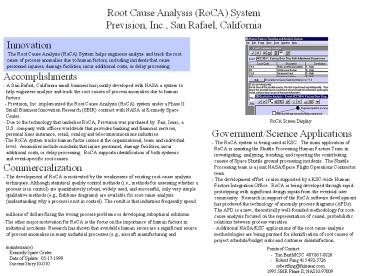
RoCA Screen Display
Government/Science Applications - The RoCA system
is being used at KSC. The main application of
RoCA is assisting the Shuttle Processing Human
Factors Team in investigating, analyzing,
trending, and reporting the contributing causes
of Space Shuttle ground processing incidents.
The Shuttle Processing team is a joint NASA/Space
Flight Operations Contractor team. - The
development effort is also supported by a
KSC-wide Human Factors Integration Office. RoCA
is being developed through rapid prototyping with
significant design inputs from the eventual user
community. Research in support of the RoCA
software development has produced the technology
of anomaly process diagrams (APDs). The APD is a
new, theoretically well-founded methodology for
root-cause analysis focused on the representation
of causal, probabilistic relations between
process variables. - Additional NASA/KSC
applications of the root cause analysis
methodologies are being pursued for
identification of root causes of project
schedule/budget risks and customer
dissatisfaction.
Commercialization - The development of RoCA is
motivated by the weaknesses of existing
root-cause analysis techniques. Although
statistical quality control methods (i.e.,
methods for assessing whether a process is in
control) are quantitatively robust, widely used,
and successful, only very simple qualitative
methods (e.g., fishbone diagrams) are available
for root-cause analysis (understanding why a
process is not in control). The result is that
industries frequently spend millions of dollars
fixing the wrong process problems or developing
suboptimal solutions. -The other major
motivation for RoCA is the focus on the
importance of human factors in industrial
accidents. Research has shown that avoidable
human errors are a significant source of process
anomalies in many industrial processes (e.g.,
aircraft manufacturing and maintenance).
Points of Contact - Tim Barth/KSC 407
867-0826 - Robert Fung 415 492-5726
robertfung_at_fairisaac.com 1995 SBIR Phase II
NAS10-97009
Kennedy Space Center Date of Update
05-17-1999 Success Story 10-010
2
(No Transcript)
Recommended

