

Simulating Disk Galaxies: a brief history of baryon acquisition PowerPoint PPT Presentation
1 / 45
Title: Simulating Disk Galaxies: a brief history of baryon acquisition
1
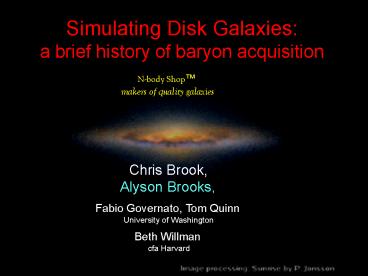
Simulating Disk Galaxiesa brief history of
baryon acquisition
N-body Shop makers of quality
galaxies Chris Brook, Alyson Brooks,
Fabio Governato, Tom Quinn University of
Washington Beth Willman cfa Harvard
2
How do baryons reach galaxies/disks?
- we use cosmological simulations at galaxies with
a range of mass, to follow how baryons reach
galaxies. - sufficient temporal and spatial resolution to
determine detailed baryonic infall/accretion
history
3
- Act I accreted vs insitu stars
- -the dominance of gas accretion
- - morphologies of the populations
- - as a function of mass
- Act II cold flows vs shocked gas
- -Alyson
Brooks - - how does gas get to the disk?
- - shock heating vs cold flows
- - as a function of mass
Thanks to Lucio Mayer
Thanks to Avishai Dekel
Thanks to James Bullock
4
Star Formation/Feedback
Stars
Gas
Kroupa IMF Padova lifetimes
Dynamical time SF efficiency
SF Threshold
Winds
lt 8 Msun
Metals
Blast Wave No Cooling
SN Ia
gt 8 Msun
SN II
2 free parameters C, eSN
5
Mass dependance of satellite accretion
3.4x10¹⁰ M?
3.3x10¹² M?
6
Dark Mergers
mergers are dark
dark matter
stars
7
Origin of galaxies stars
accreted as gas
accreted as stars
3.4x10¹⁰ M? 2.1x10¹¹ M? 1.1x10¹² M?
3.3x10¹² M?
Baryons enter galaxies primarily as gas
8
Origin of galaxies stars
accreted as gas
accreted as stars
3.4x10¹⁰ M? 2.1x10¹¹ M? 1.1x10¹² M?
3.3x10¹² M?
Increasing Mass
High mass galaxies have higher rates of stellar
accretion
9
in situ stars I band surface brightness
3.4x10¹⁰ M? 2.1x10¹¹ M?
28 27 26 25 24 23 22 21 20 19 18 17 16
1.1x10¹² M? 3.3x10¹² M?
M arcsec-2
10
accreted stars I band surface brightness
ellipticity 5.5
28 27 26 25 24 23 22 21 20 19 18 17 16
3.4x10¹⁰ M? 2.1x10¹¹ M?
ellipticity 3.5
ellipticity 3.4
1.1x10¹² M? 3.3x10¹² M?
M arcsec-2
1.1x10¹² M? 3.3x10¹² M?
11
3.3x10¹²M?
1.1x10¹²M?
accreted insitu profiles
- 2.1x10¹¹M?
3.4x10¹⁰M?
12
Conclusions from act I
- Galaxies largely acquire baryons as gas
- Accreted stars make extended ellipsoids
- Stars born in situ make disks and bulges
- The ratio of accreted vs insitu depends on
- -galaxy mass
- -accretion history
13
Act II The Shocking Truth
- Canonical model
Cold Disk
Shock radius
Infalling Cold Gas
Dark Matter Halo Hot Gas
14
The Phase Diagram
Cold Disk
canonical model-
Shock radius
Infalling Cold Gas
7 6 5 4 3
Dark Matter Halo Hot Gas
shocked gas trajectories
log ( Temp )
Cold flows
Keres et al. (2005)
0 2 4
6
log(?/?o)
15
The Phase Diagram
z1
8 Rvir
7 6 5 4 3
hot
high entropy
4 Rvir
heated
log ( Temp )
cold
2 Rvir
ambient
-4 -2 0 2 4
6 8
log(?/?o)
We distinguish several gas phases and trace the
gas all the way into the disk
1 Rvir
16
The Phase Diagram
Ambient, InterGalactic Gas
17
The Phase Diagram
4 Rvir
Rvir
High Entropy Gas
18
The Phase Diagram
Hot Halo Gas
Rvir
19
The Phase Diagram
Cold (Disk) Gas
Rvir
20
The Phase Diagram
Feedback Heated Gas
Rvir
21
How Do Galaxies Get Their Gas?
What happens at the virial radius? The Adiabatic
Spherical Cow
Dekel Birnboim (2006)
22
Hot vs Cold
Mass Dependent Stable Shocks
Dekel Birnboim (2006)
23
Purple-yellow density map
Green traces gas that has been never shocked
shocked
24
Cold flow Shocked and Satellite gas accretion
3.4x10¹⁰ M? 2.1x10¹¹ M? 1.1x10¹² M?
3.3x10¹² M?
Increasing Mass
- smooth accretion dominates over accretion
- associated with mergers/satellites
25
Cold flow Shocked and Satellite gas accretion
1.0
0.8
fraction of z 0 gas mass
0.6
0.4
0.2
0.0
3.4x10¹⁰ M? 2.1x10¹¹ M? 1.1x10¹² M?
3.3x10¹² M?
Increasing Mass
- cold flows dominate in low mass galaxies
- shocked gas dominates in higher mass galaxies
26
Compare accretion history of gas which forms the
disk
0.8
3.4x10¹⁰ M?
0.6
Gas accretion rate (M? / yr)
0.4
Disk star formation in low mass galaxy dominated
by cold flows
0.2
0.5
0.4
0.3
Star formation rate (M? / yr)
0.2
0.1
0 5 10
13.7
Time (Gyrs)
with star formation history for disk stars
27
Compare accretion history of gas which forms the
disk
Early times shocked gas and cold flows
both important star formation is dominated by
cold flows
40
3.3x10¹² M?
30
Gas accretion rate (M? / yr)
20
10
5
4
3
Star formation rate (M? / yr)
2
1
0 5 10
13.7
Time (Gyrs)
with star formation history for disk stars
28
Compare accretion history of gas which forms the
disk
40
3.3x10¹² M?
Late times shocked gas has time to
cool, and dominates the star formation in the disk
30
Gas accretion rate (M? / yr)
20
10
5
4
3
Star formation rate (M? / yr)
2
1
0 5 10
13.7
Time (Gyrs)
with star formation history for disk stars
29
Conclusions Act II Cold gas accretion dominates
in low mass galaxies Shock heating becomes
important at a few 1011 Msol Fraction of shocked
gas available to cool to disk and form stars
increases with galaxy mass (interplay between
amount of shocked gas and cooling times) Amount
of material accreted as gas which is previously
associated with other galaxies increases as a
function of galaxy mass. Brooks et al. (in
prep) Alyson Brooks
30
Size of Disks Cold gas
31
Conclusions Accreted stars make extended
spheroids Accreted gas makes disks and bulges
Cold gas accretion dominates in low mass
galaxies Shock heating becomes important at a few
1011 Msol (all of the above are modulo merger
history)
32
- Final galaxy artificial images of t hese two
galaxies. - We trace the origin of baryons in these galaxies
- Accreted label red
- Insitu label blue
33
Mvir 2.1e10 Msol at z0
34
simulation
The Formation of a Milky Way like Galaxy. Green
Gas Blue and Red Stars Frame 40 Kpc
35
Simulations are Improving!
R
F
R
F
F
R
R
R
F
R
F
Image by C. Brook, using Sunrise, courtesy P.
Jonsson.
36
Angular Momentum Loss in Galaxies
- Dynamical friction on cold gas Navarro White 96
- Angular Mom. Transfer in Gas Spiral waves
Linden-Bell Kalnajs 1971 - Torques from grainy DM halos (T.Kaufmann 07)
- Artificial Viscosity _at_Hot/Cold gas Interface
(Okamoto 06)
37
4Rvir
2Rvir
38
Conclusions Accreted stars make extended
spheroids Accreted gas makes disks and bulges
Cold gas accretion dominates in low mass
galaxies Shock heating becomes important at a few
1011 Msol (all of the above are modulo merger
history)
39
Digression details of the simulations
parallel chemo-dynamical galaxy evolution code
Tree N-body -DM stars
metal enrichment H,He,O,Fe
SPH -gas
SFR- ? p1.5
UV background radiation (Haardt Madau 96)
Compton radiative cooling
Compton radiative cooling
Supernovae feedback II Ia
40
Conclusions Accreted stars make extended
spheroids Accreted gas makes disks and bulges
Cold gas accretion dominates in low mass
galaxies Shock heating becomes important at a few
1011 Msol (all of the above are modulo merger
history)
41
(No Transcript)
42
SDSS low z galaxies.
and simulations are improving!
43
The Shocking Truth
- Shock conditions
- ? 4?o
- Tshock gt 3/8 Tvir (Dekel Bernhoim 2006)
- Sshock log(3/8Tvir)0.5/4?o
- For each timestep we test So ? Sshock ?
- Do we resolve shocks?
- In short, yes.
- See Wadsely et al. 2003
44
Abadi, Navarro, Steinmetz 2005
Milky Way seems to show similar metallicity for
local high velocity selected halo to stars
selected spatially M31 on the other hand
(Kalirai et al. 2006 talk next week!)
45
- The first stars born in late accreting
(isolated) satellites, are born from primordial
gas. - So if Pop III stars, or more likely their
footprints, exist at z0, these can be observed
locally
Scannapieco, Kawata, Brook, Schneider, Ferrara,
Gibson I 2006 N-body, semi-analytic
feedback Brook, Kawata, Scannapieco, Martel,
Gibson II 2007 SPH approach
46
Initial Conditions
WMAP satellite
The Cosmic Microwave Background Radiation
47
The radial distribution of first and second stars
at z0
Density profilecentrally concentrate,but the
profile is similar to total DM
Total DM
Fractionfirst or second stars/totalonly small
difference between inner and outer region
strong
moderate
weak
Weaker outflowflatter profile
First and second stars ends up everywhere!
48
The role of merging histories ( Renda et al
05) Galaxy tot mass 3x10¹²
1x10¹² 3x10¹¹ halo star mass fraction
19.6 9 14
49
173 N-body Milky Way like dark matter
halos. Traced the merger histories.
50
Bensby abundance
thick disk stars
thin disk stars
Bensby et al 03
51
e.g. Mould 05 (extragalactic) Prieto et al. 05
(galactic)
52
Galaxies can be imaged at different redshifts and
Bands
Z 1 Left UV Galex Right I band
53
(No Transcript)
54
Recommended

