

Mentor Relationships in the 21st Century: Focus On Clinical Education PowerPoint PPT Presentation
1 / 56
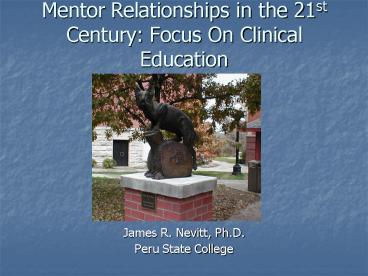
Title: Mentor Relationships in the 21st Century: Focus On Clinical Education
1
Mentor Relationships in the 21st Century Focus
On Clinical Education
- James R. Nevitt, Ph.D.
- Peru State College
2
Presentation by James R. Nevitt, Ph.D. Success
is not final, failure is not fatal it is the
courage to continue that counts.Winston
Churchill
3
Mentoring??????
- In this presentation I will
- (1) Discuss several possible definitions of the
term mentor and the various roles a faculty
mentor might assume in a life of a student.
4
Mentoring??????
- I will also
- (2) Discuss what mentors ARE and are NOT.
5
Mentoring??????
- Additionally, I will
- (3) briefly discuss some psychological,
sociocultural and economic problems experienced
by students in the 21st century that, ultimately,
may be handled best in the context of a
relationship with a faculty mentor.
6
Mentoring??????
- As well as
- (4) Discuss a range of experiences I have had as
an addiction counselor, college professor, and
member of the recovering community.
7
S.M.A.R.T. L.E.A.D.E.R. Workshop (Aug.
28th, 2005 PSC campus)Student Mentors,
Ambassadors and Athletes, Retention Leaders and
Residence Assistance, Tutors and Top Cats,
Learning, Evaluating, and Directing Educational
RelationshipsDr. Judy Grotrian, Dr. DiAnna Loy,
Dr. James Nevitt
8
Mentor Relationships
- Finally, I will
- (5) Discuss some of my experiences
- (a) both being mentored and
- (b) becoming a mentor to students at
- Peru State College
Peru State College Psych/Criminal Justice Club
9
Mentor Relationships
- Psychology/Sociology/Criminal Justice PSCJ
- (Psychology-Criminal Justice) Club
- Sponsors Dr. Kelly Asmussen, Dr. James Nevitt,
Dr. Joel Lundak, and Greg Galardi - 2005-2006 Officers
- President - Robin Sherman
- Vice President/President Elect -Tom Dunekacke
- Treasurer - Shelly Dettman
- Secretary/Web Page Coordinator - Randi
Mazzula/Melissa McCullers - Membership - Amy Taylor
Peru State College Psych/Criminal Justice Club
10
Breaking Down Barriers
- Hopefully, along the way I will also speak to the
topics of breaking down the following types of
barriers that limit student and faculty
interaction - Authority/Intimidation Barriers
- Cultural/Generational Barriers
- Lack of Commonality Barriers
11
Mentor Defined
- The Merriam-Webster Dictionary offers three
definitions of Mentor
12
1. Mentor-A Link With the Past
- Mentor-a friend of Odysseus entrusted with the
education of Odysseus son Telemachus.
13
2. Mentor-Psychological Relatedness
- Mentor-a trusted counselor or guide.
14
Mentor-Specific Academic Role
- Mentor-A tutor or coach
15
What Is Mentoring?
- Mentoring is advising, teaching, counseling and
role modeling. - Formal mentoring matches a senior or more
experienced personthe mentorto a junior or less
experienced personthe mentee. - Mentors focus on a mentees achievements, success
in school and preparation for the workforce
through a one-to-one relationship that is
non-threatening and non-judgmental to both
parties. - It is a relationship that changes over time as
each grows, learns, and gains experiences in the
relationship. - Quoted From Brainard, S.G. (1998) Mentors and
mentees, -
University of Washington, Western
Regional WEPAN Center
16
Mentor Relationships I Have Personally Studied
- Within my Field
- Harry Harlow Mentor to Abraham Maslow
- Alfred Adler Mentor to Victor Frankl
- Jerome Bruner Mentor to Berry Brazilton
17
Mentors-The World of Business
- Warren Bennis Mentor to Howard Schultz (CEO of
Starbucks) - Andrew Carnegie Mentor to Charles Schwab (First
President of U.S. Steel) - Bill Gates professed to be mentored by the board
games Monopoly and Risk.
18
Mentors-Actors/Performers
- Stanley Kubrick Mentor to Steven Spielberg and
Tom Cruise - Joseph Cambell Mentor to George Lucas
- Bill Cosby Mentor to comic Sinbad
- Jonathan Winters Mentor to comic Robin Williams
19
Mentors-Fashion and Media
- Naomi Judd Mentor to Pamela Anderson
- Jackie Gleason Mentor to Larry King
- Maya Angelou Mentor to Oprah Winfrey
- Fred Birney (high school journalism teacher)
Mentor to Walter Cronkite
20
- WHAT A MENTOR IS
- Someone who academically knows the ropes and
can help a student figure them out in their own
time and on their own terms. - Someone who can maintain confidentiality about
personal matters - Someone who can help a student grow academically
and professionally - Someone who can help a student attain certain
skills - Someone who can help a student when the student
in question requests help.
21
- II. WHAT A MENTOR IS NOT
- An interpersonal counselor
- A Boss
- Someone who will try to fix a student because
parents or staff request it - A Parent
- Someone that will make decisions for the student
- Someone that will think for the student
- A Mind Reader
22
III. Troubled Times-America in the 21st Century
- What Need is There for a Mentor in the 21st
Century? - Here are some of the Problems that Mentoring can
Overcome! - I will recommend related readings along the way.
23
Troubled Times-America in the 21st Century
- Changing Sex Roles
- Male Identity - is there still a Need for IT?
- How is Maleness defined Now?
- How is it Being Redefined?
24
Troubled Times-America in the 21st Century-Male
Identity
- Iron John A Book About Men by Robert Bly (1990).
- Homies Peer Mentoring Among African Americans by
Warren Branden (1998)
25
Troubled Times-America in the 21st Century-Male
Identity
- Is there a Need to Reconnect with our Past
Attitudes? - Old Rites of Passage
- What of the Pain and Confusion of the
Contemporary Male?
26
Troubled Times-America in the 21st
Century-Violence and Anger
- Violence and Anger
- Male Anger-Angrier Than Before!
- Vulnerabilities-violent crime following
withdrawal, silence, alienation and rage - Lack of Supervision
27
Troubled Times-America in the 21st
Century-Violence and Anger
- No Bottom Line on What Normal Is!
- Tell Me the Right Thing To Do!
- Society Riding the Fence on the Moral Issue until
it Becomes a Criminal Issue.
28
Troubled Times-America in the 21st
Century-Violence and Anger
- Lost Boys Why Our Sons Turn Violent and How We
Can Save Them by James Garbarino (1999)
29
Troubled Times-America in the 21st
Century-Obsession With Youth
- Fear of Aging, avoidance of adult
responsibilities - Physical decline overvaluation of the body
- Problems with Retirement
- Fear of Becoming Useless
30
Troubled Times-America in the 21st
Century-Obsession With Youth
- The Elder Within The Source of Mature
Masculinity by Terry Jones (2001) - The Art of Mentoring Lead, Follow Get Out of
the Way by Shirley Peddy (1999)
31
America in the 21st Century-Women and the Work
Force
- New Roles in the 21st Century
- Women Mentoring Women
- Ongoing Process
- Overcoming stereotypes of traditional male and
female occupations
32
America in the 21st Century-Women Mentoring Women
- Women wanting to Succeed in Professional life
without sacrificing personal identity. - Women wanting to Succeed in Professional Life
without violation of personal ethical codes or
sacrificing other personal goals.
33
America in the 21st Century-Women
- Women Who Couldand Did Lives of 26 Exemplary
Artists and Scientists by Karma Kitaj (2002) - Mentoring Heroes 52 Fabulous Womens Paths to
Success and the Mentors Who Empowered Them by
Mary K. Doyle (2000)
34
America in the 21st Century-Beyond Traditional
Mentors
- A portion of my other sessions have also
acknowledged my belief in a journey beyond
traditional mentoring. - Acknowledgement of the spirit that leads one to
be mentored not just from a man or woman, but
also from a sunset, poem, or special memory.
35
Beyond Traditional Mentors
- The Mentor Spirit Life Lessons on Leadership and
the Art of Encouragement by Marsha Sinetar (1998)
36
IV. Three Generations, Three Cultures, One College
- Baby Boomers Mentor Needs? (born 1946-1964)
- Generation Xers Mentor Needs? (born 1965-1976)
- Millennials Mentor Needs? (born 1977-1998)
37
Baby Boomers and Traditionalists
- Boomers are described by many as optimistic.
- They had hard working and self-sacrificing
parents who believed in putting individualism
aside and joining together to accomplish Large.
- This older generation have been called
Traditionalists. They have been described as
Loyal.
38
Baby Boomers and Traditionalists
- They survived The Great Depression, WW II and
put a man on the moon. They existed to make a
better world for their children. - Their children (Boomers) are frequently regarded
by them as indulgent. - The Me Generation.
39
Baby Boomers (Growing Up)
- Disliked authority and rigid work environments.
- Viewed peers as the competition for choice jobs
as we climbed the career ladder. - Often felt job salaries and perks taboo topics
for conversation. - Valued public recognition for hard work.
- Went to college to find ourselves and prepare
for a stellar careers. - Extremely concerned about being employed (vs
concern over employability)
40
PROFILE GENERATION X
- Generation X
- Demographics - 51 million Born 1977 1998
- Smaller Group than the Baby Boomers
- Accept diversity
- Pragmatic/practical
- Self-reliant/individualistic
41
PROFILE GENERATION X
- Generation X Is the generation following the
postWorld War II baby boom, especially people
born in the United States and Canada from the
early 1960s to the late 1970s. - After Generation X, a novel by Douglas Coupland
(born 1961), Canadian writer
42
PROFILE GENERATION X
- Tend Question or Reject Rules - Mistrust
Institutions - Trust Money and Each Other
- First Generation to Enjoy PCs
- Believe in and Use Technology
- Good at Multitasking
- Latch-key kids that witnessed economic slumps
43
Generation X (Generation 13)
- The 51 million members of Generation X, born
between 1965 and 1976, grew up in a very
different world than previous generations.
Divorce and working moms created "latchkey" kids
out of many in this generation. This led to
traits of independence, resilience and
adaptability. Generation X feels strongly that "I
don't need someone looking over my shoulder. - They value flexibility and freedom.
44
Generation X Redefined Loyalty
- Generation X saw their parents get laid off or
face job insecurity. Many of them also entered
the workplace in the early '80s, when the economy
was in a downturn. Because of these factors,
they've redefined loyalty. Instead of remaining
loyal to their company, they have a commitment to
their work, to the team they work with, and the
boss they work for. - They trust each other, money, and immediate
rewards/recognitions for hard work.
45
Generation X Takes Employability Seriously
- At the same time, Generation X takes
employability seriously. - But for this generation there isn't a career
ladder. There seems to be a career lattice. They
can move laterally, stop and start, their career
is more fluid.
46
Gen Xers-Fiercely Independent
- Generation Xers are so fiercely independent that
sometimes people assume that Xers are not
interested in having mentors. - Not true! However, the types of things they need
from a mentor differ from the needs that the Baby
Boomers professed when they were being mentored.
47
Mentoring Boomers and Gen X
- Boomers - Mentors encouraged healthy skepticism
and thinking for oneself. Gen X has already
learned these lessons. - Gen X - An effective mentoring relationship with
them must be as hands-off as possible. Providing
feedback on their performance should play a big
part, as should encouraging their creativity and
initiative to find new ways to get tasks done. As
a mentor, you'll want Gen Xers to work with you,
not for you or under you. You are perceived as
less of an authority in your field and more of
a guide through the learning process.
48
Mentoring Gen X
- Start by informing them of your expectations and
how you'll measure their progress and assure them
that you're committed to helping them learn new
skills. (Members of Generation X are eager to
learn new skills because they want to stay
employable.) Gen Xers work best when they're
given the desired outcome and then turned loose
to figure out how to achieve it. This means a
mentor should guide them with feedback and
suggestions, not step-by-step instructions.
49
Time Considerations!
- Be flexible!
- PSC 221 schedule
- Walk-in appointment periods
- Be prepared to drop everything and help them.
- Do the Technology E-mail, web page course notes
or powerpoint postings, CD ROM supplement,
On-line courses
50
Simulations and Processes
- Differential Diagnosis - How To Use the DSM-IV TR
in Diagnosis and Staffing Simulations. - How to Write Treatment Plans based on Case
Studies and Interview Simulations - How to Apply the Rules of Profiling Criminals and
Victims in a Serial Murder Simulation
51
Millennial Generation
- Just beginning to enter the workplace, The
Millennial Generation was born between 1977 and
1998. The 75 million members of this generation
are being raised at the most child-centric time
in our history. Perhaps it's because of the
showers of attention and high expectations from
parents that they display a great deal of
self-confidence to the point of appearing cocky.
52
Knows TechTrusts Tech!
- As you might expect, this group is technically
literate like no one else. Technology has always
been part of their lives, whether it's computers
and the Internet or cell phones and text pagers.
53
Millennials
- Millennials are typically team-oriented, banding
together to date and socialize rather than
pairing off. They work well in groups, preferring
this to individual endeavors. They're good
multitaskers, having juggled sports, school, and
social interests as children so expect them to
work hard. Millennials seem to expect structure
in the workplace. They acknowledge and respect
positions and titles, and want a relationship
with their boss and/or mentors. This doesn't
always mesh with Generation X's love of
independence and hands-off style.
54
Millennials
- All Millennials have one thing in common They
are new to the professional workplace. Therefore,
they are definitely in need of mentoring, no
matter how smart and confident they are. And
they'll respond well to the personal attention.
Because they appreciate structure and stability,
mentoring Millennials should be more formal, with
set meetings and a more authoritative attitude on
the mentor's part.
55
Millennials
- Provide lots of challenges but also provide the
structure to back it up. This means breaking down
goals into steps, as well as offering any
necessary resources and information they'll need
to meet the challenge. You might consider
mentoring Millennials in groups, because they
work so well in team situations. That way they
can act as each other's resources or peer
mentors.
56
Resources
- DEVON SCHEEF is president of Scheef
Organizational Development and Training, Inc. and
cofounder of The Learning Café. Devon assists
clients in making peace with multiple workplace
generations, leadership development, succession
planning, talent-retention strategies, and
mentoring initiatives. - DIANE THIELFOLDT is cofounder of The Learning
Café. Her consulting expertise includes
retention, mentoring, generational differences in
the workplace, and experiential learning design
and facilitation.Diane Thielfoldt and Devon
Scheef Human Resources in the 21st Century,
published by John Wiley Sons Inc. - Diane Thielfoldt and Devon Scheef Love Em or
Lose Em Getting Good People to Stay. - Diane Thielfoldt and Devon Scheef Mentoring A
How-To Guide published by the American Society
for Training Development - Lynne C. Lancaster and David Stillman When
Generations Collide, 2002, Harper Collins
Publishers Inc. - Douglas C. Coupland Generation X Tales For An
Accelerated Culture, 1991, St. Martins Press.
Recommended

