

Federal Railroad Administration FRA U.S. Department of Transportation USDOT PowerPoint PPT Presentation
1 / 26
Title: Federal Railroad Administration FRA U.S. Department of Transportation USDOT
1
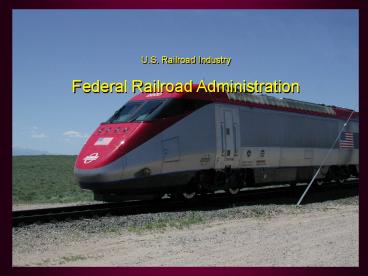
U.S. Railroad Industry Federal Railroad
Administration
2
- The Roles of FRA, DOT and the U.S. Rail Industry
3
Federal Railroad Administration (FRA), U.S.
Department of Transportation Key Players
- Federal Agencies
- Federal Railroad Administration
- Surface Transportation Board
- National Mediation Board
- Industry Associations
- Association of American Railroads
- American Short Line Regional Railroad
Association - Railway Supply Institute
- Major Shipper Associations
- National Industrial Transportation League
- Edison Electric Institute
- American Chemistry Council
4
Federal Railroad Administration (FRA), U.S.
Department of Transportation FRA Organization
Structure
Administrator
Public Affairs/ Civil Rights
Safety
Chief Counsel
Administration/ Finance
Policy and Communications
Railroad Development
5
Federal Railroad Administration (FRA), U.S.
Department of Transportation FRA Regions
6
Federal Railroad Administration (FRA), U.S.
Department of Transportation FRA Mission
Statement
- Promulgate and enforce rail safety regulations
- Administer railroad financial assistance
- programs
- Conduct research and development in support
- of improved rail safety
- Develop national rail transportation policy
- Administer grant agreements to Amtrak
7
- Operating Statistics and Financial Results of the
U.S. Rail Freight System
8
Federal Railroad Administration (FRA), U.S.
Department of Transportation Selected 2006 Rail
Freight Statistics
- 140,490 miles of road owned by railroads
- 23,732 locomotives
- 1.3 million rail freight cars
- 99 average tons per carload
- 186,957 workers Class I 168,438
- 2.0 billion ton-miles carried
- 32.1 million freight cars originated
- 52.2 billion annual operating revenue
- 11.3 rate of return on shareholders equity
- Class I only
9
Federal Railroad Administration (FRA), U.S.
Department of Transportation GIS Rail Density
Map (Volume in Millions of Tons)
10
Federal Railroad Administration (FRA), U.S.
Department of Transportation 2002 Freight
Comparisons in 000,000 ton/km
Source UIC
11
Federal Railroad Administration (FRA), U.S.
Department of Transportation 2001 Passenger
Comparisons in pax/km
Source UIC
12
Federal Railroad Administration (FRA), U.S.
Department of Transportation Freight Market
Share
13
Federal Railroad Administration (FRA), U.S.
Department of Transportation Commodities Tons
Carried
14
Federal Railroad Administration (FRA), U.S.
Department of Transportation U.S. Railroad Net
Investment cumulative in billions of
15
Federal Railroad Administration (FRA), U.S.
Department of Transportation U.S. Railroad
Industry Staffing in thousands
16
Federal Railroad Administration (FRA), U.S.
Department of Transportation Staggers Act
Productivity ton-miles/employee-hour
Staggers Act
17
Rail Rates
- Rail freight rates adjusted for inflation
declined an average of 0.6 per year - from 1990 through 2005
Staggers Act 1980
Sources Bureau of Labor Statistics, Producer
Price Index for Line-Haul Railroads
Bureau of Economic Analysis, Implicit Price
Deflator for Gross Domestic Product
18
Rail, Maritime, andIntermodalism
19
Federal Railroad Administration (FRA), U.S.
Department of Transportation Intermodal Traffic
- Intermodal traffic second only to coal
- 1980 3.0 million trailers and containers
originated - 2005 11.7 million trailers and containers
originated - Double-stack container loads increasing,
including expansion from the Midwest to the
Eastern Seaboard - advantage of 1 train with a crew of 2 hauling 200
containers versus 100 truck drivers and trucks
hauling 100 double trailers
20
INTERMODAL GROWTHLOADINGS IN MILLIONS OF UNITS
Source Association of American Railroads,
Railroad Facts
21
Freight Volumes Growing Faster than Passenger
22
- Issues Facing the Industry
23
Truck Freight Flows, All CommoditiesAll truck
types highway freight density in tons
Federal Railroad Administration (FRA), U.S.
Department of Transportation A Question of
Congestion and Capacity
Rail Freight Flows, All CommoditiesRail freight
density in tons
24
The Future
- Freight traffic is expected to double by 2020.
- Population growth and economic growth mean that
the domestic transportation system will be
further strained. - Funding for expansion not identified.
- Environmental issues will slow increases in
capacity.
25
Railroad Freight Growth 2003 - 2008
Rail ton-miles 3.0 per year Rail intermodal
units 4.9 per year Rail tons carried 2.2
per year Rail carloads 1.9 per year
26
Rail Capacity Growth
- Railroads are expanding workforces and
infrastructure. - Rate of expansion determined by profitability.
- Demand for intermodal and coal are the key
factors. - Railroads reluctant to invest speculatively
will the demand be there in the future? - Railroad profits do not justify rapid increases
in capacity.
27
In Closing
- Economic strength and trade relationships will
increasingly define global influence in the 21st
centuryand influence can help guide change - 16th-19th century.age of locational advantage
- 20th centuryage of competitive advantage
- 21st centuryage of competitive collaborative
advantage
28
- The End
http\\www.fra.dot.gov
Recommended

