

Blogs in the classroom: Utilizing CommentPress for a case-study course PowerPoint PPT Presentation
1 / 22
Title: Blogs in the classroom: Utilizing CommentPress for a case-study course
1
Blogs in the classroom Utilizing CommentPress
for a case-study course
- Joon Soo Lim, The School of Journalism
2
My teaching in case study
- Case study in public relations online public
relations. - One of the challenges
- the lack of standard textbook
- too many industry jargons
- rapidly changing communication technologies, and
finally, - Surprisingly, todays college students are NOT
tech-savvy. - Use of a Blog for educational tool
- to facilitate inside and out of the classroom
discussion - to improve students digital literacy
3
Blogs in the Classroom
- the use of blogs in education is on the rise
- educational blogging business Edublog (blogging
for teachers and students) - Free without any advertising,
- come with 100MB of free upload space
- Powered by WordPress
- Uses (Richardson, 2009)
- Post and upload class materials information
- Provide cases and examples with multimedia clips
- Provide links to external Web resources
- Invite students comments or feedback
4
Advantages of using blogs in classroom
- A useful pedagogical device
- Flexibility and the ability to recontextualize
information (Williams Jacobs, 2004) - Save time and costs (Quible, 2005)
- Blog-based conversation as a powerful tool for
learning (Instone, 2005 Glogoff, 2005) - Promote deep learning (Instone, 2005)
5
Some issues in adopting blogs in education
- Reverse Chronological ordering
- All comments are displayed linearly at the bottom
of the page - Even the discussion in the form of comments and
trackbacks are not threaded
6
Overcoming the limitations using CommentPress
- What is CommentPress
- an open source theme for the WordPress that
allows readers to comment paragraph by paragraph
in the margins of a text column - Digital version of Marginalia
- developed by the Institute for the Future of the
Book - Philosophy
- Text is meant to be a conversation.
7
Overcoming the limitations using CommentPress
8
Screenshot Chronological ordering of posts
9
Screenshot Threaded comment
10
Innovation in the blog-based discussion
- Innovation in discussion
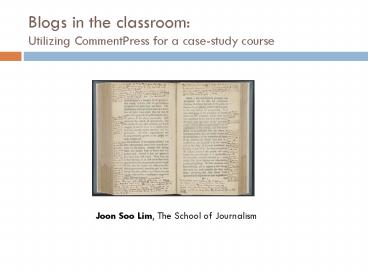
- Marginalia is not new in the history of book
Marginalia
11
Whats new, then?
- allows multiple readers to engage with a text
simultaneously, and to engage with one another
across time and distance
- made it possible to have the comment area move in
the right hand column as you scrolled down the
page, changing its contents depending on which
paragraph in the left hand column you selected. - helps capture the immediacy and interactivity of
the margin note for class blogs
12
Advantages
- Make comments in the margin
- Next to the paragraph of the text to which the
comment pertains - promotes dialogue within and around the text
- Within comment on the page as a whole
- Around comment on each paragraph.
- add threadedness to the discussion,
- commenters can reply to each other
13
Advantages of using CommentPress
- Table of Contents
- Discussion topics will be viewable in a
chronological order.
14
How to install CommentPress
- Install WordPress, then upload CommentPress onto
the WP-Content gt Themes - Then, activate the CommentPress from WP-admin gt
Design tab - Sign up for the Edublogs service
- Then, go to presentation from the dashboard, and
choose CommentPress as your theme.
15
Testimonials
- Elevated the level of class discussion about
those poems. CommentPress in My Classroom, The
author of The USA English Forum Blog
16
Testimonials (contd)
- Providing so many points of entry really gives
the possibility of a much more rich and nuanced
conversation University Publishing in a digital
age, by Ithaka, a NPO.
17
CommentPress in Education Some examples (contd)
- Literary-criticism courses
- Critiques of Poems
- The Divine Comedy Inferno
18
CommentPress in Education Some examples (contd)
- Textbook writing
- Publish chapters of ones upcoming book
- Jonathan Zittrain, The future of the Internet and
how to stop it. Yale University Press (CCL)
19
CommentPress in Education gamer theory (contd)
20
CommentPress for a case-study course Case
studies in PR online public relations
- Organize class lessons in a chronological context
- Provide cases and examples with multimedia clips
- Questions or feedback directly on the chunks of
text. - Have students put comments on text or,
- have students respond to each others case
analysis from their own blogs i.e., Trackbacks
21
Suggestions Possible Use
- Speech analysis Responding to different segments
of speech
22
References
- Glogoff, S. (2005). Instructional blogging
Promoting interactivity, student-centered
learning, and peer input. Innovate 1 (5).
Retrieved July 18 from http//www.innovateonline.i
nfo/index.php?viewarticleid126 - Instone, L. (2005). Conversations beyond the
classroom Blogging in a professional development
course. Proceedings of the Australasian Society
for Computers in Learning in Tertiary Education
2005. Retrieved July 2, 2008, from
http//www.ascilite.org.au/conferences/brisbane05/
blogs/proceedings/34_Instone.pdf. - Johnson, A. (2004). Creating a Writing Course
Utilizing Class and Student Blogs. The Internet
TESL Journal, 10(8). Retrieved July 15, from
http//iteslj.org/Techniques/Johnson-Blogs/ - Read, B. (2007, September 28). Marginally better
Software uses side notes to turn books into
discussions. The Chronicle of Higher Education.
Vol 54, issue 5, p. A23. - Richardson, W. (2009). Blogs, Wikis, Podcasts,
and other powerful Web tools for classrooms (2nd
Ed).Thousand Oaks, CA Corwin Press. - Quible, Z. K. (2005). Blogs and written business
communication courses a perfect union. Journal
of Education for Business, 80(6), 327-333. - Williams, J. B., Jacobs, J. (2004). Exploring
the use of blogs as learning spaces in the higher
education sector. Australasian Journal of
Educational Technology, 20(2), 232-247.
Recommended

