

NO ONE TAUGHT THEM THE RULES: Children Make Visual Information PowerPoint PPT Presentation
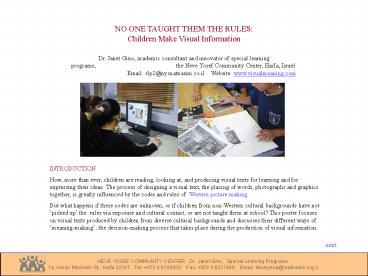
Title: NO ONE TAUGHT THEM THE RULES: Children Make Visual Information
1
NO ONE TAUGHT THEM THE RULES
Children Make Visual Information Dr.
Janet Gino, academic consultant and innovator of
special learning programs,
the Neve Yosef
Community Center, Haifa, Israel
Email slp2_at_ny.matnasim.co.il
Website www.visualmeaning.com
INTRODUCTION Now, more than ever, children are
reading, looking at, and producing visual texts
for learning and for expressing their ideas. The
process of designing a visual text, the placing
of words, photographs and graphics together, is
greatly influenced by the codes and rules of
Western picture making . But what happens if
these codes are unknown, or if children from
non-Western cultural backgrounds have not picked
up the rules via exposure and cultural contact,
or are not taught them at school? This poster
focuses on visual texts produced by children from
diverse cultural backgrounds and discusses their
different ways of meaning-making, the
decision-making process that takes place during
the production of visual information.
next
NEVE YOSEF
COMMUNITY CENTER Dr. Janet Gino, Special
Learning Programs
1a, Harav
Mashash St., Haifa 32167 Tel 972 4 8129200
Fax 972 4 8227499 Email Neveyose_at_matnasim.or
g.il
2
WESTERN PICTURE MAKING In 1435 Leon-Battista
Alberti wrote his treatise De pictura (On
painting) which explained his idea that a picture
could function as a window onto the world.
Founded on mathematical calculations, Alberti
devised the concept of perspective, a form of
visual representation that depicted depth and
volume in a flattened form. This gave rise to the
terms vanishing point, with objects drawn
smaller as the distance from the observer
increased, and foreshortening which involved
spatial distortions. The invention of
perspective has fundamentally affected how
Western eyes see the world, shaped the rules of
visual communication and has even influenced the
way we think see what I mean?
Design of Albertis perspective diagram. Mario A.
Caro
back
NEVE YOSEF
COMMUNITY CENTER Dr. Janet Gino, Special
Learning Programs
1a, Harav
Mashash St., Haifa 32167 Tel 972 4 8129200
Fax 972 4 8227499 Email Neveyose_at_matnasim.or
g.il
3
LOCATION All the visual texts shown in this
poster were produced by children aged 11 years,
involved with the Neve Yosef Community Center.
This Center, belonging to the Israeli Association
of Community Centers, serves a low
socio-economic, urban neighborhood in Haifa. The
local population consists of native born families
(40) and newcomers from the former Soviet Union
and Ethiopia (60). Over the years, the Neve
Yosef Community Center has become a leading
exponent in the development of intercultural
social interaction and equality in Israel. The
staff strongly supports programs that encourage
children to develop and enrich their range of
visual literacies, helping them succeed in an
education system that increasingly uses visual
texts (book and electronic) for teaching.
The Neve Yosef Community Center, Haifa, Israel
next
NEVE YOSEF
COMMUNITY CENTER Dr. Janet Gino, Special
Learning Programs
1a, Harav
Mashash St., Haifa 32167 Tel 972 4 8129200
Fax 972 4 8227499 Email Neveyose_at_matnasim.or
g.il
4
BACKGROUND Dr. Janet Ginos personal background
has played a significant role in her interest in
multicultural visual literacies. Many years ago
she also came to Neve Yosef as a newcomer, and
like many of her neighbors she was able to access
a range of cultural alternatives for making
meaning of the world. Spending time with the
local children, who like to work in same-culture
groups, Dr. Gino was able to witness at first
hand their interaction with visual images. Their
enthusiasm, indifference or negative responses to
the viewing and/or making of visual ideas and
messages, prompted her to question the complex
relationship between visual language and the
cultural history of the child.
A group of native born Israeli girls arranging
information on road safety
next
NEVE YOSEF
COMMUNITY CENTER Dr. Janet Gino, Special
Learning Programs
1a, Harav
Mashash St., Haifa 32167 Tel 972 4 8129200
Fax 972 4 8227499 Email Neveyose_at_matnasim.or
g.il
5
THE RESOURCES Numerous visual information
projects have been carried out at the Neve Yosef
Community Center. The same set of visual
resources and equipment are always used - paper,
photocopied photographic segments (depending on
the subject), writing and drawing tools. The
photographic segments represent partial images of
objects, structures, and familiar details, cut
out of context and set onto a white background.
These are placed in separate transparent plastic
files, each holding 15-20 copies. The files are
scattered at random on tables, in no order of
subject matter. Most of the children feel
comfortable working with these visual resources.
They can be used to create a wide range of
semiotic systems (visual and linguistic) and to
construct a variety of different visual
configurations.
An example of the visual resources and equipment
used in the visual information projects.
next
NEVE YOSEF
COMMUNITY CENTER Dr. Janet Gino, Special
Learning Programs
1a, Harav
Mashash St., Haifa 32167 Tel 972 4 8129200
Fax 972 4 8227499 Email Neveyose_at_matnasim.or
g.il
6
VISUAL TEXTS The paths children take when
making meaning with a set of given materials,
the way they use and manipulate words and
photographs to make visual information, reflects
on their social knowledges, motivations and
interests. The theoretical framework used to
analyze the childrens works is based on 1) The
socio-cultural constructionist perspective
regards children as social beings who
understand/learn about the world through the
socio-cultural environments in which they are
nurtured. 2) The interpretative analysis of
iconology seeks to understand the meaning behind
humankinds art making and creative efforts. 3)
Visual social semiotic theory tracks the
production of meaning by carefully unpicking the
visual characteristics that make up a text,
providing a descriptive framework that helps
interpret meaning-making as a cultural and
historic process.
Two examples from the My Neighborhood project,
produced by children aged 11 years. These texts
represent two different identifiable visual
styles made by children living in the Neve Yosef
neighborhood.
next
NEVE YOSEF
COMMUNITY CENTER Dr. Janet Gino, Special
Learning Programs
1a, Harav
Mashash St., Haifa 32167 Tel 972 4 8129200
Fax 972 4 8227499 Email Neveyose_at_matnasim.or
g.il
7
COMPARISON OF TWO VISUAL STYLES (1) The my
neighborhood project involved many children from
the local community. They were given pencils,
paper and photograph segments, and asked to make
some information about the neighbourhood. No
instructions were given, and guidance offered as
to how to use the materials. The example below,
with the neighbourhood observed from one
viewpoint, has been arranged by a 11 year old boy
from the former Soviet Union (FSU), four years in
Israel. It can be seen that the visual text has
been set out in accordance with the accepted
convention for creating distance in three levels
top background, middle ground, bottom
foreground. The visual elements, all placed in
the same direction, are linked together in a
spatial connectedness that joins these three
levels together. The child demonstrates his
understanding of perspective by the occlusion
(blocked sight line) of the pedestrian crossing
by the trees (lower left corner). From the large
amount of visual texts produced in this visual
style, it is possible to make a list of rules
that most of the children from the FSU followed
Set the information in a rectangular, landscape
format. Divide the page up into three sections to
correspond with perspective far, near and
nearer. Integrate pencil drawing with
photographic segments. Add written insets as
clues to help viewers understand the information.
All visual elements placed in the same viewing
direction
Photo segments are extended with pencil line
Visual elements lined up in three levels
background, middle ground and foreground
Sign smoking forbidden in the community
center helps map out the neighborhood for the
viewer.
White background cut off from photographic
segments and seamed together to make a new
image
Occlusion of pedestrian crossing
next
NEVE YOSEF
COMMUNITY CENTER Dr. Janet Gino, Special
Learning Programs
1a, Harav
Mashash St., Haifa 32167 Tel 972 4 8129200
Fax 972 4 8227499 Email Neveyose_at_matnasim.or
g.il
8
COMPARISON OF TWO VISUAL STYLES (2) The example
on the right, with a multi-directional viewpoint,
was produced by a 11 year old boy from Ethiopia,
four years in Israel. To the Western eye there
seems to be no clues as to how to read the
composition. None of the photographic segments
have been cut or manipulated in any way the
white background remains intact, as found in the
plastic files. A few children added partially
drawn suns at the four corners of the page (see
below). These compositional arrangements do not
follow the rules of Western picture making, so
it is difficult for a viewer familiar with
Western visualization to trace the information
values that the children have given to their
images. From the large amount of visual texts
produced in this visual style by children from
Ethiopia, it is possible to find some common
characteristics The same type of circular
composition, no manipulation of photo segments,
the ideational representation of a conceptual
neighborhood.
Name, written twice in same direction, could be
an indicator of viewing direction
No signs or clues are given to the viewer to
help with reading
White background separates photographic segments
Multi-directional viewpoint
circular type of composition
No manipulation of the photo segments
next
NEVE YOSEF
COMMUNITY CENTER Dr. Janet Gino, Special
Learning Programs
1a, Harav
Mashash St., Haifa 32167 Tel 972 4 8129200
Fax 972 4 8227499 Email Neveyose_at_matnasim.or
g.il
9
(1) Part of a 19th Ethiopian protective, healing
scroll. Parchment and ink.
(2) Soviet Socialist Realism Aleksei
Alexandrovich Vasilev They are writing about us
in Pravada,1951. Oil painting.
DISCUSSION It is suggested that the
decision-making process that guided both the boys
whilst they made visual information about my
neighborhood, was shaped by the social
knowledges and cultural practices existing in
each of their different family communities, which
perhaps also reflected different worldviews, i.e.
holistic, egocentric. An unexpected finding was
the strong connection between the boys visual
texts with the traditional visual culture of
their family backgrounds. That is, their visual
styles reflected codes and rules found in
Ethiopian (1), and Soviet (2) visual
representations, respectively. However, if
children are to become makers of visual
information, some might need more help than
others in understanding how words, photographs
and graphic elements work together to build a
message. Dr. Gino examines the range of visual
literacies children bring with them to elementary
school in the Oral Hygiene Project , which
illustrates this point. For an example of
multicultural visual communication that
encourages visual literacies and creativity using
new technologies, go to www.visualmeaning.com and
click on Through the Eyes.
next
NEVE YOSEF
COMMUNITY CENTER Dr. Janet Gino, Special
Learning Programs
1a, Harav
Mashash St., Haifa 32167 Tel 972 4 8129200
Fax 972 4 8227499 Email Neveyose_at_matnasim.or
g.il
10
1
2
3
Examples from some of the visual information
projects carried out in the Neve Yosef Community
Center 1) road safety 2) producing word/picture
stories 3) learning about the visual language of
photographs.
CONCLUSION The notion of literacy has broadened
as potentials for communication have widened.
Today, texts combine words and photographs, sound
and movement. Visual literacies are needed in the
production of these texts, either on paper or on
the screen. The visual information projects
carried out in Neve Yosef have shown that
children from different cultural backgrounds
chose different paths when constructing visual
meaning. All the paths are valid, and attempts
should be made to nurture the various visual
styles that reflect differing worldviews.
However, the children live and learn in a society
which communicates using specific historical and
cultural visual rules. Attempts should be made to
create projects that encourage all children to
become effective and creative makers of visual
information.
next
NEVE YOSEF
COMMUNITY CENTER Dr. Janet Gino, Special
Learning Programs
1a, Harav
Mashash St., Haifa 32167 Tel 972 4 8129200
Fax 972 4 8227499 Email Neveyose_at_matnasim.or
g.il
11
SUGGESTED READING Bearne, E. and.Wolstencroft H.
(2007) Visual approaches to teaching writing
(book and electronic resource) multimodal
literacy 5-11. London Paul Chapman. Bruner, J.
and Haste, H. (eds.) (1987) Making Sense. London
and New York Methuen. Cope, B. and Kalantzis, M.
(2000) Multiliteracies. London Routledge.
Kozulin, A. (1998) Psychological Tools.
Cambridge Mass. Harvard University. Jewitt, C.
(2005) Technology, literacy, learning. London
Routledge. Jewitt, Carey, Gunther Kress, Jon
Ogborn and Charalampos Tsatsarelis. (2000)
Materiality as an Aspect in Learning, in
Zeitschrift fur Erziehungswissenschaft, 3 Jahrg.,
Heft 2/2000, pp267-284. Kress, G. and van
Leeuwen, T. (1996) Reading Images. London
Routledge. Kress, G. (2003) Literacy in the New
Media Age. London Routledge. Ormerod, F. and
Ivanic, R. (2002) Materiality in childrens
meaning-making practices, in Visual
Communication, 1(1), pp 65-91. Russell, G.
(2000) Print-Based and Visual Discourses in
Schools implications for pedagogy, in
Discourse studies in the cultural politics of
education, 21(2), pp 205-217. Schirato, T. and
Webb, J. (2004) Understanding the visual. London
Sage Publications. Unsworth, L. (2001) Teaching
Multiliteracies Across the Curriculum.
Buckingham Open University Press. Wells, L.
(1997) Photography A critical Introduction.
London Routledge.
back to start
NEVE YOSEF
COMMUNITY CENTER Dr. Janet Gino, Special
Learning Programs
1a, Harav
Mashash St., Haifa 32167 Tel 972 4 8129200
Fax 972 4 8227499 Email Neveyose_at_matnasim.or
g.il
12
THE ORAL HYGIENE PROJECT Location An elementary
school located in an multicultural Israeli
neighborhood.
An instructor from the health department came to
the school to talk to each class about the
importance of cleaning teeth.
After the talk each student received printed
information and received a gift of a toothbrush
and tube of tooth paste.
next
NEVE YOSEF
COMMUNITY CENTER Dr. Janet Gino, Special
Learning Programs
1a, Harav
Mashash St., Haifa 32167 Tel 972 4 8129200
Fax 972 4 8227499 Email Neveyose_at_matnasim.or
g.il
13
A few weeks later, the 4th grade class, a mixture
of children from Israeli and newcomer families,
were questioned why clean your teeth?. The
children answered that teeth cleaning prevented
tooth decay and the yellowing of teeth. They were
asked to pass this information on to other
children who had not attended the talk with the
instructor from the health department, to put
what they wanted to say into words and pictures.
Arranged on a table in the classroom were writing
and drawing tools, and 14 trays displaying
different photographic segments (see below).
The children were shown the materials but were
not given any instructions or guidance as to how
to use them. The school had no visual literacy
program so it was assumed that in order to
fulfill the task the children would tap into
social knowledges learnt out-of-school.
next
NEVE YOSEF
COMMUNITY CENTER Dr. Janet Gino, Special
Learning Programs
1a, Harav
Mashash St., Haifa 32167 Tel 972 4 8129200
Fax 972 4 8227499 Email Neveyose_at_matnasim.or
g.il
14
Eighteen works were collected from 23 children
Translation of the Hebrew text Yes to white, no
to yellow
Five segments (1) (2) (3) (4) (5)
Translation of the Hebrew text Its
important to be strict about cleaning teeth
A third of the children produced work with a
headline and visual sentences produced by
cutting and overlaying the photograph segments.
For example, the child (left) seamed together
five different segments.
next
NEVE YOSEF
COMMUNITY CENTER Dr. Janet Gino, Special
Learning Programs
1a, Harav
Mashash St., Haifa 32167 Tel 972 4 8129200
Fax 972 4 8227499 Email Neveyose_at_matnasim.or
g.il
15
Translation of the Hebrew text Headline Brush
teeth day and night. Subtext You must brush
teeth day and night otherwise youll have holes
in your teeth and youll get germs.
Other children used the photographic segments
without altering them, as they found them in the
trays.
next
NEVE YOSEF
COMMUNITY CENTER Dr. Janet Gino, Special
Learning Programs
1a, Harav
Mashash St., Haifa 32167 Tel 972 4 8129200
Fax 972 4 8227499 Email Neveyose_at_matnasim.or
g.il
16
Most of the children in the class who came from
families from oral cultural backgrounds, who had
been studying for 4 years in the education system
in Israel, made doodles unconnected to the task.
CONCLUSION A range of linguistic, audio and
visual literacies are needed for learning in
school today. However, some children attending
school may come from cultural backgrounds that
prioritize these literacies in different ways, or
give value to other literacies. Schools have
specific learning cultures, if some children are
not taught the rules of visual language whilst in
elementary school, they may be greatly
disadvantaged as they progress through the
education system.
return
NEVE YOSEF
COMMUNITY CENTER Dr. Janet Gino, Special
Learning Programs
1a, Harav
Mashash St., Haifa 32167 Tel 972 4 8129200
Fax 972 4 8227499 Email Neveyose_at_matnasim.or
g.il
Recommended

