

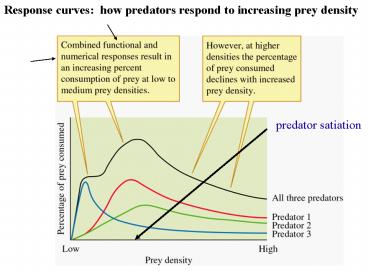
Response curves: how predators respond to increasing prey density PowerPoint PPT Presentation
1 / 29
Title: Response curves: how predators respond to increasing prey density
1
Response curves how predators respond to
increasing prey density
predator satiation
2
- Prey protection from predation
- By numbers1. Out-reproducing effects of predation
- Masting (Eucalyptus sps.)
- Two plots burn vs. control
- 3 weeks following fire
- 405 seeds/m2 on experimental plot
- 10 seeds/m2 on control plot
3
Masting a defense against predation?
Aha!
4
Cicada masting 13 17 year species density
can reach 4 x 10⁶ individs/ha
Largest recorded biomass for a terrestrial animal.
Bird predators
16 ha study site c. 1 million emerged over
a four day period
5
(No Transcript)
6
Moose and wolves
7
(No Transcript)
8
(No Transcript)
9
(No Transcript)
10
(No Transcript)
11
(No Transcript)
12
(No Transcript)
13
(No Transcript)
14
(No Transcript)
15
(No Transcript)
16
c. 5
17
c. 2
18
Age of moose killed by wolves
19
(No Transcript)
20
Exploitation Parasitism
21
Tapeworm life history
22
Hydatid cyst
23
(No Transcript)
24
Winter tick an ectoparasite
25
Life cycle of Plagiorhynchus cylindraceus
Acanthocephala Spiny-headed worms
26
Starling predation on Armadillidium vulgare
27
Exploitation of vascular plant by a fungus
Arabis hoelbollii Rockcress, a host Montane and
subalpine zones talus slopes, gravelly
stream-banks Invade, modify host to
enhance Population growth of the fungus
28
Puccinia monoica a fungus a rust
pathogenic Reproductive strategy disseminate
spores
29
Dispersal of spores
Recommended

