

Arts PowerPoint PPT Presentation
1 / 28
Title: Arts
1
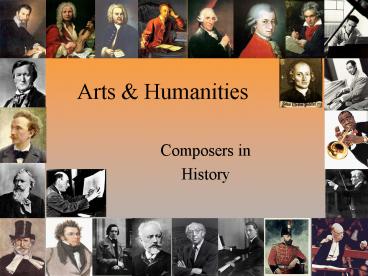
Arts Humanities
- Composers in
- History
2
BAROQUE
- Monteverdi
- Vivaldi
- Johann Pachelbel
- J.S. Bach
- Handel
3
Claudio Monteverdi
- He wrote one of the earliest operas, L'Orfeo,
which is still regularly performed.
4
Antonio Vivaldi
- Nicknamed "The Red Priest", was a Baroque music
composer and Venetian priest, as well as a famous
virtuoso violinist he was born and raised in the
Republic of Venice. The Four Seasons, a series of
four violin concerti, is his best-known work and
a highly popular Baroque piece.
5
Johann Pachelbel
- German Baroque composer, organist and teacher,
who brought the south German organ tradition to
its peak. He composed a large body of sacred and
secular music, and his contributions to the
development of the chorale prelude and fugue have
earned him a place among the most important
composers of the middle Baroque era. Today,
Pachelbel is best known for the Canon in D, the
only canon he wrote.
6
J.S. Bach
- Bach was a German composer and organist whose
sacred and secular works for choir, orchestra,
and solo instruments. While Bach's fame as an
organist was great during his lifetime, he was
not particularly well-known as a composer. A
revival of interest and performances of his music
began early in the 19th century, and he is now
widely considered to be one of the greatest
composers in the Western tradition, being
included with Ludwig van Beethoven and Johannes
Brahms as one of the "three Bs". Bach's works
include the Brandenburg concertos, the Goldberg
Variations, the English Suites, the French
Suites, the Partitas, the Well-Tempered Clavier,
the Mass in B Minor, the St. Matthew Passion, the
St. John Passion, the Magnificat, The Musical
Offering, The Art of Fugue, the Sonatas and
Partitas for violin solo, the Cello Suites, more
than 200 surviving cantatas, and a similar number
of organ works, including the celebrated Toccata
and Fugue in D Minor.
7
G.F. Handel
- German-born Baroque composer who is famous for
his operas, oratorios, and concerti grossi. Born
as Georg Friederich Händel in Halle, he spent
most of his adult life in England, becoming a
subject of the British crown. His works include
Messiah, Water Music, and Music for the Royal
Fireworks. Strongly influenced by the techniques
of the great composers of the Italian Baroque
era, as well as the English composer Henry
Purcell, Handel's music became well-known to many
composers, including Haydn, Mozart, and
Beethoven.
8
CLASSICAL
- Haydn
- Mozart
- Beethoven
9
Haydn
- Haydn was an Austrian composer. He was one of the
most prominent composers of the classical period,
and is called by some the "Father of the
Symphony" and "Father of the String Quartet". A
life-long citizen of Austria, Haydn spent much of
his career as a court musician for the wealthy
Hungarian Esterházy family on their remote
estate.
10
W.A. Mozart
- Mozart was a prolific and influential composer of
the Classical era. He composed over 600 works,
many of which are acknowledged as pinnacles of
symphonic, concertante, chamber, piano, operatic,
and choral music and he is among the most
enduringly popular of classical composers. Born
in Salzburg into a musical family, Mozart showed
prodigious ability from earliest childhood. He
could compose when only five years old, and was
already competent on keyboard and violin. He
toured for much of his childhood and adolescence,
performing before the royal courts of Europe.
11
Ludwig van Beethoven
- Beethoven was a German composer and pianist. He
was a crucial figure in the transitional period
between the Classical and Romantic eras in
Western classical music, and remains one of the
most acclaimed and influential composers of all
time. Born in Bonn, then in the Electorate of
Cologne in western Germany, he moved to Vienna in
his early twenties and settled there, studying
with Joseph Haydn and quickly gaining a
reputation as a virtuoso pianist. Beethoven's
hearing gradually deteriorated beginning in his
twenties, yet he continued to compose, and to
conduct and perform, even after he was completely
deaf.
12
ROMANTIC
- Beethoven
- Wagner
- R. Strauss
- Brahms
- Verdi
- Schubert
- Chopin
- Tchaikovsky
13
Richard Wagner
- German composer, conductor, theatre director and
essayist, primarily known for his operas (or
"music dramas", as they were later called).
Unlike most other great opera composers, Wagner
wrote both the scenario and libretto for his
works. - Wagner's compositions, particularly those of his
later period, are notable for contrapuntal
texture, rich chromaticism, harmonies and
orchestration, and elaborate use of leitmotifs
musical themes associated with particular
characters, locales or plot elements.
14
Richard Strauss
- German composer of the late Romantic and early
modern eras, particularly of operas, Lieder and
tone poems. Strauss was also a prominent
conductor.
15
Verdi
- Italian Romantic composer, mainly of opera. He
was one of the most influential composers of
Italian opera in the 19th century. His works are
frequently performed in opera houses throughout
the world and, transcending the boundaries of the
genre, some of his themes have long since taken
root in popular culture.
16
Brahms
- Composer and pianist, was one of the leading
musicians of the Romantic period. Born in
Hamburg, Brahms spent much of his professional
life in Vienna, Austria, where he was a leader of
the musical scene. In his lifetime, Brahms's
popularity and influence were considerable. He
is sometimes grouped with Johann Sebastian Bach
and Ludwig van Beethoven as one of the Three Bs.
Brahms composed for piano, for chamber ensembles,
for symphony orchestra, and for voice and chorus.
17
Schubert
- Was an Austrian composer. He wrote some 600
lieder, nine symphonies (including the famous
"Unfinished Symphony"), liturgical music, operas,
and a large body of chamber and solo piano music.
He is particularly noted for his original melodic
and harmonic writing.
18
Chopin
- Was a composer and virtuoso pianist of the
Romantic period. He is widely regarded as the
greatest Polish composer, and ranks as one of
music's greatest tone poets. Chopin's extant
compositions were written primarily for the piano
as a solo instrument. Though they are technically
demanding his style emphasizes nuance and
expressive depth. Chopin invented musical forms
such as the ballade and was responsible for major
innovations in forms such as the piano sonata,
waltz, nocturne, étude, impromptu and prelude.
His works are mainstays and masterpieces of
Romanticism in 19th-century classical music.
19
Tchaikovsky
- Russian composer of the Romantic era. While not
part of the nationalistic music group known as
"The Five", Tchaikovsky wrote music which was
distinctly Russian. Tchaikovsky's essential
outlook musically remained Russian, both in his
use of native folk song and his deep absorption
in Russian life and ways of thought. Tchaikovsky
wrote several works well known among the general
classical publicRomeo and Juliet, the 1812
Overture, his three ballets The Nutcracker, Swan
Lake, and The Sleeping Beauty and Marche Slave.
These, along with two of his four concertos,
three of his six symphonies and two of his 10
operas, are probably among his most familiar
works.
20
20TH CENTURY
- Copland
- Gershwin
- John Phillip Sousa
- Stravinsky
- Bernstein
- Armstrong
- Ellington
- Cage
- Schoenberg
21
Copland
- American composer of concert and film music, as
well as an accomplished pianist. Instrumental in
forging a distinctly American style of
composition, he was widely known as "the dean of
American composers." Copland's music achieved a
balance between modern music and American folk
styles. Aside from composing, Copland was a
teacher, lecturer, critic, writer, and conductor
of his own works. Copland was awarded the New
York Music Critics Circle Award and the Pulitzer
Prize in composition for Appalachian Spring.162
His scores for "Of Mice and Men" (1939), "Our
Town" (1940), and "The North Star" (1943) all
received Academy Award nominations, while "The
Heiress" won Best Music in 1950.146
22
Gershwin
- American composer and pianist. He wrote most of
his vocal and theatrical works in collaboration
with his elder brother, lyricist Ira Gershwin.
George Gershwin composed songs for both Broadway
and the classical concert hall. Many of his
compositions have been used on television and in
numerous films, and many became jazz standards.
Countless singers and musicians have recorded
Gershwin songs, including Fred Astaire, Louis
Armstrong, Al Jolson, Bobby Darin, Art Tatum,
Bing Crosby, Janis Joplin, John Coltrane, Frank
Sinatra, Billie Holiday, Sam Cooke, Diana Ross,
Miles Davis, Herbie Hancock, Hiromi Uehara,
Madonna, Judy Garland, Julie Andrews, Barbra
Streisand, Marni Nixon, Natalie Cole, Patti
Austin, Nina Simone, Maureen McGovern, John
Fahey, The Residents, Kate Bush, Sublime, and
Sting. - Popular Orchestral Works
- Rhapsody in Blue (for piano and orchestra,
1924) - An American in Paris (for orchestra, 1928)
- Broadway Musicals
- Strike up the Band (1927)
- Opera
- Porgy and Bess (1935 this was, however, first
presented on Broadway, rather than in an opera
house)
23
John Phillip Sousa
- American composer and conductor of the late
Romantic era known particularly for American
military and patriotic marches. Because of his
mastery of march composition and resultant
prominence, he is known as "The March King". In
public he was typically referenced by his full
name.
24
Igor Stravinsky
- Russian-born composer, considered by many to be
the most influential composer of 20th century
music. In addition to the recognition he
received for his compositions, he also achieved
fame as a pianist and a conductor, often at the
premieres of his works. He first achieved
international fame with three ballets
commissioned by the impresario Sergei Diaghilev
and performed by Diaghilev's Ballets Russes
(Russian Ballets) L'Oiseau de feu ("The
Firebird") (1910), Petrushka (1911/1947), and Le
Sacre du printemps ("The Rite of Spring") (1913).
The Rite, whose premiere provoked a riot,
transformed the way in which subsequent composers
thought about rhythmic structure, and was largely
responsible for Stravinky's enduring reputation
as a musical revolutionary, pushing the
boundaries of musical design.
25
Leonard Bernstein
- Multi-Emmy-winning and Academy Award nominated
American conductor, composer, author, music
lecturer and pianist. He was the first conductor
born and educated in the United States of America
to receive worldwide acclaim. He is perhaps best
known for his long conducting relationship with
the New York Philharmonic, which included the
acclaimed Young People's Concerts series, and
also for his compositions, which include the
musical theater works West Side Story, Candide,
and On the Town. Bernstein was the first
classical music conductor to make numerous
television appearances, all between 1954 and
1989. Additionally he had a formidable piano
technique, and was a highly respected composer.
He is one of the most influential figures in the
history of American classical music, championing
the works of American composers and inspiring the
careers of a generation of American musicians.
26
Duke Ellington
- American composer, pianist, and bandleader. Duke
Ellington was recognized during his life as one
of the most influential figures in jazz, if not
in all American music. His reputation has
increased since his death, including a special
award citation from the Pulitzer Prize Board. He
often composed specifically for the style and
skills of individuals, such as "Jeep's Blues" for
Johnny Hodges, "Concerto for Cootie" ("Do Nothing
Till You Hear from Me") for Cootie Williams and
"The Mooche" for Tricky Sam Nanton. He also
recorded songs written by his bandsmen, such as
Juan Tizol's "Caravan" and "Perdido" which
brought the "Spanish Tinge" to big-band jazz.
After 1941, he frequently collaborated with
composer-arranger Billy Strayhorn, whom he called
his alter-ego.
27
John Cage
- American composer. A pioneer of chance music,
electronic music and non-standard use of musical
instruments, Cage was one of the leading figures
of the post-war avant-garde and, in the opinion
of many, the most influential American composer
of the 20th century. Cage is perhaps best known
for his 1952 composition 4'33?, the three
movements of which are performed without a single
note being played. A performance of 4'33? can be
perceived as including the sounds of the
environment that the listeners hear while it is
performed, rather than merely as four minutes and
thirty three seconds of silence and became one of
the most controversial compositions of the
twentieth century. Another famous creation of
Cage's is the prepared piano (a piano with its
sound altered by placing various objects in the
strings), for which he wrote numerous
dance-related works and a few concert pieces, the
most well-known of which is Sonatas and
Interludes (194648).
28
Schoenberg
- Austrian and later American composer, associated
with the expressionist movement in German poetry
and art, and leader of the Second Viennese
School. He famously developed twelve-tone
technique, a widely influential compositional
method of manipulating an ordered series of all
twelve notes in the chromatic scale. - Schoenberg was also a painter, an important music
theorist, and an influential teacher of
composition his students included Alban Berg,
Anton Webern, and later John Cage, Lou Harrison,
and David Van Vactor.
Recommended

