

Quiet Product Design Dr. Gary Koopmann, Group Leader PowerPoint PPT Presentation
1 / 39
Title: Quiet Product Design Dr. Gary Koopmann, Group Leader
1
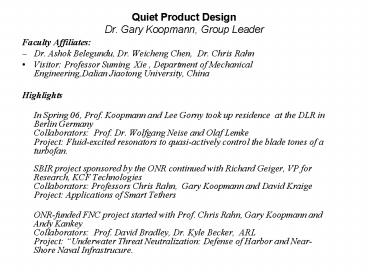
Quiet Product Design Dr. Gary Koopmann, Group
Leader
- Faculty Affiliates
- Dr. Ashok Belegundu, Dr. Weicheng Chen, Dr.
Chris Rahn - Visitor Professor Suming Xie , Department of
Mechanical Engineering,Dalian Jiaotong
University, China - Highlights
- In Spring 06, Prof. Koopmann and Lee Gorny took
up residence at the DLR in Berlin
GermanyCollaborators Prof. Dr. Wolfgang Neise
and Olaf LemkeProject Fluid-excited resonators
to quasi-actively control the blade tones of a
turbofan. SBIR project sponsored by the
ONR continued with Richard Geiger, VP for
Research, KCF TechnologiesCollaborators
Professors Chris Rahn, Gary Koopmann and David
Kraige Project Applications of Smart Tethers - ONR-funded FNC project started with Prof. Chris
Rahn, Gary Koopmann and Andy Kankey
Collaborators Prof. David Bradley, Dr. Kyle
Becker, ARL Project Underwater Threat
Neutralization Defense of Harbor and Near-Shore
Naval Infrastrucure.
2
Theses Completed/ 2006 Graduations
- Randy Rozema, M.Engr. Spring 2006Thesis Topic
Assesssing the Accuracy of Measuring Sound
Intensity and Sound Power with an Automated
Moving Probe. Sponsor Emerson Climate
Technologies Advisor G. Koopmann - Brian Zellers, Ph.D. Winter 2006Thesis Topic
An Acoustic Superposition Method for Computing
Structural Radiation in Spatially Digitized
Domains. Sponsor Office of Naval Research - Advisors G. Koopmann and M. Jonson
- David Kraige, MS Engineering, Spring 2007
- Thesis Topic Model-based Algorithm for
Localization of Tethered Bodies Using Distributed
Sensors. - Sponsor KCF Technologies SBIR
- Advisors G.H. Koopmann, Chris Rahn
3
Graduate Students and Research Projects in
Progress
- Germain Huang, Ph.D. expected Fall 2007
- Thesis Topic Simulation of Radiation Fields via
Universal Impedances Functions in Digitized
Acoustic Domains. - Sponsor The Graduate Program in
AcousticsAdvisors G. Koopmann and V. Sparrow - Lee Gorny, Ph.D. expected summer 2008
- Thesis Topic The Use of Flow-excited
Resonators for Quasi-active Control of Blade
Tones and Their Harmonics. - Sponsor Applied Research Laboratory EF
funding - Advisors G. Koopmann and D. Capone
- Andy Kankey , Ph.D. expected Fall 2008
- Thesis Topic Develop a system level control
architecture that integrates the detection and
tracking of an intruder in the complex and
dynamic underwater environment with sound source
control agility to keep up with a moving
target. - Sponsor Office of Naval ResearchAdvisors
G. Koopmann and Chris Rahn
4
Underwater Threat Neutralization Swimmer Defense
ONR Project with ARL, CAV Dr. Gary Koopmann, Dr.
Chris Rahn Dr. David Bradley, Dr. Kyle Becker ME
PhD Candidate Andrew Kankey ACS MS Student
Michael Zucker
5
Motivation Vulnerability of ships in offshore
anchoring sites or within the harbors and ports
throughout the world are targets for small craft,
submersibles and swimmers.
- Increase the technology and understanding of
lower frequency underwater acoustics. - Develop means of modeling, simulating and
controlling underwater acoustic systems.
6
Swimmer
dSPACE System
High Frequency Sonar Source
Harbor Acoustic Model
7
Harbor Acoustic Model
8
Harbor Acoustic Model
9
Harbor Acoustic Model
10
Harbor Acoustic Model
11
Jacksonville Quarry Experimental Venue
Sources
Hydrophones
60m
12
Phases for sources were obtained experimentally
to create maximum pressure at the Swimmer
location. This result is a numerical simulation.
Frequency was 250 Hz.
13
Theoretical Results, 250 Hz
Theoretical Results, using Experimental Phases
Theoretical Results, using Experimental Phases,
and reflections off of nearest wall
14
UAIM will be used to model acoustic of Codding
Cove Harbor (including sources and complex
boundary conditions).
source
Field Nodes
Universal Acoustic Impedance Matrix, Z
(UAIM) pZv
15
After generating a digitized, numerical model for
the harbor and its boundaries, the optimal phase
of the sound sources can be calculated which
includes the effects of reflections.
16
Future Endeavors
- More Quarry Tests
- Trip to Narraganset Bay (RI) in July
- More work on Numerical Method
17
Simulating Acoustic Fields in Digital SpaceUsing
a Universal Impedance Template
Yongsin Hwang, Ph,D. Candidate
Dr. G. Koopmann (Co-advisor) Dr. V. Sparrow
(Co-Advisor) Ph.D. Committee Members Dr. J.
Fahnline Dr. M. Trethewey
18
In this new approach, meshed, elemental surfaces
are replaced with points contained within
digitized, cubic acoustic volume
An Acoustic Impedance Template is generated
relating each point to every other point
A vibration of a structure is described simply
by placing velocity sources at points
corresponding to the geometry of the structure
19
Example of Universal Acoustic Impedance Matrix to
compute Radiation in Digitized Space
20
Example of a 1-D Digitized Volume of Acoustic
Impedance
Line configuration
Cube Volume
Given a velocity, pressure at every point is
obtained from the relationship,
Line conf. result
21
UAIM compared to conventional Superposition
method Substantial simplification in computation
22
UAIM compared to conventional Superposition
method Substantial simplification in computation
23
Superposition by x, y, z components
- A major challenge in UAIM was learning how to
incorporate surface normal and velocity vectors
into impedance information before geometry is
defined.
x component
R
Actual surface undefined
v
24
Superposition by x, y, z components
Solution Velocity is always normal to the
surface. In other words, surface normal and
velocity are parallel, and surface normal can be
tailored with velocity at a later step in the
calculation.
x component
R
Component surface
Actual surface
vx
v
where
25
Superposition by x, y, z components
- Must input vector form of velocity to tailor
surface normal in UAIM - Each of x,y,z components is calculated
separately, then summed for total pressure
26
Transposing Velocity components
- UAIM requires 3 impedance matrices in each x,y,z
axis. - Being independent of geometry allows UAIM to use
single impedance matrix by means of coordinate
transpose.
4 sources in 2D and resulting pressures
27
Preliminary results by UAIM show good agreement
with analytical solutions
- A pulsating cube prescribed with velocity
distribution as described above on all 6 faces. - Compared to a sphere of an equal surface area
radially pulsating at 1 m/s. - To meet structural dimension, a for sphere is
diameter instead of typically used radius.
28
Preliminary results by UAIM indicate no
singularities due to non-uniqueness
A cube of a side length of 0.4m given a velocity
distribution of a sphere (r 0.1m) pulsating at
1m/s
0.4m
Comparison of power output from pulsating sphere
of radius of 0.1m using 3 different methods
Red line closed from solution Black line
a cube with velocity matching that of a said
sphere using UAIM Blue line a cube with
velocity matching that of a said sphere using
Superposition
29
Digitizing Acoustic Space Results in Major
Simplifications for Computing Radiation from
Vibration Surfaces
- Advantages include
- Avoiding singularity in Greens functions
calculations - Simplifying definition of surface normals
- Eliminating the non-uniqueness problem
- Eliminating the need to integrate Greens
function over surface of geometry - Circumventing the need to invert large matrices
for every design iteration
30
Smart Tether Device for Localization of Tethered
Bodies in Ship Hull Inspection
Tether Length gt Depth
- Sponsor Technical Direction
- ONR Phase II STTR
- Dr. Tom Swean
- NSWC Panama City
- Chuck Bernstein
- Key Personnel
- KCF Technologies
- Jeremy Frank, Presenter
- Richard Geiger
- Penn State University
- Professor Gary Koopmann
- Professor Chris Rahn
- David Kraige
- Status
- Prototype Demonstration in July 2006
- Phase II ? September 2007
- Defining Transition Application
- Ship Hull Inspection
Large Watch Circle Error
Unknown Vehicle Position
31
Technical Strategy
- Project Vision
- Develop a new technique for navigation of
tethered underwater vehicles (crawlers, ROVs,
UUVs) - Objectives
- Develop a prototype and demonstrate feasibility
- Develop a functional system for an application
Ship Hull Inspection - Advantages
- Refresh rate 10-20 Hz
- Dependability
- Rapid deployment (minutes)
- Unaffected by noise, reflections
- Accuracy (lt 1.5 meters)
32
Phase II Prototype DemonstrationNSWC Panama
City, July 2006
Buoy
Float/Radio
Visual Markings
Buoy
Prototype Tether
Float/Radio
MockCrawler
Sensor Node (1)
Test Pond NSWC Panama City
33
2006 Phase II Prototype DemonstrationNSWC Panama
City, July
Utility Float w/ Radio
Receiver / Data Processing
User Interface
- KCF Technologies / Penn State
- Professor Chris Rahn
- Professor Gary Koopmann
- David Kraige
- NSWC Panama City
- Chuck Bernstein
- Ed Kloess
- Lee Cofer
Sensor Node on Tether(Lazy Line)
34
Graphical Interface and Confidence Indicator
Buoy
Float/Radio
35
Experimental Results
Max error 1.0 m (3.3 ft., 5.1 of Tether Length)
Static error lt 0.25 m (1 ft.)
Average error lt 0.4 m (1.3 ft., 2.0 of Tether
Length)
36
Generation 2Hardware Implementation
KCF Smart Tether
ROVVideoRay Scout
PATENT PENDING
37
Generation 2Hardware Implementation
KCF Smart Tether
ROVVideoRay Scout
PATENT PENDING
38
Smart Tether Transition Application- Navigation
for Ship Hull Inspection
PATENT PENDING
- Advantages for HULS
- Refresh rate 10-20 Hz
- Dependability (confidence indicator)
- Rapid deployment (minutes)
- Unaffected by noise
- Accuracy (lt 1.5 meters)
- Robust (magnetic field variance)
- No signature (passive)
- Compatibility
39
Upcoming Activities
- Navy Opportunity Forum (Show Tell)
- 7-9 May, 2007
- Transition Assistance Program (TAP)
- Crystal City, VA
- Demonstration
- AUVFest June 2007
- Questions?
Contact KCF Technologies, Inc. State College,
PA 814-867-4097 www.kcftech.com jfrank_at_kcftech.com
Recommended

