

An Introduction To The Health Effects of Nicotine See Notes Section PowerPoint PPT Presentation
1 / 31
Title: An Introduction To The Health Effects of Nicotine See Notes Section
1
An Introduction To The Health Effects of
Nicotine(See Notes Section)
ENVH 375 Toxicology
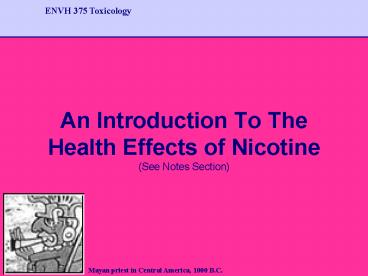
Mayan priest in Central America, 1000 B.C.
2
What Is Nicotine?
3
Nicotine
- Nicotine (C10H14N2) is a naturally occurring
liquid alkaloid. - An alkaloid is an organic compound made out of
carbon, hydrogen, nitrogen and sometimes oxygen.
4
Question
- Have you every tried nicotine?
- What were the immediate effects?
5
Historical Awareness
- 2,000 years ago (maybe 6,000) - natives of the
Americas used tobacco as a medicine, in religious
ceremonies, and as offerings to spirits. - 1492 - Christopher Columbus introduce tobacco and
nicotine to Spain
6
Historical Awareness
- 1612 - British colony at Jamestown, Virginia,
exporting tobacco to England became an
essential source of money - 1700-1800s - Farms used slaves to cultivate
tobacco
7
Historical Events
1614 Cigarettes were invented by beggars in
Seville, Spain (from scrap of cigars) 1763
Nicotine used as an insecticide 1828 Nicotine
isolated from tobacco leaves 1850s Cigarettes
increased in popularity 1880 Machine to roll
cigarettes patented (10,000 per hour)
cigarettes get cheaper
8
Quote - Quitting
- To cease smoking is the easiest thing I ever
did. I ought to know, I've done it a thousand
times." - Mark Twain
9
Sir Walter Raleigh
Sir Walter Raleigh popularized pipe smoking in
England. He was beheaded on October 28, 1618 but
before his head dropped he requested to smoke a
final bowl full of tobacco.
10
Modern Events
1964 U.S. surgeon general linked cigarette
smoking with lung cancer and coronary artery
disease. 1996? FDA finds that nicotine is
addictive 1999? US Supreme Court rules that FDA
can not regulate nicotine 2000? Tobacco
companies required to pay billions to compensate
for health effects 2000 World wide tobacco
consumption continues to increase
11
Smoking
- Nicotine in a cigarette 8 to 10 mg
- Smoking delivers about 1 mg to the smoker
- Technique of smoker can increase nicotine (time
smoke is in lungs, rapid puffing)
12
Nicotine Absorption
- Lung (nicotine enters brain in 7 seconds)
- Skin (slower absorption, more constant blood
levels) - G.I. (poor very little in stomach, a little
more in intestines) - Nicotine moves right into the small blood vessels
that line the tissues - From there, nicotine travels through your
bloodstream to the brain, and then is delivered
to the rest of your body.
13
Nicotine LD50
- Nicotine is one of the most toxic substances.
- Lab animals demonstrate an LD50 of about 1.0
mg/kg of body weight
14
Agent LD-50 (mg/kg)
Ethyl alcohol 10,000 Salt (sodium
chloride) 4,000 Iron (Ferrous sulfate) 1,500 Mor
phine 900 Mothballs (paradichlorobenzene) 500
Aspirin 250 DDT 250 Cyanide 10 Nicotine
1 Tetrodotoxin (from fish) 0.01 Dioxin
(TCDD) 0.001 Botulinum Toxin 0.00001
15
Acute Adverse Effects
- Acute nicotine exposure
- (From insecticide sprays or tobacco)
- Nausea, vomiting, salivation, diarrhea,
dizziness, mental confusion, weakness - Fatal exposure (60 mg fatal for adult)
- Decreased blood pressure, difficulty breathing,
irregular pulse, convulsions, respiratory failure
and death
16
Fetal Effects
- Chronic nicotine exposure to developing fetus
- Decreased birth weight
- Attention deficit disorder
- Cognitive impairment
17
Withdrawal Effects
- Restlessness
- Anxiety, hostility
- Irritability, impatience
- Difficulty concentrating
- Increased appetite (weight gain)
- Depression
18
Metabolism
- Cotinine - Major metabolite
- Lung First site of metabolism
- Liver Major site
- Half-life 1-2 hours
19
Excretion
- Nicotine and metabolites
- Primarily in urine
- Breast milk (heavy smoker 0.5 mg per liter of
milk (infant is small large dose) - Insurance companies look for cotinine (longer
half-life)
20
Mechanism Of Action
21
Nicotine
- Once in your bloodstream, nicotine flows almost
immediately to your brain - The half-life of nicotine is about 1 hour.
- About 80 of nicotine is broken down to cotinine
by enzymes in your liver. - Nicotine can both invigorate and relax a smoker,
depending on how much and how often they smoke.
This is known as biphasics
22
Nicotine
- Nicotine initially causes a rapid release of
adrenaline, the "fight-or-flight" hormone - Rapid heartbeat
- Increased blood pressure
- Rapid, shallow breathing
- What can this continued adrenaline release cause?
23
Nicotine in the Brain
- Increased release of acetylcholine
- Stimulation of cholinergic neurons - promotes the
release of the neurotransmitter dopamine - Release of glutamate - a neurotransmitter
involved in learning and memory - glutamate may
create a memory loop of the good feelings you get
and further drive the desire to use nicotine - Endorphins may also be released
24
Nicotine - Medicinal Uses
- May be used to treat Alzheimer's Disease
- May be used to treat Tourettes Syndrome (see
notes)
Georges Gilles de la Tourette
25
Nicotine
- Both psychological and physiological dependence
explain this? - Withdrawal Irritability, Anxiety, Depression,
Craving for nicotine - Nicotine products lead to Cancer, Emphysema,
Heart disease, Stroke - What are the acute effects of nicotine through
other routes?
26
Nicotine as Insecticide
- Mimics the action of acetylcholine
- Muscle tremor
- Convulsions
- Death (respiratory paralysis)
27
Reducing Exposure
- Dont use tobacco
- Handle nicotine insecticides carefully
28
Smokeless Tobacco Health
- Addiction to nicotine
- Gum recession
- Sores in the mouth
- Cancer of the mouth
- Increased blood pressure
- Heart disease
- Ulcers
- Generally not good
29
Smokeless Tobacco Money
- In the U.S.
- Sales - 112.2 million pounds sold in 2001
- Revenues - 2.13 billion in 2001
- Advertising 236.7 million in 2001
- U.S. Federal Trade Commission Smokeless Tobacco
Report for the years 2000 to 2001
30
Regulatory Status
March 22, 2000 The United States Supreme Court
ruled in a 5-4 decision that the U.S. Food and
Drug Administration (FDA) cannot regulate tobacco
products.
31
Additional Information
- Web Sites
- World Health Organization (WHO). Online.
lthttp//www.who.int/health_topics/tobacco/en/gt
(accessed 2 April 2003). - Covers tobacco and international efforts to
track and reduce use of tobacco. - Health Canada - Tobacco (CDC). Online.
lthttp//www.hc-sc.gc.ca/hecs-sesc/tobacco/index.ht
mlgt (accessed 9 April 2003). - Heath Canada information on the health
effects of tobacco.
Recommended

