

Jeff Rabin, OD, PhD Chief, Visual Function Laboratory PowerPoint PPT Presentation
1 / 22
Title: Jeff Rabin, OD, PhD Chief, Visual Function Laboratory
1
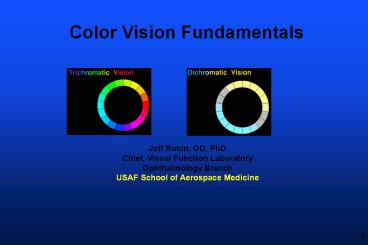
Color Vision Fundamentals
Jeff Rabin, OD, PhD Chief, Visual Function
Laboratory Ophthalmology Branch USAF School of
Aerospace Medicine
2
- Visible light is small part of electromagnetic
spectrum.
UV
IR
3
- The visible spectrum includes 300 wavelengths
(400-700 nm), and in some portions we can discern
color differences of 1 wavelength. The ability
to see so many colors depends on - a separate cone for each wavelength.
- optic nerve fibers for each color.
- visual cortex neurons sensitive to each
color. - difference in stimulation of red, green and
blue sensitive cones.
4
- Retinal ConesNormal Color Vision
- Red cones
- Green cones
- Blue cones
- Brightness R G
- Color R G
- Color B (RG)
- Red cones outnumber green cones 2/1
- Red Green cones outnumber blue cones 10/1
5
- Retinal ConesNormal Color Vision
Red, green and blue cone sensitivity vs.
wavelength curves
6
- What happens in hereditary color deficiency?
- Red or green cone peak sensitivity is shifted.
- Red or green cones absent.
7
NORMAL CONE SENSITIVITY CURVES(TRICHROMAT)
533 nm
437 nm
564 nm
B
R
G
8
5 of Males
437 nm
564 nm
B
R
Deuteranomaly(green shifted toward red)
9
Deutan Dichromat(no green cones only red and
blue)
1 of Males
437 nm
564 nm
B
R
10
1 of Males (there is no green curve)
437 nm
564 nm
R
B
Deutan Dichromat(no green cones only red and
blue)
11
Protanomalous (red shifted toward green)
1 of Males
533 nm
437 nm
B
G
12
1 of Males
533 nm
437 nm
B
G
Protan Dichromat(no red cones only green and
blue)
13
1 of Males (there is no red curve)
533 nm
437 nm
B
G
Protan Dichromat(no red cones only green and
blue)
14
Why do colors that look different to us appear
the same to color deficient individuals?
15
Consider a green vs. yellow light
The two spots appear different in color because
R-G is large for one, and small for the other.
B
R
Color Normal Individual
16
Each spot produces the same R-G stimulation and
thus looks the same!
B
R
Deuteranomaly
(the green sensitivity curve is shifted toward
the red)
17
Some Views With and Without Color Vision
Link? Jay and Maureen Neitz Color Vision Page
18
Drs. Jay and Maureen NeitzDepartment of Cell
Biology, Neurobiology AnatomyDepartment of
OphthalmologyMedical College of Wisconsin
19
Color Labeling
- Color deficients rely heavily on context and
learningapple is red because patient learns to
call it red same hue may appear gray when
presented without other cues. - For wavelengths beyond 545, relative brightness,
context, and learning play a significant role
verbal label and response.
20
Hereditary Color Deficiency
- 8-10 of males and 1/200 females (0.5) are born
with red or green color deficiency. - Sex-linked recessive condition (X chromosome).
- Protanomalyred cone peak shifted toward green
(1) - Protan Dichromatred cones absent (1)
- Deuteranomalygreen cone peak shifted toward red
(5) - Deutan Dichromatgreen cones absent (1)
- Hereditary tritan defects are rare (0.008)
21
(No Transcript)
22
END SLIDE SHOWOF COLOR VISION FUNDIMENTALS
Recommended

