

Central and Peripheral Corneal Iron Deposits after PowerPoint PPT Presentation
1 / 1
Title: Central and Peripheral Corneal Iron Deposits after
1
Central and Peripheral Corneal Iron Deposits
after Implantation of the KAMRA (AcuFocus
Corneal Inlay) G.Nix1, O.Seyeddain1, W.Riha1,
M.Hohensinn1, G.Grabner1, E. Messmer2,
A.K.Dexl1 1 University Eye Clinic, Paracelsus
Medical University, Salzburg, Austria2
Department of Ophthalmology, Ludwig-Maximilian-Uni
versity, Munich, Germany
Purpose To describe central and peripheral
corneal iron deposits after KAMRA implantation
in naturally emmetropic presbyopic patients.
Methods We evaluated 32 eyes undergoing KAMRA
implantation. The intracorneal inlay was
implanted by one surgeon (G.G.) in the
non-dominant eye by creating a superior hinged
flap with the Intralase 60kHz femtosecond laser
and placing it over the line of sight
intrastromally. Corneal iron deposits were
analyzed with slit-lamp and in vivo confocal
microscopy with regard to the postoperative time
interval and corneal topography.
Conclusions This is the first report of the
appearance of corneal iron deposits following
KAMRA implantation in 17 patients. They have no
noticeable influence on final visual acuity,
either distance or near, corrected or
uncorrected. As reported for other corneal iron
lines and dots (e.g. the Hudson-Stähli-line, iron
deposits with keratoconus, the Fleischer ring,
following trabeculectomy, radial keratotomy,
epikeratophakia, LASIK and others) the authors
suggest that alterations in tear film thickness,
possibly its composition and corneal epithelial
basal cell storage - as a result of changes of
corneal topography - constitute the contributory
factor for these specific iron depositions.
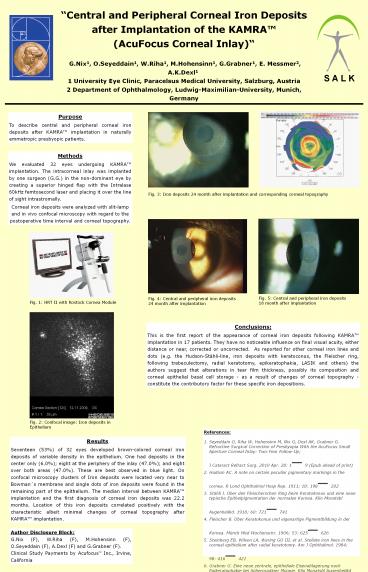
Fig. 2 Confocal image Iron deposits in
Epithelium
- References
- Seyeddain O, Riha W, Hohensinn M, Nix G, Dexl AK,
Grabner G. Refractive Surgical Correction of
Presbyopia With the AcuFocus Small Aperture
Corneal Inlay Two-Year Follow-Up - J Cataract Refract Surg. 2010 Apr. 28 1 - 9
(Epub ahead of print) - 2. Hudson AC. A note on certain peculiar
pigmentary markings in the cornea. R Lond
Ophthalmol Hosp Rep. 1911 18 198 - 202 - 3. Stähli J. Über den Fleischerschen Ring beim
Keratokonus und eine neue typische
Epithelpigmentation der normalen Kornea. Klin
Monatsbl Augenheilkd. 1918 60 721 - 741 - 4. Fleischer B. Über Keratokonus und eigenartige
Pigmentbildung in der Kornea. Münch Med
Wochenschr. 1906 53 625 - 626 - 5. Steinberg EB, Wilson LA, Waring GO III, et al.
Stellate iron lines in the corneal epithelium
after radial keratotomy. Am J Ophthalmol. 1984
98 416 - 421 - 6. Grabner G. Eine neue zentrale, epitheliale
Eisenablagerung nach Epikeratophakie bei
höhergradiger Myopie. Klin Monatsbl Augenheilkd
1987 190 424 - 427 - 7. Ruckhofer J. Klinische und histologische
Studien zu den intrastromalen kornealen
Ringsegmenten (ICRS, Intacs). Klin Monatsbl
Augenheilkd. 2002 219 557 - 574 - 8. Yeung L, et al. Central Corneal Iron
Deposition After Myopic Laser-Assisted In Situ
Keratomileusis. Cornea 2006 25(3) 291- 295 - 9. Fernandes BF, et al. Histopathological study
of 49 cases of keratoconus. Pathology 2008
40(6) 623 - 626
Results Seventeen (53) of 32 eyes developed
brown-colored corneal iron deposits of variable
density in the epithelium. One had deposits in
the center only (6.0) eight at the periphery of
the inlay (47.0) and eight over both areas
(47.0). These are best observed in blue light.
On confocal microscopy clusters of Iron deposits
were located very near to Bowmans membrane and
single dots of iron deposits were found in the
remaining part of the epithelium. The median
interval between KAMRA implantation and the
first diagnosis of corneal iron deposits was 22.2
months. Location of this iron deposits correlated
positively with the characteristic albeit minimal
changes of corneal topography after KAMRA
implantation.
Author Disclosure Block G.Nix (F), W.Riha (F),
M.Hohensinn (F), O.Seyeddain (F), A.Dexl (F) and
G.Grabner (F). Clinical Study Payments by
Acufocus? Inc., Irvine, California
Recommended

