

Dealing With Change and Stress Forces for Change PowerPoint PPT Presentation
Title: Dealing With Change and Stress Forces for Change
1
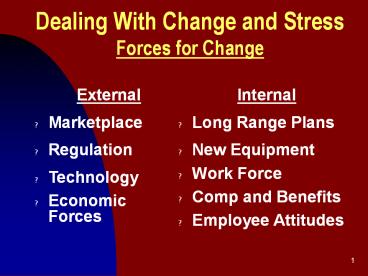
Dealing With Change and StressForces for Change
- External
- Marketplace
- Regulation
- Technology
- Economic Forces
- Internal
- Long Range Plans
- New Equipment
- Work Force
- Comp and Benefits
- Employee Attitudes
2
External Forces
- Environmental Dynamics
- These changes include new government regulations,
changing social and political trends, new tax
laws, changes in labor market conditions, or new
strategies taken by competitors.
3
External Forces
- New Technologies
- The introduction of new equipment, tools,
methods, automated machinery, and computerization
allows employees and supervisors to do their jobs
better and faster.
4
External Forces
- Environmental Dynamics
- These changes include new government regulations,
changing social and political trends, new tax
laws, changes in labor market conditions, or new
strategies taken by competitors.
5
Internal Forces
- Include changes in the organizations overall
strategy, reorganizations, changes in the
composition of the work force, introduction of
new equipment, and the need to modify employee
attitudes.
6
Change Agents
- People who act as catalysts and assume the
responsibility for overseeing the change process. - The change agent can be a supervisor, a staff
specialist, or an outside consultant.
7
Two Views on the Change Process
- Traditional - allows for successful change by
requiring unfreezing of the status quo
(equilibrium state), changing to a new state, and
refreezing the new change. - Contemporary - environments are both uncertain
and dynamic and change is a continuous process.
8
Two Views on the Change Process
- In the contemporary setting the old saying if it
aint broke, dont fix it no longer applies. It
has been replaced with if it aint broke, you
havent looked hard enough. Fix it anyway.
9
Resistance to Change
- Individual resistance to change is a universal
condition and it takes many forms - Habit - programmed responses.
- Threats of job or income.
- Fear of the unknown.
- Selective perception.
- Threat to expertise.
- Threat to established power and
interpersonal relationships.
10
Reducing Resistance to Change
- Build trust
- Open channels of communication
- Involve employees
- Provide incentives
11
Changing Employee Attitudes
- Attitudes - evaluative statements or judgements
concerning objects, people, or events. - ID the attitude you want to change
- Determine what sustains the attitude
- Unfreeze the attitude
- Offer an alternative attitude
- Refreeze the new attitude
12
Work-Related Stress
- An adaptive response resulting from any
environmental action, situation, or event that
places excessive psychological and/or physical
demands on a person.
13
Work-Related Stress
- Two conditions are necessary for a potentially
stressful situation to create actual stress for a
person - Uncertainty over the outcome
- The outcome must be important
14
Sources of Work Stress
- Organizational Factors
- Task demands
- Role demands
- Interpersonal demands
- Organizational structure
- Organizational leadership
- Individual Factors
- Family problems
- Economic problems
- Personality
15
Work-Related Stress
Stress factors are additive and individuals react
to stress differently.
16
Work-Related Stress
- Four individual difference factors have been
found to be important - Perception - Stress is not negative to
everyone - Experience
- Social Support
- Hostility - Type A vs Type B behavior
17
Symptoms of Stress
Headaches High Blood Pressure Heart
Disease Anxiety Depression Decreased Job
Satisfaction Change in Productivity Change in
Absenteeism Increased Turnover
18
Stress Reduction
Be a good supervisor, apply all of the concepts
and principles outlined in this text, and when
that isnt enough look for help elsewhere EAP
- programs designed to act as a first stop for
individuals seeking psychiatric or
substance-abuse help, with the goal of getting
productive employees back on the job as swiftly
as possible. Wellness Programs - designed to
keep employees healthy, focusing on such things
as smoking cession, weight control, stress
management, physical fitness, etc.
Recommended

