

3 Main Factors that affect show animal performance PowerPoint PPT Presentation
1 / 18
Title: 3 Main Factors that affect show animal performance
1
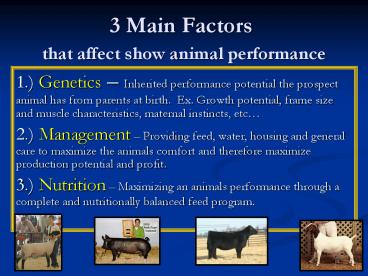
3 Main Factors that affect show animal
performance
- 1.) Genetics Inherited performance potential
the prospect animal has from parents at birth.
Ex. Growth potential, frame size and muscle
characteristics, maternal instincts, etc - 2.) Management Providing feed, water, housing
and general care to maximize the animals comfort
and therefore maximize production potential and
profit. - 3.) Nutrition Maximizing an animals performance
through a complete and nutritionally balanced
feed program.
2
Nutrition Management for Show Lambs and Goats
- Market trends change through out time.
1880
But the basic nutritional requirements of all
livestock have not.
3
Nutrition
- 6 Nutrient Classes essential for proper body
function-
- Protein-
- Made up of Amino Acids, building blocks of
complex proteins. Build Structure (frame and
muscle), repair and regulation - Body frame and structure
Soybean meal, cottonseed meal, fish meal, corn
gluten meal, whey products, animal protein
products, plant protein products, etc
4
Nutrition
- 6 Nutrient Classes essential for proper body
function-
2. Carbohydrates Primary function to provide
energy, contribute small amounts to protein and
other nutrients. Fuel for the body and some
structure Corn, barley, oats, milo, grain
by-products, forage products, etc
5
Nutrition
- 6 Nutrient Classes essential for proper body
function-
- 3. Lipids (fats)
- Only function to provide energy, fatty acids aid
in skin condition, hair coat 95 fat, allows
for economically increase the energy density of a
feed without feeding more bulk . - Fuel for the body
- liquid vegetable oils, dried fats, animal tallow,
etc
6
Nutrition
- 6 Nutrient Classes essential for proper body
function-
- 4. and 5. Vitamins and Minerals
- Vitamins- Regulation of bodily function Vitamin
A, D, E, K, C, B-Vitamins (Thiamine,
riboflavin, B12, etc) - Minerals- Building Stucture (skeletal), body
repair, function and regulation
(Calcium, Phosphorus, Sodium, Potassium, Zinc,
Copper, Manganese, Iron, Selenium,
Iodine, etc) - Remember that sheep have a low
tolerance for copper (max. 25 ppm) but goats
dont. - Structural and Regulatory Support
7
Nutrition
- 6 Nutrient Classes essential for proper body
function-
- 6. Water -
- MOST IMPORTANT nutrient, and most forgotten.
Involved in the regulation of all bodily
functions. Makes up largest single component of
body average 60 in large livestock. - Effects feed intake, ability to fight stress,
illness and disease. - Never with-hold water for more than
very short periods of time with the exception of
under a veterinarians instruction and
supervision.
8
Complete and Balanced
9
How to Pick a Feed
- Species-Cattle, Dairy, Swine, Sheep, Goat, Horse,
Poultry, Rabbit. For show animals,
general grain mixes or mixed species feeds may be
cheaper, but are not specific in nutrients
(especially vitamins and minerals) for optimum
growth and production. - Type of digestive system
- Ruminant Beef and Dairy Cattle, Sheep, Goats.
They have 4 chambers in digestive tract (rumen,
reticulum, omasum and abomasum). Primary feed is
vegetative, plants. High fiber with large
capacity. - Non-ruminant (Simple stomach) Swine, dogs,
fish, and humans. Have one stomach. Limited
capacity. - Non-ruminant Herbivore Horses, rabbits,
guinea pig, hamster Have limited capacity, but
primary feed is vegetative, plants. Grazing
10
Feeding Show Lambs
- Grower/Finisher For lambs from weaning to
market weight - Complete Feed vs
Concentrate (Grain) Ration - Complete Feed - Contains grain mix and roughage
all in one feed. Minimizes need for long stem
hay. - 17- 18 crude
protein, 3.0 4.0 crude fat - Medicated with Bovatec feed
efficiency, weight gain, coccidiostat
- Feeding Rate Lambs will be eat between 2.5
to 3 body weight per day, and
since this is a complete feed, no need to
separate concentrate and roughage portions. - For Example a 80 lamb will eat between 2.25
2.7 pounds complete
feed per head per day. - Feed a handful of long stemmed alfalfa or
grass hay every day for rumen health. - Feed at least 2 times per day.
- Provide free choice access to a clean, fresh
water supply and salt at all times. - Sheep are very salt tolerant and
will tend to eat dirt, etc.. to get at salt.
11
Feeding Show Lambs
- Grower/Finisher For lambs from weaning to
market weight - Complete Feed vs
Concentrate (Grain) Ration - Concentrate Feed - Contains grain mix (grain,
protein, vitamins and minerals) but no roughage.
Long stemmed or pelleted alfalfa or grass hay
must be provided also. - 14 15
crude protein, 2.50 3.5 crude fat -
Medicated with Deccox (coccidiostat)
- Feeding Rate Lambs will be eat between 2.5
to 3 body weight in total feed per day,
starting out 2/3 roughage to
concentrate then shifting to 1/3 roughage to - concentrate towards the
finishing. - For Example a 80 lamb will
eat an average 2.5 pounds total feed per day. - For
growing phase 1.5 roughage to 1 grain ration,
then very gradually -
increase the grain ration for the finishing
phase. - Feed at least 2 times per day.
- Provide free choice access to a clean, fresh
water supply and salt at all times. - Sheep are very salt tolerant and
will tend to eat dirt, etc.. to get at salt.
12
Feeding Show Goats
- Grower/Finisher For kid goats from weaning to
market weight - Complete Feed - Contains grain mix and roughage
all in one feed. Minimizes need for long stem
hay. - 17- 18 crude
protein, 3.0 4.0 crude fat - Medicated
with Deccox (coccidiostat)
- Feeding Rate Goats will be eat between 2.5
to 3 body weight per day, and
since this is a complete feed, no need to
separate concentrate and roughage portions. - For Example a 80 goat will eat between 2.25
2.7 pounds complete
feed per head per day. - Feed a handful of long stemmed alfalfa or
grass hay every day for rumen health. - Feed at least 2 times per day.
- Provide free choice access to a clean, fresh
water supply and salt at all times.
13
Feeding Show Lambs and Goats
- Supplements- Feed additives top dressed or mixed
into primary feed to produce a more specific
result. - - Vegetable Oil added to increase energy (fat)
density of primary feed. - - Prebiotics and Probiotics addition of
microbial products to strengthen digestive
health and balance during times of stress. -
Probios, Manna E, BioMos, Acidifiers - - Other additives Calf Manna (goats only),
Beet Pulp, Sumo, Full Tank,
MEDICATIONS, etc. Be aware of copper limits in
lambs. - All of these feeds have specific purposes.
- Using a product by mistake or inappropriately
- can not only be expensive, it can prevent a
successful project. - Call your feed store or contact the
manufacturer for any questions.
14
Metabolic and health Issues in Lambs and Goats
- Worms and Internal Parasites all livestock
should be wormed when they first arrive, then
again at 60 days, then 2 weeks before fair. Worm
every 30 days if going to jackpots where
re-infection is more probable. - Enterotoxemia Overeating disease. Lambs and
kids should have received their initial
vaccination at days old, then a booster at 21-28
days. If vaccination has not been given, or if
you dont know purchase Clostridium perfringens
C D vaccine from your local feed store or vet,
and administer as directed. - Urinary Calculi stones in the urinary tract
that form primarily in male lambs and - goats. Caused by feeding a ration that is
unbalanced and excessive in phosphorus. The
calcium to phosphorus ratio should be 21.
Ammonium chloride is added to most show feeds as
a preventative. - Coccidiosis also sometimes known as bloody
scours is a protozoal disease, not viral or
bacterial. Is an opportunistic disease that
usually occurs as a secondary infection when the
immune system is already under challenge.
Antibiotics are not affective against this
disease, only coccidiostats such as Decoquinate
or Amprolium are effective treatments. Can be
added in the feed, or may be added to water.
15
Medications
- Medications are added to feed for specific
reasons. Do not assume that if it works in one
species, it automatically would work in another.
- For example Bovatec, works in cattle,
sheep and goats but is fatal to horses. - Do not misuse or abuse any medications.
- Do not use in unapproved species. Not only
is this unlawful, but it is unethical and
may be causing undo harm to an animal and you
wont know it. - Always follow label instruction for proper
use. Off label use is against the
law. Dont forget that you are raising food! - Do not over-dose. Well, it this
much works this good, more should work
even better. Not necessarily, some medications
when over-dosed become harmful, even
lethal. - Always check expiration dates on
medications. Some expired drugs get
weaker the older they get, but some get stronger
and even lethal . Even check the dates
when your at the feed store. - ALWAYS, ALWAYS, ALWAYS pay attention to
warning about personal safety when using a
product. -
16
Management
- Figuring (ADG) Average Daily Gain needed to make
fair weight. - 1. Get accurate start weight of animal. Example
40 piglett - 2. Determine finished weight desired at fair
time. Example 230 pig - 3. Check calendar and determine how many days
until fair check in. - Example 4 months and 8 days
128 days total - Calculation 2 parts
- Part 1 Finish weight Start
weight Total weight needed to gain - (230) -
(40) 190 pounds needed to gain -
then - Part 2 Pounds needed to gain Number
of day until fair check in Average Daily Gain
(ADG) - 190
128 days 1.48 ADG - Meaning Your pig needs to gain at a minimum
1.48 a day until fair to hit the target weight
of 230. - Do this exercise regularly!!! 2 3 x per
month is not too often with animals that may be
smaller, slower growers or fast growers and easy
keepers. This will help determine how well your
animal is growing and will prevent any surprises
at the check-in scales. It is easier to hold or
slow down versus pushing hard.
17
Estimating weight without a scale
18
Dana Moore-Young
The Greeley Elevator
Company (970) 352-2575
dyoung.greeleyelevator_at_gmail.com
Recommended

