

Chapter 13 - The Peripheral Nervous System and Reflex Activity PowerPoint PPT Presentation
1 / 53
Title: Chapter 13 - The Peripheral Nervous System and Reflex Activity
1
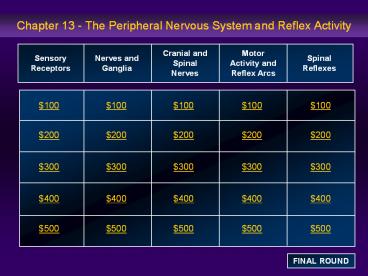
Chapter 13 - The Peripheral Nervous System and
Reflex Activity
Cranial and Spinal Nerves
Motor Activity and Reflex Arcs
Sensory Receptors
Nerves and Ganglia
Spinal Reflexes
100
100
100
100
100
200
200
200
200
200
300
300
300
300
300
400
400
400
400
400
500
500
500
500
500
FINAL ROUND
2
Sensory Receptors 100 Question
- Nociceptors respond to what type of stimulus?
- a. Touch
- b. Sound
- c. Vibration
- d. Pain
ANSWER
BACK TO GAME
3
Sensory Receptors 100 Answer
- Nociceptors respond to what type of stimulus?
- a. Touch
- b. Sound
- c. Vibration
- d. Pain
BACK TO GAME
4
Sensory Receptors 200 Question
- Receptors located in our skeletal muscles,
tendons, and joints are classified as ________. - a. baroreceptors
- b. nociceptors
- c. proprioceptors
- d. interoceptors
ANSWER
BACK TO GAME
5
Sensory Receptors 200 Answer
- Receptors located in our skeletal muscles,
tendons, and joints are classified as ________. - a. baroreceptors
- b. nociceptors
- c. proprioceptors
- d. interoceptors
BACK TO GAME
6
Sensory Receptors 300 Question
- An example of an unencapsulated receptor is a
________. - a. Merkel disc
- b. Meissners corpuscle
- c. Pacinian corpuscle
- d. Ruffini ending
ANSWER
BACK TO GAME
7
Sensory Receptors 300 Answer
- An example of an unencapsulated receptor is a
________. - a. Merkel disc
- b. Meissners corpuscle
- c. Pacinian corpuscle
- d. Ruffini ending
BACK TO GAME
8
Sensory Receptors 400 Question
- Ascending pathways make up which level of sensory
integration? - a. Receptor level
- b. Circuit level
- c. Perpetual level
- d. Transduction
ANSWER
BACK TO GAME
9
Sensory Receptors 400 Answer
- Ascending pathways make up which level of sensory
integration? - a. Receptor level
- b. Circuit level
- c. Perpetual level
- d. Transduction
BACK TO GAME
10
Sensory Receptors 500 Question
- The two-point discrimination test is performed to
measure the quality of which type of
discrimination? - a. Magnitude
- b. Spatial
- c. Perceptual
- d. Pattern
ANSWER
BACK TO GAME
11
Sensory Receptors 500 Answer
- The two-point discrimination test is performed to
measure the quality of which type of
discrimination? - a. Magnitude
- b. Spatial
- c. Perceptual
- d. Pattern
BACK TO GAME
12
Nerves and Ganglia 100 Question
- Nerves that only carry information to the CNS are
classified as ________. - a. afferent
- b. efferent
- c. mixed
- d. spinal
ANSWER
BACK TO GAME
13
Nerves and Ganglia 100 Answer
- Nerves that only carry information to the CNS are
classified as ________. - a. afferent
- b. efferent
- c. mixed
- d. spinal
BACK TO GAME
14
Nerves and Ganglia 200 Question
- A group of neuron cell bodies in the PNS is a
________. - a. nerve
- b. nucleus
- c. ganglion
- d. tract
ANSWER
BACK TO GAME
15
Nerves and Ganglia 200 Answer
- A group of neuron cell bodies in the PNS is a
________. - a. nerve
- b. nucleus
- c. ganglion
- d. tract
BACK TO GAME
16
Nerves and Ganglia 300 Question
- The connective tissue covering that surrounds the
myelin sheaths of a peripheral nerve is the
________. - a. endoneurium
- b. epineurium
- c. neurilemma
- d. perineurium
ANSWER
BACK TO GAME
17
Nerves and Ganglia 300 Answer
- The connective tissue covering that surrounds the
myelin sheaths of a peripheral nerve is the
________. - a. endoneurium
- b. epineurium
- c. neurilemma
- d. perineurium
BACK TO GAME
18
Nerves and Ganglia 400 Question
- Regeneration in the nervous system is restricted
to _____________ . - a. cell bodies in the PNS
- b. cell bodies in the CNS
- c. cell fibers in the PNS
- d. cell fibers in the CNS
ANSWER
BACK TO GAME
19
Nerves and Ganglia 400 Answer
- Regeneration in the nervous system is restricted
to _____________ . - a. cell bodies in the PNS
- b. cell bodies in the CNS
- c. cell fibers in the PNS
- d. cell fibers in the CNS
BACK TO GAME
20
Nerves and Ganglia 500 Question
- The ability to detect the intensity of a stimulus
is called ________. - a. perceptual detection
- b. magnitude estimation
- c. feature abstraction
- d. quality discrimination
ANSWER
BACK TO GAME
21
Nerves and Ganglia 500 Answer
- The ability to detect the intensity of a stimulus
is called ________. - a. perceptual detection
- b. magnitude estimation
- c. feature abstraction
- d. quality discrimination
BACK TO GAME
22
Cranial and Spinal Nerves 100 Question
- Nerves that innervate our upper limb arise from
the _________. - a. cervical plexus
- b. brachial plexus
- c. lumbar plexus
- d. cutaneous nerves
ANSWER
BACK TO GAME
23
Cranial and Spinal Nerves 100 Answer
- Nerves that innervate our upper limb arise from
the _________. - a. cervical plexus
- b. brachial plexus
- c. lumbar plexus
- d. cutaneous nerves
BACK TO GAME
24
Cranial and Spinal Nerves 200 Question
- Parts of this cranial nerve would be deadened
during dental work. - a. Abducens
- b. Facial
- c. Trigeminal
- d. Vagus
ANSWER
BACK TO GAME
25
Cranial and Spinal Nerves 200 Answer
- Parts of this cranial nerve would be deadened
during dental work. - a. Abducens
- b. Facial
- c. Trigeminal
- d. Vagus
BACK TO GAME
26
Cranial and Spinal Nerves 300 Question
- Partial paralysis of facial muscles could be due
to a problem with which cranial nerve? - a. III
- b. V
- c. VII
- d. X
ANSWER
BACK TO GAME
27
Cranial and Spinal Nerves 300 Answer
- Partial paralysis of facial muscles could be due
to a problem with which cranial nerve? - a. III
- b. V
- c. VII
- d. X
BACK TO GAME
28
Cranial and Spinal Nerves 400 Question
- The ventral root of a spinal nerve contains axons
of the __________. - a. motor neurons
- b. sensory neurons
- c. association neurons
- d. unipolar neurons
ANSWER
BACK TO GAME
29
Cranial and Spinal Nerves 400 Answer
- The ventral root of a spinal nerve contains axons
of the __________. - a. motor neurons
- b. sensory neurons
- c. association neurons
- d. unipolar neurons
BACK TO GAME
30
Cranial and Spinal Nerves 500 Question
- Our funny bone is actually this nerve.
- a. Brachial
- b. Median
- c. Radial
- d. Ulnar
ANSWER
BACK TO GAME
31
Cranial and Spinal Nerves 500 Answer
- Our funny bone is actually this nerve.
- a. Brachial
- b. Median
- c. Radial
- d. Ulnar
BACK TO GAME
32
Motor Activity and Reflex Arcs100 Question
- All are levels of complex motor activity except
- a. segmental.
- b. projection.
- c. reflex.
- d. precommand.
ANSWER
BACK TO GAME
33
Motor Activity and Reflex Arcs 100 Answer
- All are levels of complex motor activity except
- a. segmental.
- b. projection.
- c. reflex.
- d. precommand.
BACK TO GAME
34
Motor Activity and Reflex Arcs 200 Question
- A reflex that results from practice is a(n)
______ reflex. - a. intrinsic
- b. acquired
- c. autonomic
- d. skilled
ANSWER
BACK TO GAME
35
Motor Activity and Reflex Arcs 200 Answer
- A reflex that results from practice is a(n)
______ reflex. - a. intrinsic
- b. acquired
- c. autonomic
- d. skilled
BACK TO GAME
36
Motor Activity and Reflex Arcs 300 Question
- These two brain areas, along with the cerebral
cortex, are the precommand areas. - a. Spinal cord and midbrain
- b. Midbrain and basal nuclei
- c. Basal nuclei and cerebellum
- d. Cerebellum and spinal cord
ANSWER
BACK TO GAME
37
Motor Activity and Reflex Arcs 300 Answer
- These two brain areas, along with the cerebral
cortex, are the precommand areas. - a. Spinal cord and midbrain
- b. Midbrain and basal nuclei
- c. Basal nuclei and cerebellum
- d. Cerebellum and spinal cord
BACK TO GAME
38
Motor Activity and Reflex Arcs 400 Question
- Central pattern generators are involved in which
type of movement? - a. Rhythmic
- b. Reflex
- c. Skilled
- d. Postural
ANSWER
BACK TO GAME
39
Motor Activity and Reflex Arcs 400 Answer
- Central pattern generators are involved in which
type of movement? - a. Rhythmic
- b. Reflex
- c. Skilled
- d. Postural
BACK TO GAME
40
Motor Activity and Reflex Arcs 500 Question
- All of the following are true of somatic reflexes
except - a. they may be monosynaptic or polysynaptic.
- b. both motor and sensory neurons are part of the
reflex arc. - c. the CNS is not part of the reflex
- arc.
- d. a receptor is necessary.
ANSWER
BACK TO GAME
41
Motor Activity and Reflex Arcs 500 Answer
- All of the following are true of somatic reflexes
except - a. they may be monosynaptic or polysynaptic.
- b. Both motor and sensory neurons are part of the
reflex arc. - c. the CNS is not a part of the reflex
- arc.
- d. a receptor is necessary.
BACK TO GAME
42
Spinal Reflexes100 Question
- Which of the following is a superficial reflex?
- a. Stretch
- b. Flexor
- c. Plantar
- d. Golgi tendon
ANSWER
BACK TO GAME
43
Spinal Reflexes 100 Answer
- Which of the following is a superficial reflex?
- a. Stretch
- b. Flexor
- c. Plantar
- d. Golgi tendon
BACK TO GAME
44
Spinal Reflexes 200 Question
- The receptors for the stretch reflex are the
_________. - a. pain receptors
- b. muscle spindles
- c. tendon organs
- d. touch receptors
ANSWER
BACK TO GAME
45
Spinal Reflexes 200 Answer
- The receptors for the stretch reflex are the
_________. - a. pain receptors
- b. muscle spindles
- c. tendon organs
- d. touch receptors
BACK TO GAME
46
Spinal Reflexes 300 Question
- The reflex that causes a muscle to relax due to
an increase in muscle tension is the
________________. - a. stretch reflex
- b. plantar reflex
- c. Golgi tendon reflex
- d. crossed-extensor reflex
ANSWER
BACK TO GAME
47
Spinal Reflexes 300 Answer
- The reflex that causes a muscle to relax due to
an increase in muscle tension is the
________________. - a. stretch reflex
- b. plantar reflex
- c. Golgi tendon reflex
- d. crossed-extensor reflex
BACK TO GAME
48
Spinal Reflexes 400 Question
- When a reflex occurs on the same side of the body
as the stimulus, it is classified as ________. - a. monosynaptic
- b. contralateral
- c. ipsilateral
- d. reciprocal
ANSWER
BACK TO GAME
49
Spinal Reflexes 400 Answer
- When a reflex occurs on the same side of the body
as the stimulus it is classified as ________. - a. monosynaptic
- b. contralateral
- c. ipsilateral
- d. reciprocal
BACK TO GAME
50
Spinal Reflexes 500 Question
- Antagonistic muscles are inhibited during
reflexes. This is known as _________. - a. reciprocal inhibition
- b. ipsilateral inhibition
- c. Babinskis sign
- d. reciprocal activation
ANSWER
BACK TO GAME
51
Spinal Reflexes 500 Answer
- Antagonistic muscles are inhibited during
reflexes. This is known as _________. - a. reciprocal inhibition
- b. ipsilateral inhibition
- c. Babinskis sign
- d. reciprocal activation
BACK TO GAME
52
FINAL ROUND Question
- The area of skin innervated by a single spinal
nerve is called a(n) __________. - a. nerve division
- b. segment level
- c. integument segment
- d. dermatome
ANSWER
BACK TO GAME
53
FINAL ROUND Answer
- The area of skin innervated by a single spinal
nerve is called a(n) __________. - a. nerve division
- b. segment level
- c. integument segment
- d. dermatome
BACK TO GAME
Recommended

