

HEDIS is a set of standardized performance measures designed PowerPoint PPT Presentation
1 / 35
Title: HEDIS is a set of standardized performance measures designed
1
Monitoring Evaluation
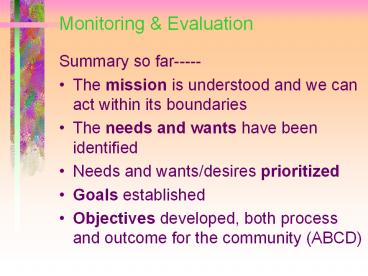
- Summary so far-----
- The mission is understood and we can act within
its boundaries - The needs and wants have been identified
- Needs and wants/desires prioritized
- Goals established
- Objectives developed, both process and outcome
for the community (ABCD)
2
Monitoring Evaluation
- Intervention plans complete with programs
designed and the other Ps completed
3
Monitoring Evaluation
- Why are we jumping to Evaluation? What about
Marketing? - Within the intervention, part of the program
planning was undoubtedly - Marketing (Chapter 13)
- Marketing is the need to communicate effectively
the messages - throughout the components-
4
Marketing is Communication
- Need to communicate- market -effectively the
messages - throughout the components- including
when - determining needs/desires
- setting priorities (How were they determined?)
- determining goals and objectives
- developing intervention strategies
- Marketing could have been in the center as well
5
Evaluation as a central component
Evaluation as a central component
6
Obj 1. Describe how the evaluation component is
part of the overall management process
- It is seen in management texts as
- controlling (planning, organizing, leading and
controlling) - Monitoring
- Benchmarking
- (is the process by which a company compares its
performance with that of other companies then
learns how the strongest-performing companies
achieve their results)
7
Obj 1. Describe how the evaluation component is
part of the overall management process
- Public Health See in conjunction with
- monitoring
- controlling --- costs
- Functions of public health
- Assessing
- Assuring
- Policy development
8
Obj 1. Describe how the evaluation component is
part of the overall management process
- Measurement vs. Evaluation
- Measurement is the assignment of numbers to
objectives, events, concepts- - - - - Evaluation is clarifying, estimating, ranking
rating, surveying or weighting factors. It
includes measurement.
9
Kinds of evaluation
- Summative is research conducted at the end of a
program that helps determine whether a program
was effective and how it might be improved - Formative is the process of testing and
assessing certain elements of a program before it
is implemented fully - A pilot of materials, methods where data are
collected on what does and doesnt work.
10
Kinds of evaluation
- Impact Evaluates programs methods and
activities to determine if resulted behavioral
changes have occurred in client or community
given the methods/activities. - Outcome Measurable, measuring a change in one or
more aspects of the communitys behaviors e.g.
health status. - The outcome of the research had an impact on
the community
11
Obj 2. List describe evaluation as a function
of public health
- Core functions of public health are
- Assessment
- Policy Development
- Assurance
- Where is evaluation?
12
Evaluation in the core functions of Public Health
- Assessment (chapter 10)
- Assess needs/desires
- Compare to standards- - report differences --
- set priorities and make changes
- Figure 10-3-- review
13
Evaluation in the core functions of Public Health
- Policy Development
- Based on gathering and presenting evaluation data
from programs and services - e.g. of monitoring SLP vs. providing more fruit
and vegetables along with education - Allow companies to calcium fortify favorite
foods (fortify soda) or get nutrients from foods
that naturally contain calcium.
14
Evaluation in the core functions of Public Health
- Assurance
- development and maintenance of services and
activities needed to maintain an adequate, safe
food supply for optimal nutrition and health of
populations. Assure services ! - Requires monitoring of existing services related
to needs and determining the difference OR
EVALUATION
15
Obj 3. Differentiate the terms used to measure
quality in providing food nutrition services
- Terms that identify quality control and
management functions of healthcare organizations - QA
- TQM
- CQI
- QI
16
Obj 4. Describe explain the roles of JCAHO
(JACHO), OBRA, HEDIS
- JCAHO (Joint Commission On Accreditation Of
Healthcare Organizations-- an accreditation body - largest accrediting body
- participation is NOT mandatory but hospitals do
participate
17
- Are hospitals the only facilities that are
accredited by JACHO - No! Nursing homes, Community Health Centers
- See http//www.jeffdanger.com/JACHO.htm ,
accessed 2/27/04 - This site has a good and funny description of
JCAHO - With readers responses. It is a private site so
it can say what it wants. - HCFA Health Care Finance Administration (now
Center for Medicare and Medicaid)
18
JCAHO website
- www.jcaho.org
- See also Montanas Primary Care Association
JACHO site www.mtpca.org/jcaho-ws.htm
accessed 2/27/04
19
Indicators
- See box p 321
- Clinical
- Process
- Outcome
20
- How many JCAHO surveyors does it take to change a
lightbulb? 25 -
21
- One to change the light bulb and twenty-four to
write the standards ...
22
Obj 4. Describe explain the roles of JACHO,
OBRA, HEDIS
- Be able to differentiate
- OBRA-contains goals for caring properly for the
residents of long-term care facilities and elders
23
OBRA
- In 1987, President Ronald Reagan signed into law
the first major revision of the federal standards
for nursing home care since the 1965 creation of
both Medicare and Medicaid 42 U.S.C1396r, 42
U.S.C. 1395i-3, 42 CFR 483. - The landmark legislation changed forever
societys legal expectations of nursing homes and
their care. Long term care facilities wanting
Medicare or Medicaid funding are to provide
services so that each resident can attain and
maintain her highest practicable physical,
mental, and psycho-social well-being.
24
Why OBRA is not going to improve care
- The Minimum Data Set (MDS) focuses mainly on a
person's ability to function (eating, continence,
etc.). The Resident Assessment Protocols (RAPs)
offer some guidance on defining problems and
identifying their causes. But they both skip many
important details, especially about methods for
making and recognizing appropriate care
decisions. - Am Medical Directors Association
25
Dietitians Role
Poor advice from surveyors tends to reinforce
outmoded practices. Regulations ask surveyors
"Do the dietitian and the speech therapist
determine the optimum textures and consistency
for the resident's food that provide both a
nutritionally adequate diet and effectively use
oropharyngeal capabilities of the resident?" But
they don't state that coughing and choking during
meals may be caused by conditions that require
evaluation by doctors and nurses before a
dietitian or speech therapist is brought in. The
result? Many nursing homes have shifted the
primary responsibility for diagnosing and
managing anyone with an eating problem to
dietitians and speech therapists. Thus, residents
may receive unnecessary diet restrictions and
doctors and nurses may miss important causes of
eating problems.
26
HEDIS-Health Plan Employer Data and Information
Set.
- HEDIS is a set of standardized performance
measures designed to ensure that purchasers and
consumers have the information they need to
reliably compare the performance of managed
health care plans. - Health plans can be compared Employer can
understand value of the health care dollarHolds
health plan accountable - http//www.ncqa.org/Programs/HEDIS/ accessed
3/2002
27
Obj 5. Describe the National Nutrition Monitoring
Related Research (NNMRR) Program
- Agencies that monitor - USDA DHHS developed a
10 year monitoring plan (NNMRR) - http//www.barc.usda.gov/bhnrc/foodsurvey/pdf/Tren
ds.pdf
28
NNMRR
- Changed
- Recommend a standardized mechanism and
instrument(s) for defining and obtaining data on
the prevalence of food insecurity or food
insufficiency in the United States and
methodologies that can be used across the NNMRR
Program and at State and local levels. 04
29
- Page 324 National Studies and Surveys
- Appendix 13B Federally funded surveys and
studies. - PNSS PedNSS, BRFSS, YRBSS (See Ch 6 assignment
and review how you would use)
30
What is the difference?
- Nutrition Surveys
- Nutrition Surveillance
- Continuous watching over list one ____
31
Other Studies/surveys
- NFCS
- CSFII
- NHANES
- NHIS
- US Census
- HDS
- BRFSS
- PNSS
- PedNSS
- NMIHS
32
Obj 6. Define cost-effectiveness cost-benefit
analysis (No test questions)
- Cost effectiveness relates to other alternatives
for achieving the same outcome-- is this the
effective method over another input or method - Cost benefits Was the investment a net gain or
loss. WIC 1 saves 3 in intensive care costs
33
- What is the cost savings for AIDs patient who
received MNT? - What was the cost savings for an Arizona
dietitian treating a patient with gestational
diabetes? - What is the difference in cost between delivering
a very-low birth weight infant and a normal
infant?
34
Priority setting and cost effectiveness
- Why prioritize when there isn't enough money?
byDaniel Wikler Department of Population and
International Health, Harvard School of Public
Health, Boston MA 02115, USACost Effectiveness
and Resource Allocation 2003, 15The electronic
version of this article is the complete one and
can be found online at http//www.resource-alloca
tion.com/content/1/1/5
35
- Bring to class examples of cost effectiveness and
dietetic practice. - We will collect and discuss
- (Not in 04
Recommended

