

Chapter 11 - Fundamentals of the Nervous System and Nervous Tissue PowerPoint PPT Presentation
1 / 53
Title: Chapter 11 - Fundamentals of the Nervous System and Nervous Tissue
1
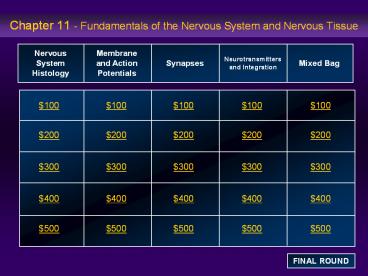
Chapter 11 - Fundamentals of the Nervous System
and Nervous Tissue
Nervous System Histology
Membrane and Action Potentials
Neurotransmitters and Integration
Synapses
Mixed Bag
100
100
100
100
100
200
200
200
200
200
300
300
300
300
300
400
400
400
400
400
500
500
500
500
500
FINAL ROUND
2
Nervous System Histology 100 Question
- All of the following are neuroglial cells except
- a. Schwann cells.
- b. ependymal cells.
- c. microglia.
- d. perikaryons.
ANSWER
BACK TO GAME
3
Nervous System Histology 100 Answer
- All of the following are neuroglial cells except
- a. Schwann cells.
- b. ependymal cells.
- c. microglia.
- d. perikaryons.
BACK TO GAME
4
Nervous System Histology 200 Question
- Nissl bodies are found ______________.
- a. in the neuroglia
- b. in the neuronal axons
- c. in the neuronal cell bodies
- d. in the neuronal dendrites
ANSWER
BACK TO GAME
5
Nervous System Histology 200 Answer
- Nissl bodies are found ______________.
- a. in the neuroglia
- b. in the neuronal axons
- c. in the neuronal cell bodies
- d. in the neuronal dendrites
BACK TO GAME
6
Nervous System Histology 300 Question
- Synaptic knobs are found ___________.
- a. in the neuroglia
- b. in the neuronal axons
- c. in the neuronal cell bodies
- d. in the neuronal dendrites
ANSWER
BACK TO GAME
7
Nervous System Histology 300 Answer
- Synaptic knobs are found ___________.
- a. in the neuroglia
- b. in the neuronal axons
- c. in the neuronal cell bodies
- d. in the neuronal dendrites
BACK TO GAME
8
Nervous System Histology 400 Question
- Myelin sheaths in the CNS are produced by the
________. - a. astrocytes
- b. microglia
- c. oligodendrocytes
- d. Schwann cells
ANSWER
BACK TO GAME
9
Nervous System Histology 400 Answer
- Myelin sheaths in the CNS are produced by the
________. - a. astrocytes
- b. microglia
- c. oligodendrocytes
- d. Schwann cells
BACK TO GAME
10
Nervous System Histology 500 Question
- Neuroglial cells that line the ventricles of the
brain are the ______. - a. astrocytes
- b. ependymal cells
- c. microglia
- d. Schwann cells
ANSWER
BACK TO GAME
11
Nervous System Histology 500 Answer
- Neuroglial cells that line the ventricles of the
brain are the ______. - a. astrocytes
- b. ependymal cells
- c. microglia
- d. Schwann cells
BACK TO GAME
12
Membrane and Action Potentials 100 Question
- If a membrane has a resting transmembrane
potential of 90 mV, it is said to be _________. - a. depolarized
- b. polarized
- c. hyperpolarized
- d. unresponsive
ANSWER
BACK TO GAME
13
Membrane and Action Potentials 100 Answer
- If a membrane has a resting transmembrane
potential of 90 mV, it is said to be _________. - a. depolarized
- b. polarized
- c. hyperpolarized
- d. unresponsive
BACK TO GAME
14
Membrane and Action Potentials 200 Question
- At rest, a cell will have more ______ ions in the
cytoplasm than outside the cell. - a. sodium
- b. chloride
- c. potassium
- d. calcium
ANSWER
BACK TO GAME
15
Membrane and Action Potentials 200 Answer
- At rest, a cell will have more ______ ions in the
cytoplasm than outside the cell. - a. sodium
- b. chloride
- c. potassium
- d. calcium
BACK TO GAME
16
Membrane and Action Potentials 300 Question
- During membrane repolarization, there is a
decrease in the membrane permeability to which
ion? - a. Potassium
- b. Sodium
- c. Calcium
- d. Both potassium and
- sodium
ANSWER
BACK TO GAME
17
Membrane and Action Potentials 300 Answer
- During membrane repolarization, there is a
decrease in the membrane permeability to which
ion? - a. Potassium
- b. Sodium
- c. Calcium
- d. Both potassium and
- sodium
BACK TO GAME
18
Membrane and Action Potentials 400 Question
- A membrane maintains its resting potential mainly
due to _________. - a. the sodium-potassium pump
- b. chemically gated sodium channels
- c. potassium leak channels
- d. calcium leak channels
ANSWER
BACK TO GAME
19
Membrane and Action Potentials 400 Answer
- A membrane maintains its resting potential mainly
due to _________. - a. the sodium-potassium pump
- b. chemically gated sodium channels
- c. potassium leak channels
- d. calcium leak channels
BACK TO GAME
20
Membrane and Action Potentials 500 Question
- Which channels are open during the absolute
refractory period of a neuron? - a. Potassium
- b. Sodium
- c. Calcium
- d. All of the above
ANSWER
BACK TO GAME
21
Membrane and Action Potentials 500 Answer
- Which channels are open during the absolute
refractory period of a neuron? - a. Potassium
- b. Sodium
- c. Calcium
- d. All of the above
BACK TO GAME
22
Synapses 100 Question
- The space between the presynaptic and postsyaptic
membranes is called the __________. - a. synaptic cleft
- b. neurotransmitter
- c. synaptic delay
- d. synaptic vesicle
ANSWER
BACK TO GAME
23
Synapses 100 Answer
- The space between the presynaptic and postsyaptic
membranes is called the __________. - a. synaptic cleft
- b. neurotransmitter
- c. synaptic delay
- d. synaptic vesicle
BACK TO GAME
24
Synapses 200 Question
- The presynaptic neuron releases neurotransmitters
in response to an influx of _______ ions. - a. sodium
- b. potassium
- c. calcium
- d. sodium and potassium
ANSWER
BACK TO GAME
25
Synapses 200 Answer
- The presynaptic neuron releases neurotransmitters
in response to an influx of _______ ions. - a. sodium
- b. potassium
- c. calcium
- d. sodium and potassium
BACK TO GAME
26
Synapses 300 Question
- IPSPs cause the postsynaptic membrane to become
more permeable to ________. - a. calcium
- b. sodium
- c. potassium
- d. chloride
ANSWER
BACK TO GAME
27
Synapses 300 Answer
- IPSPs cause the postsynaptic membrane to become
more permeable to ________. - a. calcium
- b. sodium
- c. potassium
- d. chloride
BACK TO GAME
28
Synapses 400 Question
- __________ has occurred when a neuron is
stimulated by more than one terminal. - a. Temporal summation
- b. Spatial summation
- c. Synaptic delay
- d. Synaptic potentiation
ANSWER
BACK TO GAME
29
Synapses 400 Answer
- __________ has occurred when a neuron is
stimulated by more than one terminal. - a. Temporal summation
- b. Spatial summation
- c. Synaptic delay
- d. Synaptic potentiation
BACK TO GAME
30
Synapses 500 Question
- Generation of an action potential can be
inhibited by all of the following except - a. IPSPs.
- b. presynaptic inhibition.
- c. depolarization.
- d. hyperpolarization.
ANSWER
BACK TO GAME
31
Synapses 500 Answer
- Generation of an action potential can be
inhibited by all of the following except - a. IPSPs.
- b. presynaptic inhibition.
- c. depolarization.
- d. hyperpolarization.
BACK TO GAME
32
Neurotransmitters and Integration100 Question
- Which of the following is not a class of
neurotransmitters? - a. Peptides
- b. Amino acids
- c. Biogenic amines
- d. Acetylcholinesterases
ANSWER
BACK TO GAME
33
Neurotransmitters and Integration 100 Answer
- Which of the following is not a class of
neurotransmitters? - a. Peptides
- b. Amino acids
- c. Biogenic amines
- d. Acetylcholinesterases
BACK TO GAME
34
Neurotransmitters and Integration 200 Question
- The natural opiates of our body are the
- a. biogenic amines.
- b. GABA.
- c. endorphins.
- d. histamines.
ANSWER
BACK TO GAME
35
Neurotransmitters and Integration 200 Answer
- The natural opiates of our body are the
- a. biogenic amines.
- b. GABA.
- c. endorphins.
- d. histamines.
BACK TO GAME
36
Neurotransmitters and Integration 300 Question
- A neuronal circuit where incoming information is
spread around or amplified is ________. - a. converging
- b. diverging
- c. reverberating
- d. parallel after-discharge
ANSWER
BACK TO GAME
37
Neurotransmitters and Integration 300 Answer
- A neuronal circuit where incoming information is
spread around or amplified is ________. - a. converging
- b. diverging
- c. reverberating
- d. parallel after-discharge
BACK TO GAME
38
Neurotransmitters and Integration 400 Question
- Neuronal circuits involved in rhythmic activities
such as breathing and arm swinging are _________. - a. converging
- b. diverging
- c. reverberating
- d. parallel after-discharge
ANSWER
BACK TO GAME
39
Neurotransmitters and Integration 400 Answer
- Neuronal circuits involved in rhythmic activities
such as breathing and arm swinging are _________. - a. converging
- b. diverging
- c. reverberating
- d. parallel after-discharge
BACK TO GAME
40
Neurotransmitters and Integration 500 Question
- Dopamine and serotonin are examples of which
class of neurotransmitters? - a. Peptides
- b. Purines
- c. Biogenic amines
- d. Acetylcholinesterases
ANSWER
BACK TO GAME
41
Neurotransmitters and Integration 500 Answer
- Dopamine and serotonin are examples of which
class of neurotransmitters? - a. Peptides
- b. Purines
- c. Biogenic amines
- d. Acetylcholinesterases
BACK TO GAME
42
Mixed Bag100 Question
- All of the following are found in the PNS except
- a. spinal nerves.
- b. cranial nerves.
- c. myelinated axons.
- d. microglia.
ANSWER
BACK TO GAME
43
Mixed Bag100 Answer
- All of the following are found in the PNS except
- a. spinal nerves.
- b. cranial nerves.
- c. myelinated axons.
- d. microglia.
BACK TO GAME
44
Mixed Bag 200 Question
- Association neurons are always _________.
- a. found in the PNS
- b. multipolar
- c. sensory
- d. efferent
ANSWER
BACK TO GAME
45
Mixed Bag 200 Answer
- Association neurons are always _________.
- a. found in the PNS
- b. multipolar
- c. sensory
- d. efferent
BACK TO GAME
46
Mixed Bag 300 Question
- The nodes of Ranvier are found _______.
- a. in the CNS only
- b. on dendrites
- c. on the neuroglia
- d. on myelinated axons
ANSWER
BACK TO GAME
47
Mixed Bag 300 Answer
- The nodes of Ranvier are found _______.
- a. in the CNS only
- b. on dendrites
- c. on the neuroglia
- d. on myelinated axons
BACK TO GAME
48
Mixed Bag 400 Question
- The neurilemma is found on the _______________.
- a. dendrites of the CNS
- b. dendrites of the PNS
- c. axons of the CNS
- d. axons of the PNS
ANSWER
BACK TO GAME
49
Mixed Bag 400 Answer
- The neurilemma is found on the _______________.
- a. dendrites of the CNS
- b. dendrites of the PNS
- c. axons of the CNS
- d. axons of the PNS
BACK TO GAME
50
Mixed Bag 500 Question
- All of the following are true of action
potentials except - a. they exhibit an all-or-none response.
- b. they are inhibited by IPSPs.
- c. they need a threshold stimulus.
- d. they travel more slowly on
- myelinated fibers.
ANSWER
BACK TO GAME
51
Mixed Bag 500 Answer
- All of the following are true of action
potentials except - a. they exhibit an all-or-none response.
- b. they are inhibited by IPSPs.
- c. they need a threshold stimulus.
- d. they travel more slowly on myelinated fibers.
BACK TO GAME
52
FINAL ROUND Question
- Neurotransmitters are removed from the synaptic
cleft by all of the following except - a. reuptake by a presynaptic neuron.
- b. simple diffusion.
- c. enzymatic degradation.
- d. presynaptic inhibition.
ANSWER
BACK TO GAME
53
FINAL ROUND Answer
- Neurotransmitters are removed from the synaptic
cleft by all of the following except - a. reuptake by a presynaptic neuron.
- b. simple diffusion.
- c. enzymatic degradation.
- d. presynaptic inhibition.
BACK TO GAME
Recommended

