

T-DNA Mutagenesis and Plant Genetic Engineering PowerPoint PPT Presentation
1 / 33
Title: T-DNA Mutagenesis and Plant Genetic Engineering
1
T-DNA Mutagenesisand Plant Genetic Engineering
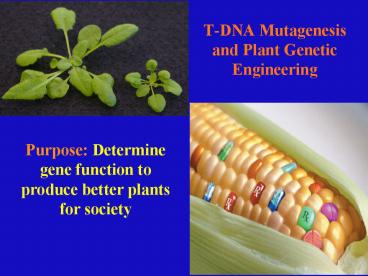
Purpose Determine gene function to produce
better plants for society
2
Mutagenesis
Mutagenesis Chemical or physical treatment that
changes the nucleotide sequence of DNA. The
altered DNA sequence may be passed on to the next
generation. Mutant An organism that differs
from the normal or wild type by one or more
changes in its DNA sequence.
3
Mutagenesis- creating mutants
- Single nucleotide change G --gt A
Mutant
Normal Wild type
Mutagenesis
ATTAGACTACCGT TAATCTGATGGCA
ATTAGGCTACCGT TAATCCGATGGCA
- Or delete or add a nucleotide
4
Mutagenesis- larger mutations
- Delete a segment of DNA - many nucleotides
Insert a segment of DNA Insertional
5
Insertion tagging
- Principle A DNA fragment (with a known
sequence) is allowed to insert into the genome
(it usually causes a recessive, loss of function
mutation). - Similar to ligating an insert into LacZ-alpha
6
Insertion tagging
- Advantages
- tags or marks the gene.
- Provides a powerful way to identify or fish the
gene out. - Disadvantages
- Cannot knock out essential genes.
- Other redundant genes mask loss of disrupted
gene. - May disrupt non-functional sub-region of gene.
7
Is it useful?
- Highly and broadly useful
- Applied to most organisms.
- Mice, bacteria, yeast and plants have had their
genes inactivated by DNA insertions - -gt knockouts.
8
A type of insertion mutagenesis
T-DNA Mutagenesis A method of disrupting genes
in plants with a T-DNA to knock-out gene
function and activity.
T-DNA Transfer DNA a segment of DNA derived
from the Ti plasmid contained inside the
bacterium, Agrobacterium tumefaciens. Agro
plant pathogen Transferred from the bacterium
to the plant. Randomly integrated into
chromosomal sites in the nuclei.
9
Agrobacterium tumefaciens - and Ti Plasmid
- Soil Bacterium infects plants through wounds
openings - Causes crown gall tumors.
- ? Expresses genes on a
- Ti plasmid - Tumor inducing Plasmid
10
Ti Plasmid
- Contains genes for
- Plant growth hormones
- - cytokinins and auxins.
- - stimulate undifferentiated growth
- Opine biosynthesis - food for Agro.
- Opine catabolism - convert opines into E
- Acetosyringone receptors
11
Bacteria is attracted to wound - receptor
tells bacteria to swim to wound
12
T-DNA is excised from Ti plasmid and integrates
into plant genome. Genes on T-DNA are activated
and stimulate cell proliferation. Opine genes
produce bacterial nutrients Opines
13
IDEA Ti- Plasmid, Tumor producing genes can be
Replaced with other genes. New genes will be
transferred!
Left right borders must be retained.
14
Ti- Plasmid - delete genes for tumor and Agro
nutrients
15
Ti- Plasmid - delete genes for tumor and Agro
nutrients
New Gene
16
New foreign genes can be carried as passengers
when the T-DNA integrates into plant genome. No
tumors formed when auxin and cytokinin genes are
replaced - plant has taken up T-DNA but no
disease!
Disarmed Ti Plasmid
17
What kind of genes can be added to T-DNA?
- Any gene - Selectable marker
Kanamycin Resistance Hygromycin R
- reporter gene, marks cells to
show they are transformed. Not always
used. - genes for crop improvement,
disease insect resistance, new
proteins, Vitamins, many possibilities
18
Modified T-DNA for GFP Expression
Plants will be hygromycin resistant and express
green fluorescent protein.
19
- Green fluorescent protein (GFP)
From luminescent jellyfish Aequorea
victoria. Produces green fluorescence under blue
and UV light
20
Redistribution of GFP-2SC in the Light
Root Root Hair cotyledon
Dark
Light
21
GFP-2SC moves from vacuole to ER and golgi, from
Dark to Light
Protoplasts plants with cell walls removed.
22
Modified T-DNA for Mutagenesis
Plants will be Kanamycin resistant. Might
disrupt a gene or spacer DNA.
23
Transformation with Disarmed Ti-plasmid in
Agrobacterium
- Mix Agro containing Ti-plasmid with -
Wounded leaf - Plant cells in culture
- Floral dip under vacuum
- plant cells or seeds on growth media containing
selection antibiotic (i.e. Kan). - Only engineered plants grow
24
Genome-wide insertional mutagenesis of
Arabidopsis thaliana (2003)
- Objective create loss of function mutations for
all genes. - Strategy use T-DNA (with kanamycin-resistance
gene as selectable marker) to generate collection
of 150,000 T1 transformants. - gt 225,000 independent T-DNA integration events
thus far.
25
Arabidopsis
- Genome size 125,000 kb Avg gene length 2 kb
- Random distribution of insertion events, predicts
96.6 probability of finding an insertion in a
gene, - To determine the site of integration of each
T-DNA, junction sequences were analyzed and
88,122 sites were proven to be at a single
genomic location - Of the 29,454 annotated genes, 21,799 (74) were
hit, - Create catalog and allow researchers to order
seeds for their favorite gene disruption on-line.
26
Not all genes can be knocked out.
T-DNA
27
T1 generation - first generation after T-DNA
insertion Single T-DNA insertion
Distribution of T-DNAs showed hot spots (in
gene-rich regions) and cold spots (in centromere
and Peri-centromeric regions)
T-DNA - heterozygous - 1 normal gene - 1
disrupted gene
28
Obtaining Homozygous - 2 T-DNAs in same gene
Heterozygous is self-pollinated
NN
NT
TN
TT
25 homozygous TT
29
Need homozygous - both copies knocked out
T-DNA - Homozygous
Screen for homozygotes by PCR using combinations
of primers to the T-DNA and to the target gene
to be knocked out
30
Want to know precise location of the T-DNA
T-DNA - Homozygous
Where is it exactly within a gene or near a gene?
31
T-DNA
Normal gene
How can PCR be used to verify copy and location
of the T-DNA?
32
PCR screen T-DNA mapping
T-DNA
Gene 5
Gene 3
No PCR product with this primer
Normal gene
33
Non-perfect, but usable, results
Recommended

